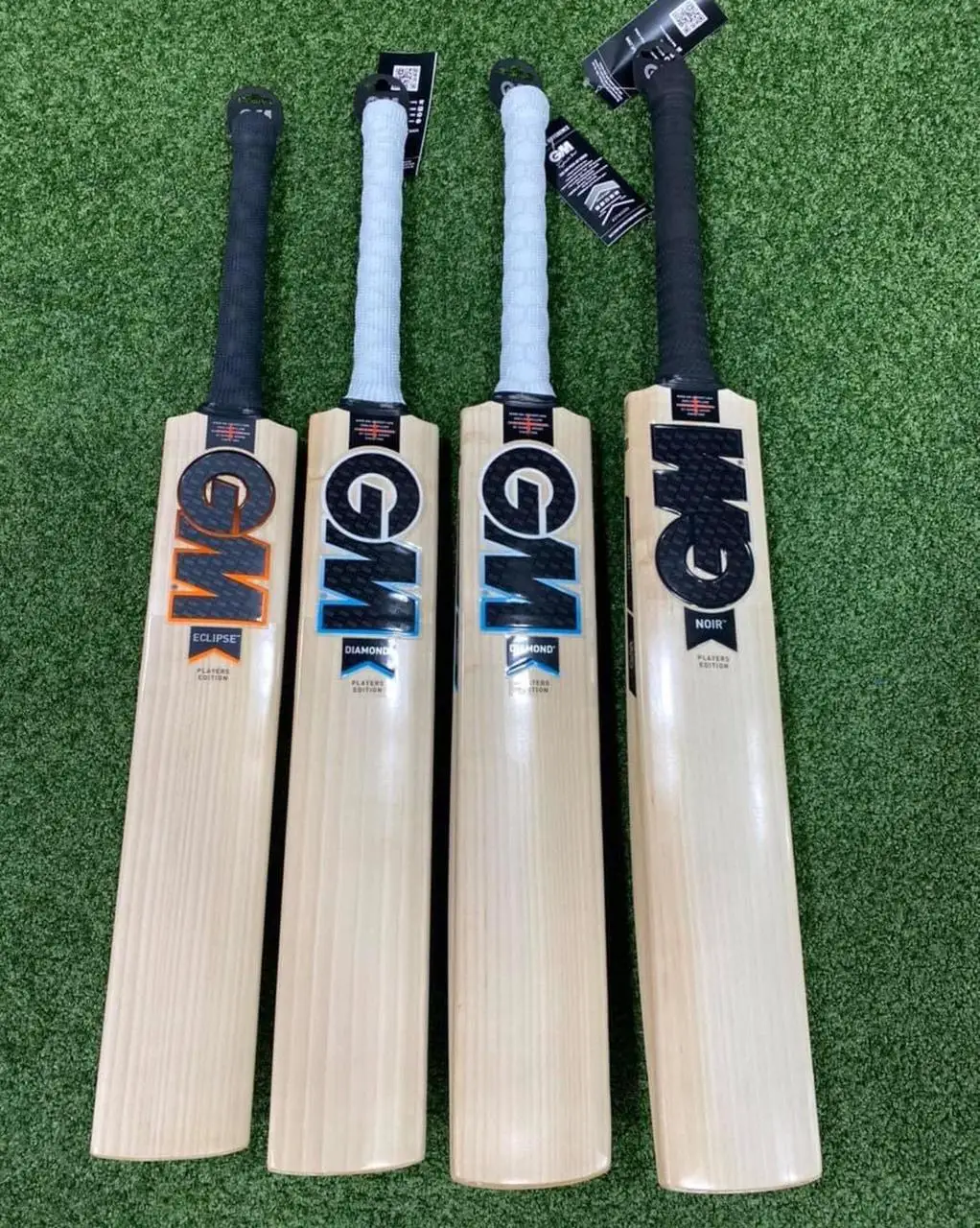
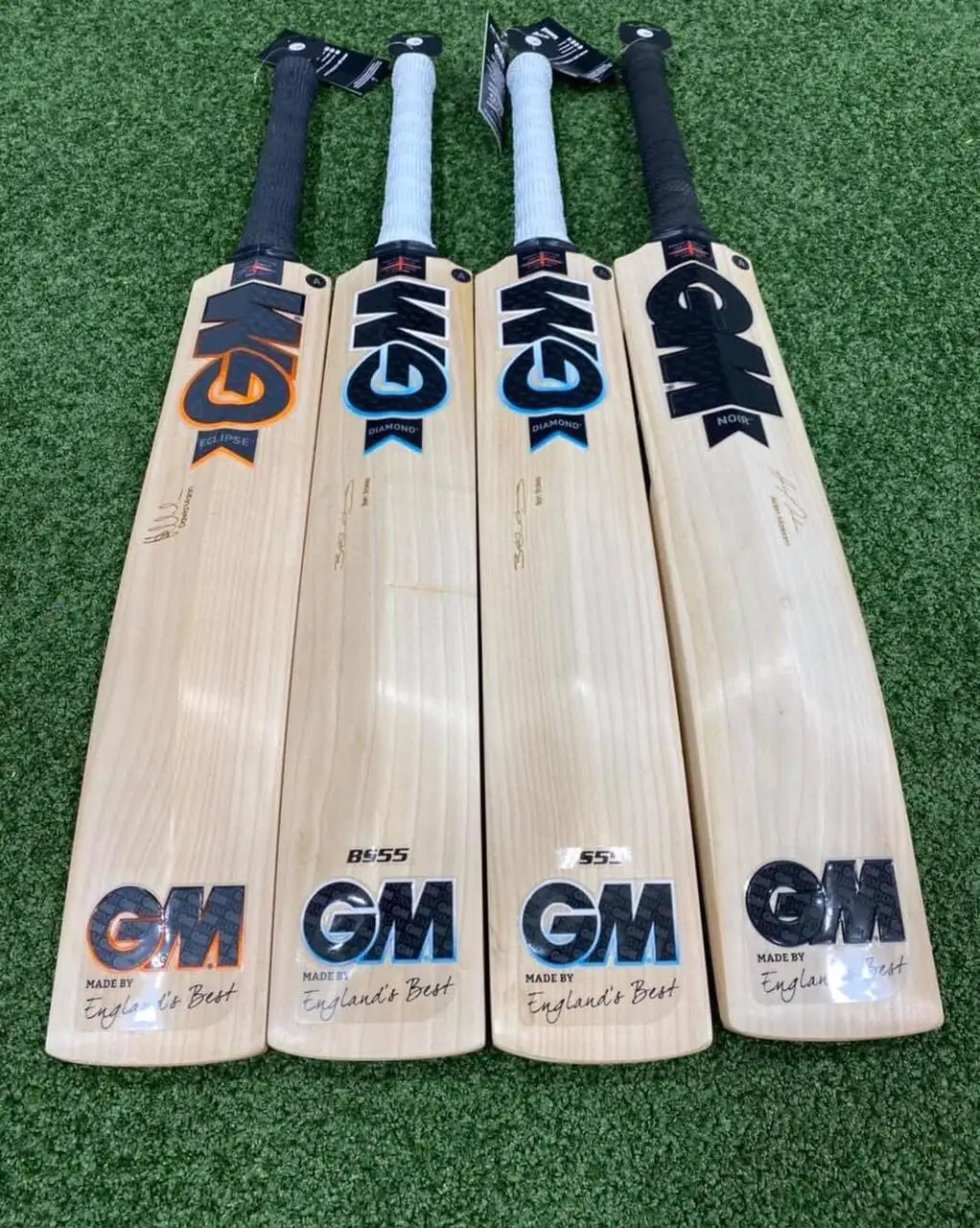
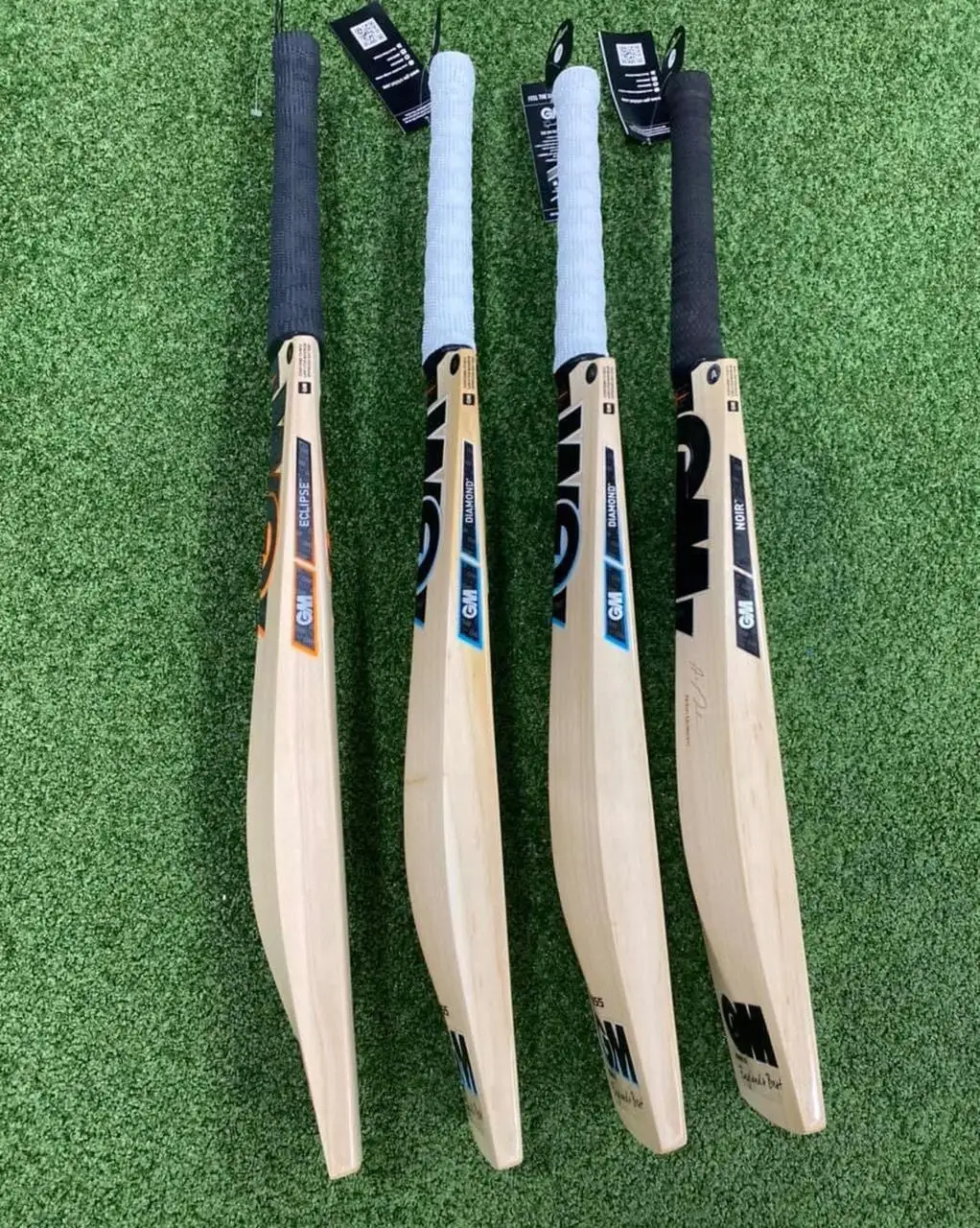
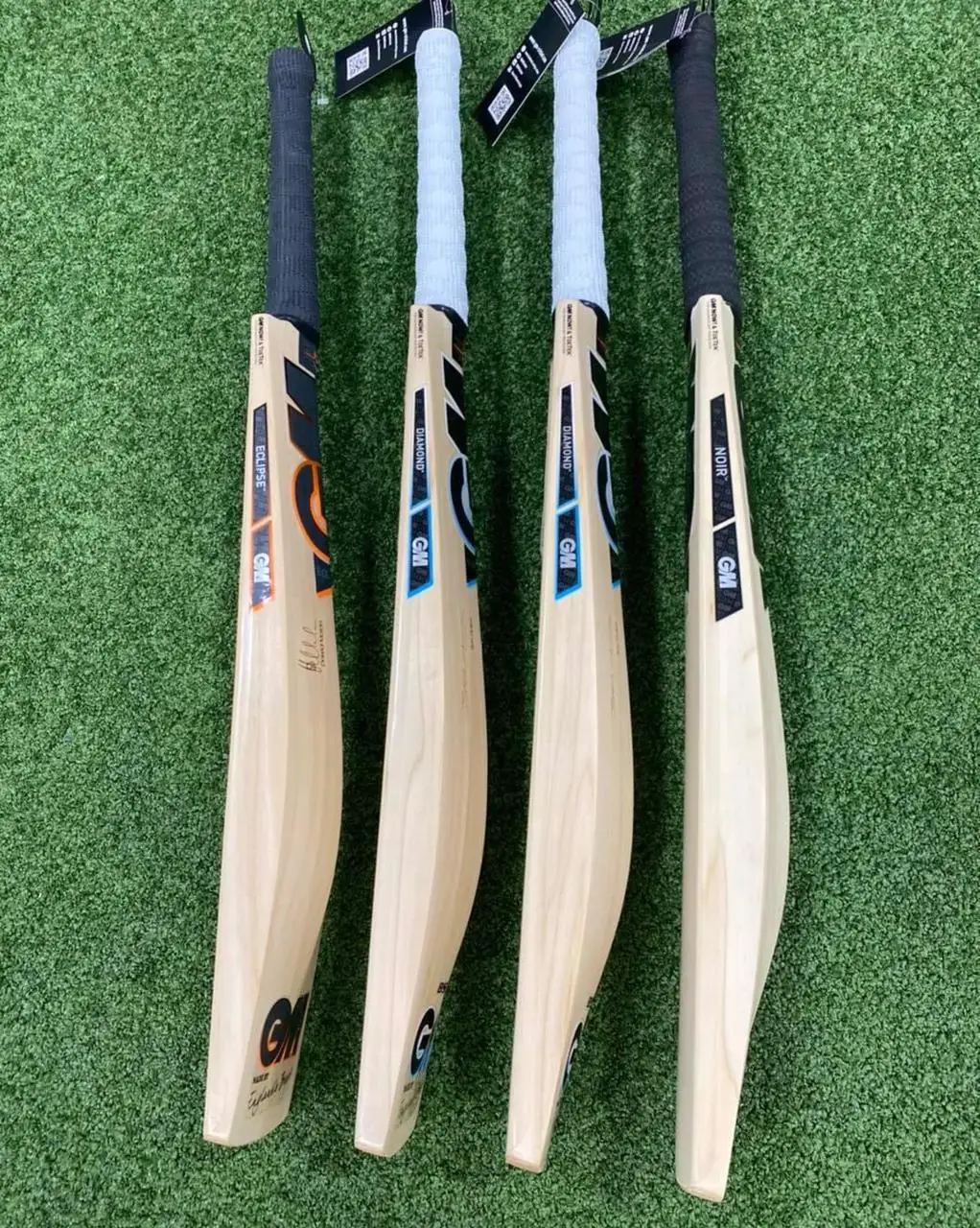
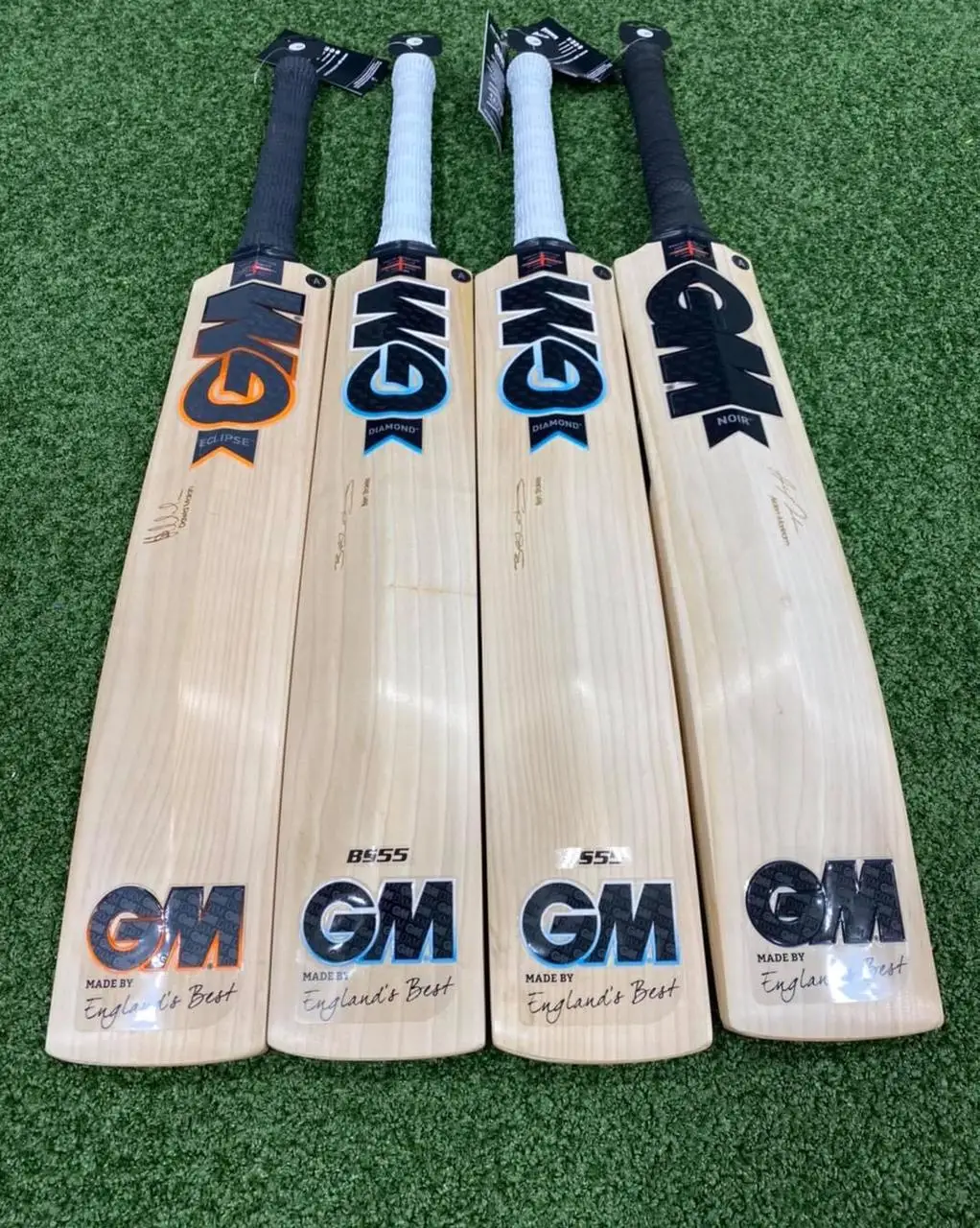
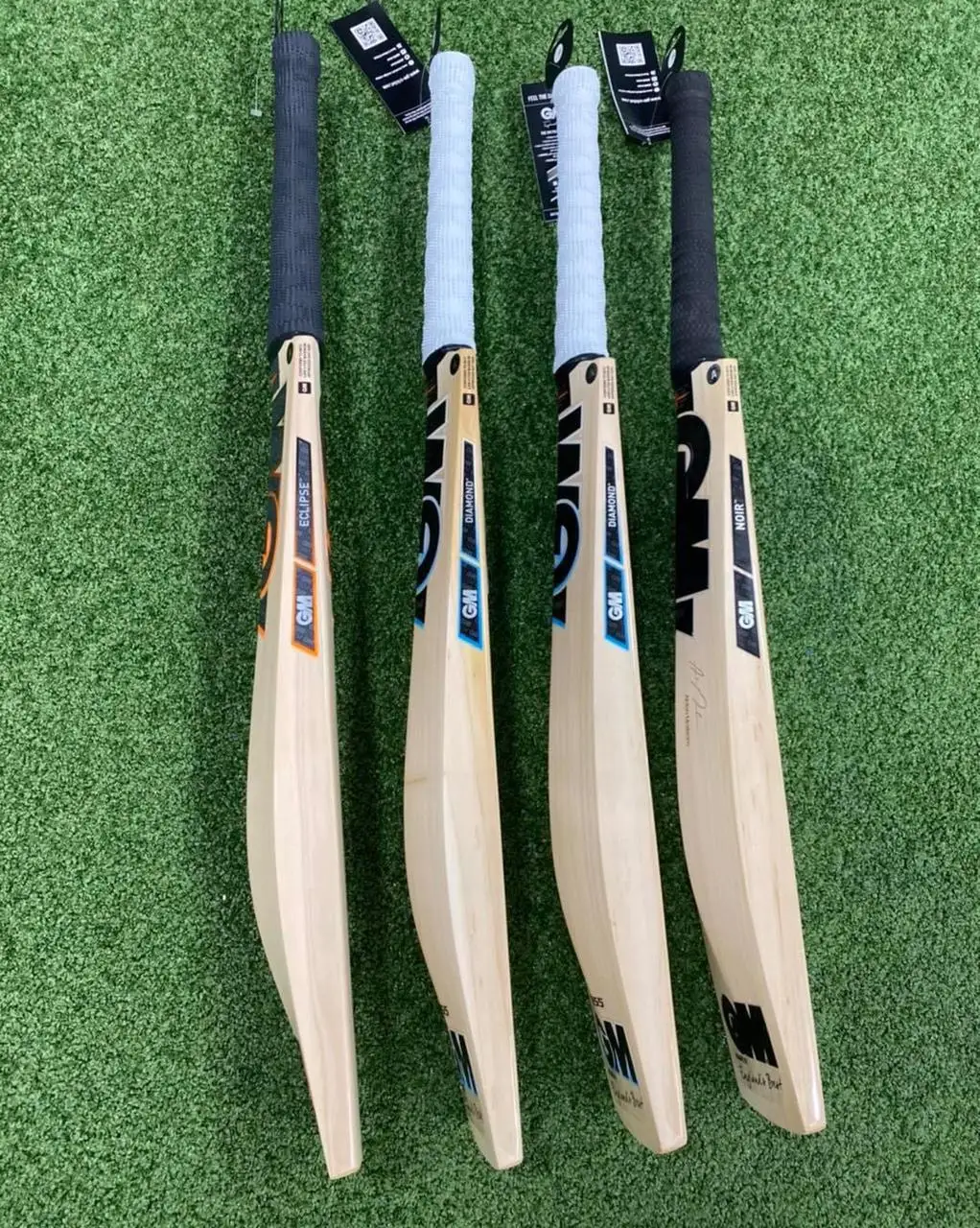
custom made players grade English willow cricket bats
- Category: >>>
- Supplier: EOIN WINSTON SPORTS
Share on (10000000300624):
Product Overview
Description
CROSS CUTTING:
Whole trees are transported into yard either using lorry or a local contractor with a larger vehicle.
The trees are then cross cut into 28 inch ( 71 cm ) lengths with chainsaws.
MANUFACTURING THE BAT BLADE:
Each length or roll is then divided up to the required size, hopefully obtaining an optimum number of pieces.
Each piece (called in the trade a “cleft”) is then shaped to the rough shape of a cricket bat blade.
It is important that the correct side of the cleft is chosen as the face as this is what will become the face of the finished bat.
The “blade” as it is now known, then has both ends waxed to prevent splitting and then air dried to the required moisture content,
however in India and Pakistan, the blade is still referred to as a cleft.
GRADING:
clefts are graded into various categories from wood suitable for the cheapest bat to that for the finest players who have obtained Test Match status.
Grading is firstly done as soon as the blades are sawn to give an approximate idea of stock levels.
Then when the blades have been dried, each blade himself very carefully before dispatch to the customer.
We have found this to be the only way to offer good, consistant quality.
We have many different grades, each one suitable for a particular market.
Here we have outlined some details of the most popular. Please note that these descriptions are for rough sawn willow clefts / blades and NOT finished bats.
Generally you will find less grains in finished bats as we saw the blades wider than the finished bat and therefore some grains are removed during processing.
GRADE 1 BLADE:
A Grade 1 is the best looking blade, though it will not necessarily play the best.
There may be some red wood evident on the edge of the blade. The grain on the face will be straight and there will be a minimum of 6 grains visible.
There may be the odd small knot or speck in the edge or back but the playing area should be clean.
GRADE 2 BLADE:
A Grade 2 blade is also very good quality and normally a larger amount of red wood can be seen on the edge of a blade,
this has no effect on the playing ability of the bat it is purely cosmetic.
Again there will be at least 6 straight grains on the face of the blade with maybe some blemishes, pin knots or “speck” visible,
we also put the top 2% of the excellent quality butterfly blades that we get into Grade 2.
GRADE 3 BLADE:
This is a middle grade that is produced in much higher numbers than the top grades and it offers very good value for money.
A Grade 3 Blade has up to half colour across the blade which again has no direct relation to the playing ability of the wood,
it just has less visual attraction. There will be a minimum of 5 grains on the face of the blade which may not always be perfectly straight.
Again some small knots or butterfly stain may be present with sometimes more prominent “speck”.
GRADE 4 BLADE:
A Grade 4 Blade is normally over half colour or contains butterfly stain. It will still play as well as the other grades.
Any number of grains are possible with often only 4 grains,
the willow containing ‘butterfly’ stain is very strong, there could also be more “speck” and other faults.
OTHER GRADES AND WHAT MAKES A GOOD BAT?
We have many other Grades which have been developed over the years to satisfy the different demands from all the different markets across the world.
Q: “What makes a good bat?” The answer is that it depends on the taste of the customer and the skill of the bat maker.
A bat should always be chosen on “feel” and not merely what it looks like.
There are bound to be some small knots or blemishes on the bat, after all it is a natural product and cannot be expected to be perfect, with no faults at all.
The only main differences in the grade are the visual appearance of the wood including
amounts of butterfly stain plus the number of blemishes or knots on the blade and the straightness of the grain.
Generally the more colour in the blade the lower the grade, there is however negligible difference in the playing ability,
it is purely a perception that if it looks good it will play well, this is not the case.
Butterfly stain (the stain resembles the shape of a butterfly), for example, used to be very popular for its superior strength and playing ability.
Unfortunately, these days because it does not “look clean and white” people do not buy it.
It does make very good bats that are very strong and perform well.
THE WIDE GRAIN MYTH
Generally we would expect a blade to have wide grain if it has less than 6 grains on the face. The width of the grain is entirely dependent upon how fast the tree
has grown, each grain represents one year’s growth.
The factors that affect the rate of growth are the soil quality and amount of water available.
In these modern times when growers want a quick return on their investment,
trees have been planted in the most ideal site for the tree to grow quickly.
This means that in the future there are going to be less narrow grain trees available.
Unfortunately when it takes all this time to grow a tree you cannot allow for changes in ‘fashion’ which could alter from year to year.
generally 12 to 18 years gives a wider grain with 25 years or more a narrower grain. A narrow grain bat will certainly play well,
quicker, but will not have a particularly long life.
On the other hand a wider grain bat (with as little as 4 grains on the face) will play as well,
given time, as a narrow grain, it will also , without doubt have a longer life span.
The reason for this is that the wood is not as old, so it is stronger and will stand up better to the beating with some of the very hard balls used in matches.
We are finding with the climate changing and growing seasons getting longer,
that the amount of narrow grain we are producing is getting less as a percentage.
There is nothing we can do about it and players will have to adapt in the coming years to accepting more wider grains.
Wide grain 3 to 4 grains on face of blade.
Average grain 5 to 9 on face of blade.
Very narrow grain. Over 15 grains on blade.
WEIGHT OF CRICKET BATS:
The two factors affecting the weight of the finished bat are the moisture content and the density of the wood.
The blades are allowed to lose moisture over a longer period of time which gives a far more even moisture content
and means that you are far less likely to get moisture trapped inside the blade,
which causes heavy weight.
When they are put in our driers after air drying to get the correct moisture content the results are unbeatable.
Although we can give no fixed guarantees on the moisture content and weight,
we do test a few blades in each drying cycle to make sure the batch is ready to come out.
Another factor affecting the weight of the finished bat is the density of the different trees,
this varies not just from area to area but also from tree to tree and is varied by soil type,
amount of sunlight, amount of water and other physical factors.
The final factor that can alter the weight of a bat is of course in the making.
When choosing a cricket bat most players ask for a specific weight.
In our opinion when choosing a bat more emphasis should be put on the pick-up and feel of the bat rather than any specific weight.
A bat can weigh 2lb 14oz but if made a certain way with the weight distributed differently it could feel like a 2 lb 7 oz bat,
it is basically down to the skill of the bat maker.
One would argue that if asked to guess the weight of a bat to the nearest ounce no player could get it right more than once in ten guesses at the very best.
We have also restricted the size of our blades to an optimum size that allows us to get a good number of blades per tree
and allows the edges to be big enough to give extra power to the finished product.
TRADITION:
The process of converting the tree into blades is still carried out in the traditional way
but we are always looking at new methods to make the process more efficient or to give a better quality product for our customers.
the generation and re-generation of willow will continue to provide the unmistakable sound of leather on willow.
Product packaging

Our Advantages
Manufacture Specification
Recommending Styles
$220 - $250 Pieces
100 Pieces (MOQ)
$220 - $250 Pieces
100 Pieces (MOQ)
100 Pieces (MOQ)
$220 - $250 Pieces
100 Pieces (MOQ)
100 Pieces (MOQ)
Company Introduction
CROSS CUTTING:
Whole trees are transported into yard either using lorry or a local contractor with a larger vehicle.
The trees are then cross cut into 28 inch ( 71 cm ) lengths with chainsaws.
MANUFACTURING THE BAT BLADE:
Each length or roll is then divided up to the required size, hopefully obtaining an optimum number of pieces.
Each piece (called in the trade a “cleft”) is then shaped to the rough shape of a cricket bat blade.
It is important that the correct side of the cleft is chosen as the face as this is what will become the face of the finished bat.
The “blade” as it is now known, then has both ends waxed to prevent splitting and then air dried to the required moisture content,
however in India and Pakistan, the blade is still referred to as a cleft.
GRADING:
clefts are graded into various categories from wood suitable for the cheapest bat to that for the finest players who have obtained Test Match status.
Grading is firstly done as soon as the blades are sawn to give an approximate idea of stock levels.
Then when the blades have been dried, each blade himself very carefully before dispatch to the customer.
We have found this to be the only way to offer good, consistant quality.
We have many different grades, each one suitable for a particular market.
Here we have outlined some details of the most popular. Please note that these descriptions are for rough sawn willow clefts / blades and NOT finished bats.
Generally you will find less grains in finished bats as we saw the blades wider than the finished bat and therefore some grains are removed during processing.
GRADE 1 BLADE:
A Grade 1 is the best looking blade, though it will not necessarily play the best.
There may be some red wood evident on the edge of the blade. The grain on the face will be straight and there will be a minimum of 6 grains visible.
There may be the odd small knot or speck in the edge or back but the playing area should be clean.
GRADE 2 BLADE:
A Grade 2 blade is also very good quality and normally a larger amount of red wood can be seen on the edge of a blade,
this has no effect on the playing ability of the bat it is purely cosmetic.
Again there will be at least 6 straight grains on the face of the blade with maybe some blemishes, pin knots or “speck” visible,
we also put the top 2% of the excellent quality butterfly blades that we get into Grade 2.
GRADE 3 BLADE:
This is a middle grade that is produced in much higher numbers than the top grades and it offers very good value for money.
A Grade 3 Blade has up to half colour across the blade which again has no direct relation to the playing ability of the wood,
it just has less visual attraction. There will be a minimum of 5 grains on the face of the blade which may not always be perfectly straight.
Again some small knots or butterfly stain may be present with sometimes more prominent “speck”.
GRADE 4 BLADE:
A Grade 4 Blade is normally over half colour or contains butterfly stain. It will still play as well as the other grades.
Any number of grains are possible with often only 4 grains,
the willow containing ‘butterfly’ stain is very strong, there could also be more “speck” and other faults.
OTHER GRADES AND WHAT MAKES A GOOD BAT?
We have many other Grades which have been developed over the years to satisfy the different demands from all the different markets across the world.
Q: “What makes a good bat?” The answer is that it depends on the taste of the customer and the skill of the bat maker.
A bat should always be chosen on “feel” and not merely what it looks like.
There are bound to be some small knots or blemishes on the bat, after all it is a natural product and cannot be expected to be perfect, with no faults at all.
The only main differences in the grade are the visual appearance of the wood including
amounts of butterfly stain plus the number of blemishes or knots on the blade and the straightness of the grain.
Generally the more colour in the blade the lower the grade, there is however negligible difference in the playing ability,
it is purely a perception that if it looks good it will play well, this is not the case.
Butterfly stain (the stain resembles the shape of a butterfly), for example, used to be very popular for its superior strength and playing ability.
Unfortunately, these days because it does not “look clean and white” people do not buy it.
It does make very good bats that are very strong and perform well.
THE WIDE GRAIN MYTH
Generally we would expect a blade to have wide grain if it has less than 6 grains on the face. The width of the grain is entirely dependent upon how fast the tree
has grown, each grain represents one year’s growth.
The factors that affect the rate of growth are the soil quality and amount of water available.
In these modern times when growers want a quick return on their investment,
trees have been planted in the most ideal site for the tree to grow quickly.
This means that in the future there are going to be less narrow grain trees available.
Unfortunately when it takes all this time to grow a tree you cannot allow for changes in ‘fashion’ which could alter from year to year.
generally 12 to 18 years gives a wider grain with 25 years or more a narrower grain. A narrow grain bat will certainly play well,
quicker, but will not have a particularly long life.
On the other hand a wider grain bat (with as little as 4 grains on the face) will play as well,
given time, as a narrow grain, it will also , without doubt have a longer life span.
The reason for this is that the wood is not as old, so it is stronger and will stand up better to the beating with some of the very hard balls used in matches.
We are finding with the climate changing and growing seasons getting longer,
that the amount of narrow grain we are producing is getting less as a percentage.
There is nothing we can do about it and players will have to adapt in the coming years to accepting more wider grains.
Wide grain 3 to 4 grains on face of blade.
Average grain 5 to 9 on face of blade.
Very narrow grain. Over 15 grains on blade.
WEIGHT OF CRICKET BATS:
The two factors affecting the weight of the finished bat are the moisture content and the density of the wood.
The blades are allowed to lose moisture over a longer period of time which gives a far more even moisture content
and means that you are far less likely to get moisture trapped inside the blade,
which causes heavy weight.
When they are put in our driers after air drying to get the correct moisture content the results are unbeatable.
Although we can give no fixed guarantees on the moisture content and weight,
we do test a few blades in each drying cycle to make sure the batch is ready to come out.
Another factor affecting the weight of the finished bat is the density of the different trees,
this varies not just from area to area but also from tree to tree and is varied by soil type,
amount of sunlight, amount of water and other physical factors.
The final factor that can alter the weight of a bat is of course in the making.
When choosing a cricket bat most players ask for a specific weight.
In our opinion when choosing a bat more emphasis should be put on the pick-up and feel of the bat rather than any specific weight.
A bat can weigh 2lb 14oz but if made a certain way with the weight distributed differently it could feel like a 2 lb 7 oz bat,
it is basically down to the skill of the bat maker.
One would argue that if asked to guess the weight of a bat to the nearest ounce no player could get it right more than once in ten guesses at the very best.
We have also restricted the size of our blades to an optimum size that allows us to get a good number of blades per tree
and allows the edges to be big enough to give extra power to the finished product.
TRADITION:
The process of converting the tree into blades is still carried out in the traditional way
but we are always looking at new methods to make the process more efficient or to give a better quality product for our customers.
the generation and re-generation of willow will continue to provide the unmistakable sound of leather on willow.
Email: | ewsports97@gmail.com |
WhatsApp: | +923225849205 |
FAQ

Q1: Can i have my own logo?
Of course,Believe our 26 years OEM experience will make your own design more beautiful. making sample for you check quality and
workmanship first.
Q2: Are there more colors available?
Yes,of course,but we suggest you use our normal colors for first trial order,it is good for lead time if you want to test quality
quickly.
Q3: How can you guarantee the quality?
We have well-trained and professional workers and strict QC system in each production link. And each product has to be 100%
inspected before shipment.
Q5: What is the best price you offer?
We are a factory with more than 100 skilled workers and a good chain of raw material suppliers to ensure that the prices we
provide for you are optimal.
Q6: How can i pay?
T/T Money Gram , Xoom, Remitly worldremit , Ria Transfer
Q7: How long is the production time?
Sample time : normally 7-8 days;Bulk order production time : 3-4 weeks after sample confirmed.
Of course,Believe our 26 years OEM experience will make your own design more beautiful. making sample for you check quality and
workmanship first.
Q2: Are there more colors available?
Yes,of course,but we suggest you use our normal colors for first trial order,it is good for lead time if you want to test quality
quickly.
Q3: How can you guarantee the quality?
We have well-trained and professional workers and strict QC system in each production link. And each product has to be 100%
inspected before shipment.
Q5: What is the best price you offer?
We are a factory with more than 100 skilled workers and a good chain of raw material suppliers to ensure that the prices we
provide for you are optimal.
Q6: How can i pay?
T/T Money Gram , Xoom, Remitly worldremit , Ria Transfer
Q7: How long is the production time?
Sample time : normally 7-8 days;Bulk order production time : 3-4 weeks after sample confirmed.
Product Description
EOIN WINSTON SPORTS are professional manufacturers of Apparel, Sports wear, Jackets and fitness wear. We are OEM, ODM manufacturers and exporters of apparel, sports wear and all kinds of fitness wear.
Having extensive experience in this field has earned us great respect in Pakistan and the other countries of world. Follow is the further information.
* We can provide American Football Uniform in all colors.
* We can provide American Football Uniform in all sizes.
* For more information feel free to contact us and we will cooperate indefinitely
Having extensive experience in this field has earned us great respect in Pakistan and the other countries of world. Follow is the further information.
* We can provide American Football Uniform in all colors.
* We can provide American Football Uniform in all sizes.
* For more information feel free to contact us and we will cooperate indefinitely
Product Name: | |||||||
Material: | |||||||
Techincs: | |||||||
Features: | |||||||
Color: | |||||||
Size: | |||||||
Why Choose su? | |||||||
Product packaging
Our Advantages
Manufacture Specification


Best Selling
Recommending Styles
$15 - $ 20 Pieces
100 Pieces (MOQ)
$ 15 - $ 18 Pieces
50 Pieces (MOQ)
$ 12 - $15.5 Pieces
50 Pieces (MOQ)
Company Introduction
Semi-Automatic PET Bottle Blowing Machine Bottle Making Machine Bottle Moulding Machine
PET Bottle Making Machine is suitable for producing PET plastic containers and bottles in all shapes.