Fort Plasticizer S-3 is a finely dispersed dry mixture consisting of silicon dioxide, a plasticizing complex and active auxiliary additives. It is a waterproofing additive for concrete.
[Application]
Fort Plasticizer S-3 is used for:
Fort Plasticizer S-3 will allow:
- production of all types of concrete of class B15 and higher, including with prestressed reinforcement;
- to obtain cast self-sealing concrete mixes that practically do not require vibration during laying;
- production of concrete mixes for architectural forms and paving elements;
- to reduce by 20% or more the water-cement ratio of the mixture (water-reducing effect) due to this, to obtain a significant increase in strength, water resistance, frost resistance, density, etc.;
- production of densely reinforced, thin-walled reinforced concrete structures.
- to reduce the consumption of cement up to 22% (in equally mobile mixtures);
- monolithic housing construction;
- to obtain concrete mixtures of increased mobility (P3-P4) in comparison with the composition without additives and to increase the strength of concrete by reducing the water-cement ratio;
- reduce the time and energy consumption for the production of concrete products;
- to produce ready-mixed concrete with the preservation of mobility without stratification and water separation, followed by pumping with pumps and laying in the formwork.
* Fort Plasticizer S-3 does not contain substances that cause corrosion of the reinforcement.
* Additive does not contribute to salting.
Recommendations For Use
Name of the additive
The additive Fort Plasticizer S-3
Description
Additive belongs to the class of superplasticizing (OK to P5) and super-water-reducing additives for concrete and mortar. Fort Additive Plasticizer C-3 consists of a mixture of modified high-molecular poly-naphthalene methylsulfonates of sodium. This additive is used in the production of a wide range of precast concrete, ready-mixed concrete, light concrete, the construction of monolithic structures, as well as in the production of small-piece concrete products.
Documentation
TU 5745-009-13453677-2016,
The products comply with sanitary standards:
Sanitary and epidemiological conclusion
No. 1-T-55pr of 22.03.2016 The products are not subject to mandatory certification.
0.5 – 0.8% of the dry additive by weight of cement. The optimal dosage is determined experimentally on the materials used.
Dosage
It is recommended to add the Fort Plasticizer C-3 additive into the concrete mixture in the form of an aqueous working solution (the dry additive is previously dissolved with water.
For more information, see the section PREPARING WATER SOLUTIONS OF ADDITIVES AND THEIR DOSING INTO THE CONCRETE MIXTURE).
After being added into the concrete mixture, it is recommended to ensure sufficient mixing time for an even distribution of the additive in the mixture.
The mixing time is also selected by the consumer based on the conditions of the technology.
The effectiveness of the additive for concrete directly depends on the chemical composition of the cement and placeholders. When changing the inert or binding agents of the concrete mixture, it is recommended to adjust the composition of the mixture in the laboratory.
Recommended concentration of the working solution
30-35%
Increasing the grade of the concrete mix for workability without reducing the strength at all times of hardening
Up to P5
Appearance
Powder from brown to dark brown color
Dark brown liquid (sediment is allowed)
Mass fraction of dry substances
not less than 93%
The tolerance of the sediment during dissolution
no more than 2%
Packaging
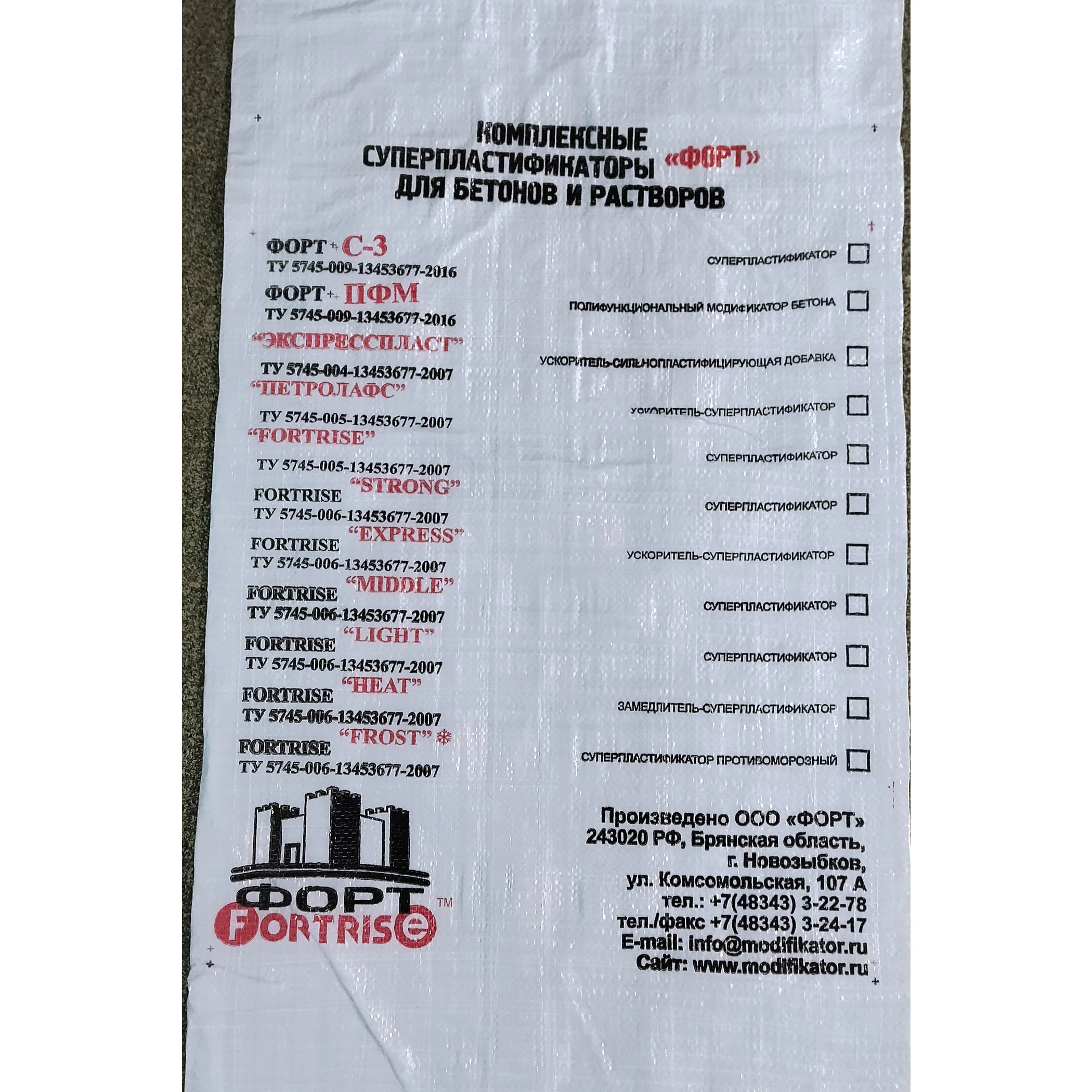
Powder: Polypropylene bag with a polyethylene liner of 20kg;
Regulations and manuals recommended for familiarization when working with the additive
- "Manual on the use of chemical additives in the production of prefabricated railway structures and products" (to SNiP 3.04.01-85)
- "Guidelines for the use of concrete with complex antifreeze additives" (Moscow, NIIZHB, 1986) - SNiP 2.03.01-84 "Concrete and railway structures"
- GOST 24211-2008 " Additives for concrete and mortar. General technical conditions"
- GOST 30459-2008 " Additives for concrete and mortar. Methods for determining the effectiveness"
Preparation Of Aqueous Solutions Of Additives And Their Dosing Into A Concrete Mixture
It is recommended to introduce the concrete additive into the concrete mixture in the form of an aqueous solution. The process of preparing an aqueous solution is carried out in special containers equipped with a mixing device and steam registers for heating the solution to a temperature of 40-50°C in order to improve dissolution.
It is necessary to prepare the solution at a positive ambient temperature. The concentration of the aqueous solution is determined by the amount of dry additive that you need to take to prepare a liquid solution is determined by the formula, kg:
T dry add.=Mr*C / (100-W),
where Mr is the mass of the solution, kg;
W is the mass fraction of water in the dry powder of the additive, % (see the data in the quality certificate);
C is the concentration of the working solution,%.
EXAMPLE: It is necessary to prepare 200 kg of an aqueous solution of the additive in 30% concentration.
T dry add.=200kg*30 / (96) = 62.5 kg
It is necessary to pour 137.5 kg of water into a 200l container and, while stirring, pour 62.5 kg of dry additive.
Calculation of the dosage of the additive introduced into the concrete mixture
If the amount of the additive introduced into the concrete mixture is 0.5%, then the additive consumption per 100 kg of cement can be calculated using the formula:
T dry add.=100kg*0,5% / 100% = 0,5kg
The amount of liquid additive is calculated similarly, but instead of 100%, the concentration of an aqueous solution is taken (let's say it is 35%):
T liquid add.=100kg*0,5% / 35% = 1,428kg
If necessary, the dosage of the additive can be made in liters, then the calculation of the amount will be as follows:
V=(100кг*0,5% / 35%) / 1,19 = 1,2 л
The indicator 1.19 is taken from the quality passport and means the density of this concentration of the additive solution g/cm3.
Solution concentration, %
The density of the solution at 20°C, g/cm3
The content of anhydrous additive in 1L, g
10
1,048
110
12
1,06
118
14
1,07
152
16
1,08
173
18
1,09
196
20
1,1
220
25
1,134
283
30
1,137
347
35
1,181
415
Technical Indicators
Appearance
Powder: from brown to dark brown Liquid: dark brown color
pH value
4 - 7
Density, at 20 °C
Powder: ≥ 92% Liquid: ≥ 30%
FAQ
1. Can I get samples?
- Sending chemical samples internationally is a very complex process. In fact, it is necessary to draw up a full-fledged contract. Therefore, the minimum batch is 1000kg or 1000l.
2. Can I have my own customized product?
- Everything is possible, except for changing the packaging itself. Changing the packaging is possible hgb orders from 200 tons per month.
3. How long does it take to calculate the shipping cost?