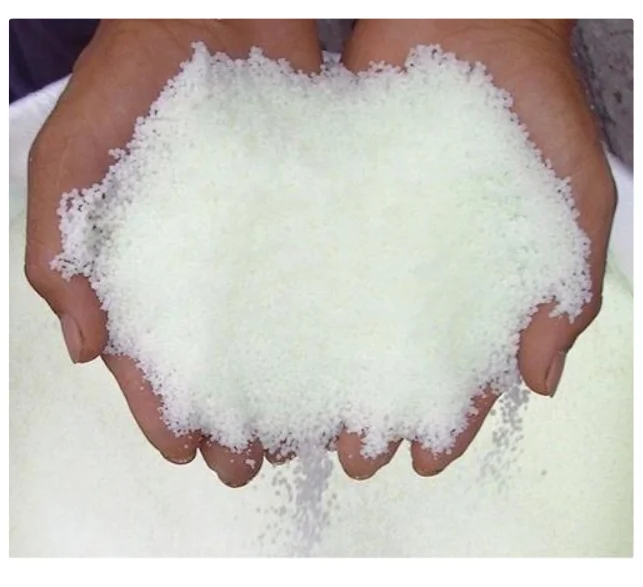
PRILLED UREA N 46% FERTILIZER

Share on (10000008665544):


Price:

Quantity:


Product Overview

Description


Calcium chloride Chemical Properties


mp


772 °C(lit.)


bp


1600 °C


density


1.086 g/mL at 20 °C


vapor pressure


0.01 mm Hg ( 20 °C)


refractive index


n20/D 1.358


Fp


>1600°C


storage temp.


2-8°C


solubility


H2O: soluble


form


powder


Water Solubility


740 g/L (20 ºC)


Sensitive


Hygroscopic


Merck


141659


Stability:


Stable. Incompatible with zinc, water, strong acids,


methyl vinyl ether, bromine trifluoride, boron oxide,


calcium oxide. Hygroscopic.


CAS DataBase Reference


10043-52-4(CAS DataBase Reference)


NIST Chemistry Reference


Calcium dichloride(10043-52-4)


EPA Substance Registry System


Calcium chloride (CaCl2)(10043-52-4)


Hazard Codes


Xi


Risk Statements


36/37/38-36-36/38-41-22


Safety Statements


26-39-24-22-36


WGK Ger


1


RTECS


EV981000


HS Code


2827200


Hazardous Substances Data


10043-52-4(Hazardous Substances Data)


Colour


White


Shape


white ball


Size


medium grain


Physical Properties


Physical properties Urea is easily soluble in water, 105 grams can be dissolved in 100 ml of water at 20 °C, and the aqueous
solution is neutral.There are two types of urea products.Crystalline urea is in the form of white needle or prismatic crystal, and
has strong hygroscopicity.[1] Granular urea is a translucent particle with a particle size of 1 to 2 mm, with a smooth appearance
and significantly improved hygroscopicity.The critical moisture absorption point at 20°C is 80% relative humidity, but at 30°C,
the critical moisture absorption point drops to 72.5%, so urea should be kept open in humid climates in midsummer.Adding
hydrophobic substances such as paraffin in urea production greatly reduces its hygroscopicity.


Chemical Properties


Urea can react with acids to form salts.There is hydrolysis.The condensation reaction can be carried out at high temperature to
generate biuret, triuret and cyanuric acid.Heated to 160 ° C to decompose, producing ammonia and turning into isocyanic
acid.Because it is contained in human urine, it is named urea.Urea contains 46% nitrogen (N), which is the highest nitrogen
content among solid nitrogen fertilizers.


Material


The raw materials for urea production are mainly liquid ammonia and carbon dioxide gas. Liquid ammonia is the main product of the
synthetic ammonia plant, and carbon dioxide gas is the by-product of the purification of the synthetic ammonia feedstock gas.The
liquid ammonia used for synthesizing urea requires a purity higher than 99.5%, oil content less than 10PPm, water and inert gas
less than 0.5%, and no solid impurities such as catalyst powder and rust.The purity of carbon dioxide is required to be greater
than 98.5%, and the sulfide content is less than 15mg/Nm³.


0.2075 s.