Product Overview
Description
More detais please view our website www.shanghaitopmark.com
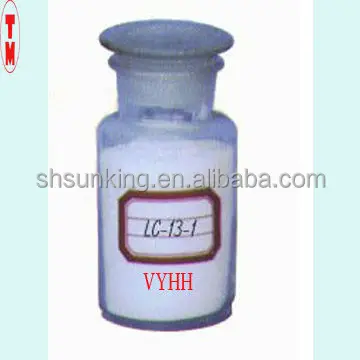
Characteristice: A high molecular weight resin having a composition of approximately 86 percent vinyl chloride and 14 percent vinyl acetate. LC-13-1 offers a desirable balance of chemical resistance, solubility, film strength, and thermoplasticity, has a good adhesion on paper, acrylic resin, PVC, ABS and PC, etc.
Solubility: LC-13-1 is usually dissolved in a relatively strong solvent/diluent combination, such as ketone solvent/aromatic diluent (50/50 percent by weight). With this system, a solids content of 20 to 25 percent can be achieved. Ketones and esters are the most commonly used solvents, and chlorinated hydrocarbons, amide used only in a few occasions. Ketones is a particularly good solvent, and esters is the relatively weak solvent. Chlorinated hydrocarbons such as dichloroethane and 1,2 - dichloroethane can completely dissolve LC-13-1, but methyl chloroform and tetrachloroethane can only swell it. Aromatic hydrocarbons have a good role in the swelling, generally using with ketone.
Application: LC-13-1 is ideally suited for marine and maintenance coatings, metal, can paint, strippable coatings, PVC and paper ink, magnetic card, cable, rubber and plastic foam materials, leather surface treatment, PU color plasm and flake, flooring, ciphertext disc, etc.
More details pls view products website:www.shanghaitopmark.com
Characteristice: Una resina de alto peso molecular que tiene una composición de aproximadamente 86 por ciento de cloruro de vinilo y 14 por ciento de acetato de vinilo. LC-13-1 ofrece un equilibrio deseable de resistencia química, solubilidad, resistencia de la película, y termoplasticidad, tiene una buena adherencia sobre el papel, resina acrílica, PVC, ABS y PC, etc
Solubilidad: LC-13-1 se disuelven por lo general en un tiempo relativamente fuerte combinación disolvente / diluyente, tal como cetona disolvente / diluyente aromático (50/50 por ciento en peso). Con este sistema, se puede lograr un contenido de sólidos de 20 a 25 por ciento. Cetonas y ésteres son los disolventes más utilizados, y los hidrocarburos clorados, amida utilizan sólo en algunas ocasiones. Las cetonas es un disolvente particularmente bueno, y ésteres es el disolvente relativamente débil. Hidrocarburos clorados tales como dicloroetano y 1,2 - dicloroetano pueden disolver completamente LC-13-1, pero metil cloroformo y tetracloroetano sólo pueden hincharse ella. Hidrocarburos aromáticos tienen un buen papel en la inflamación, utilizando generalmente con cetona.
Aplicación: LC-13-1 es ideal para marinos y el mantenimiento, recubrimientos metálicos, se puede pintar, revestimientos desprendibles, PCV y la tinta del papel, tarjeta magnética, cable, caucho y materiales de espuma de plástico, tratamiento de superficies de cuero, PU plasma de color y escamas, suelo, cifrado del disco, etc


We Recommend
New Arrivals
New products from manufacturers at wholesale prices