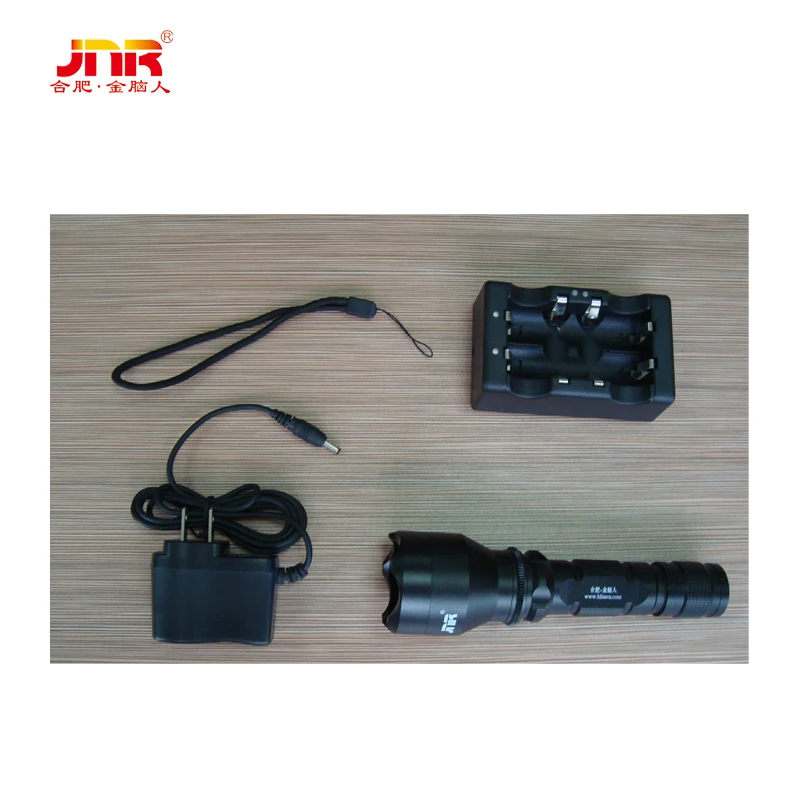

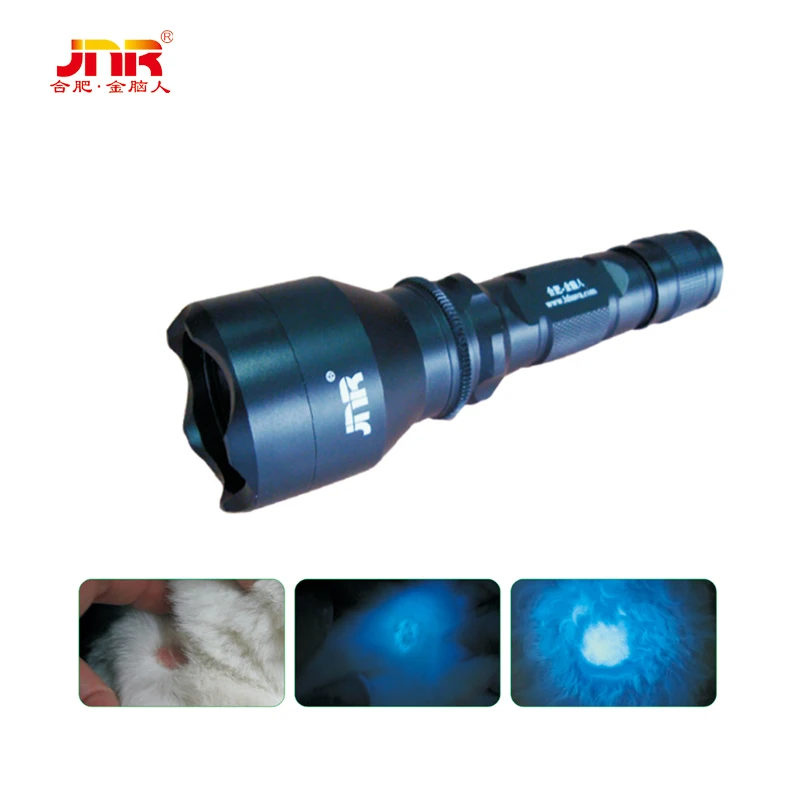



Veterinary equipment vet woods lamp animal 365nm LED woods lamp facial woods lamp
- Category: >>>
- Supplier: Hefei Golden Brains Optical Instrument Co. Ltd.
Share on (1045812066):
Product Overview
Description
facial woods lamp and 365nm led woods lamp
veterinary fungi detecting lamp woods lamp
A Wood's lamp emits ultraviolet light that is filtered through cobalt or nickel. It is used to identify the fungal dermatophyte M. canis (i.e. ringworm). Wood's lamps are useful tools for initially screening patients, for selecting the hairs to perform a fungal culture, and in monitoring a patient that is receiving treatment for dermatophytosis. (Note: It is best to let the lamp warm up for five minutes before use, and animals should be examined in a dark room.)
Figure 4: A Wood’s lamp can be used to identify Microsporum canis infection (ringworm). Infected hairs will fl uoresce, but a negative result does not rule out ringworm infection.
In 30 percent to 50 percent of M. canis cases, the infected hairs will fluoresce a characteristic candy apple green color under the Wood's lamp (Figure 4). It is important to realize that the other two common dermatophytes in small animals, M. gypseum and T
It used imported high-power LED light .And its working life can be 100 thousand hours.
it is rechargeable without the long line limitation .It is much more convenient to use it when doing the inspection .
the imported light filter is used so that the visible light can be zero .
spectrum range :320nm-400nm
maximum peak :365nm
battery voltage :3.7v
Using the torch in darkroom.And the distance between light source and pets’ skin should be 5-10 cm .Then aim the light at the infected part to see whether it fluoresce.
Detection results
Fungi | Light reaction |
Microsporum Canis | Light green fluorescence |
Tinea versicolor | Golden fluorescence |
Microsporum | Bright green fluorescence |
Pseudomonas aeruginosa | Yellow-green fluorescence |
Ulcer lesions | Purple fluorescence |
Black cell | Puce fluorescence |
hematoma | Wine-red fluorescence |
Corynebacterium minutissimum | Brick-red fluorescence |
eczema
| No fluorescence
|


We Recommend



New Arrivals
New products from manufacturers at wholesale prices