Tobee Effluent Handling
$12,600
Share on (1404956174):
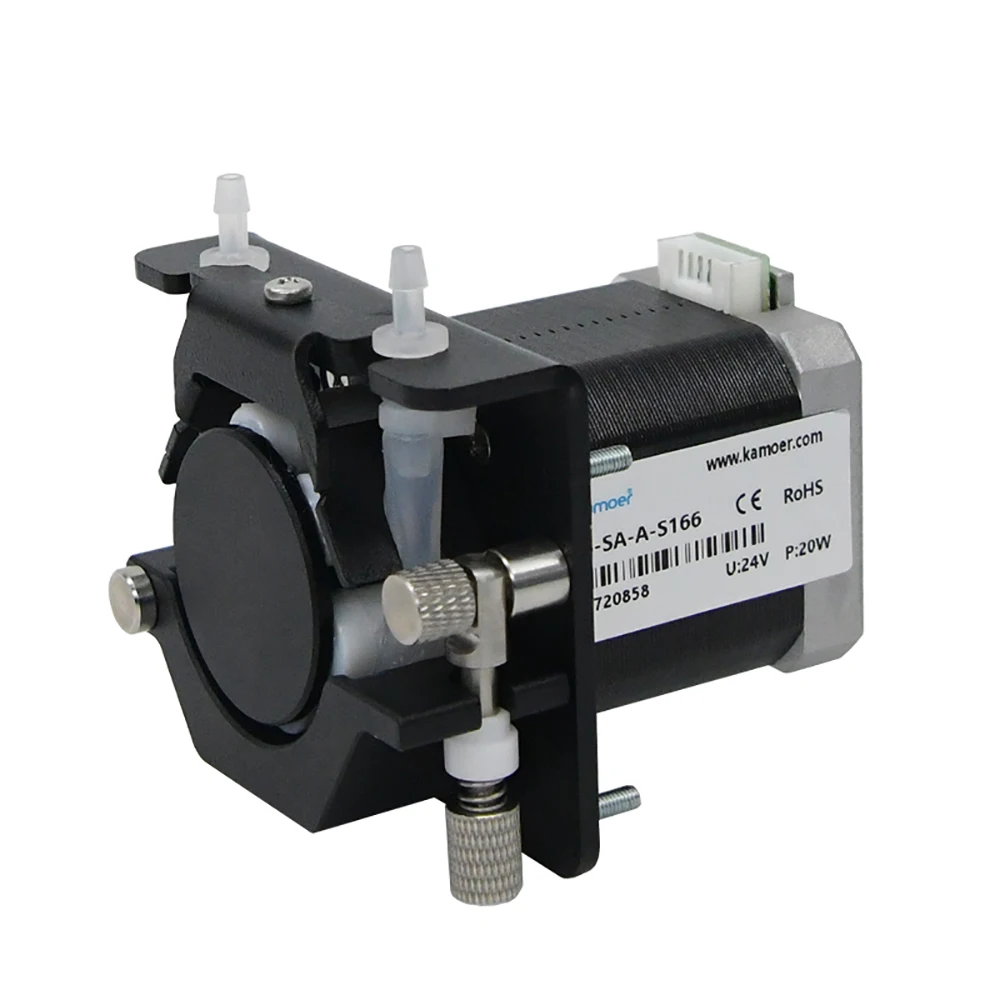
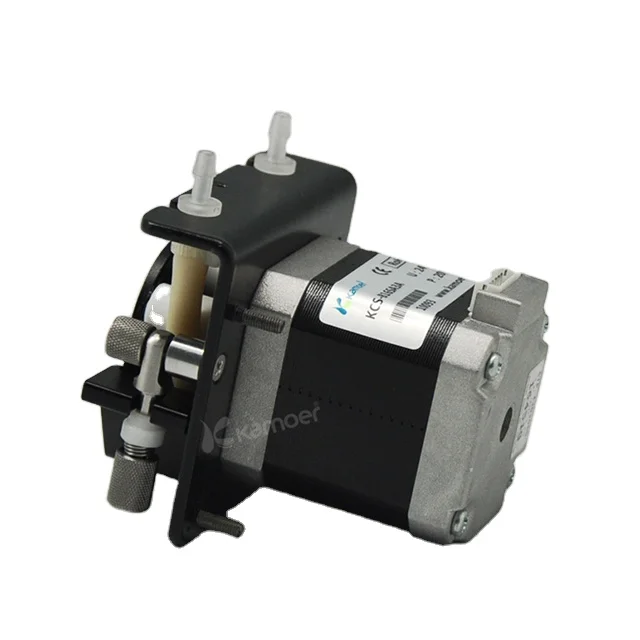
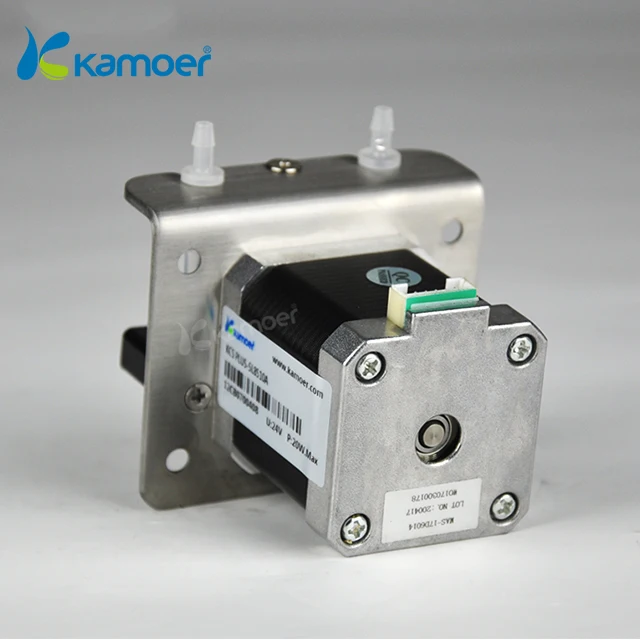
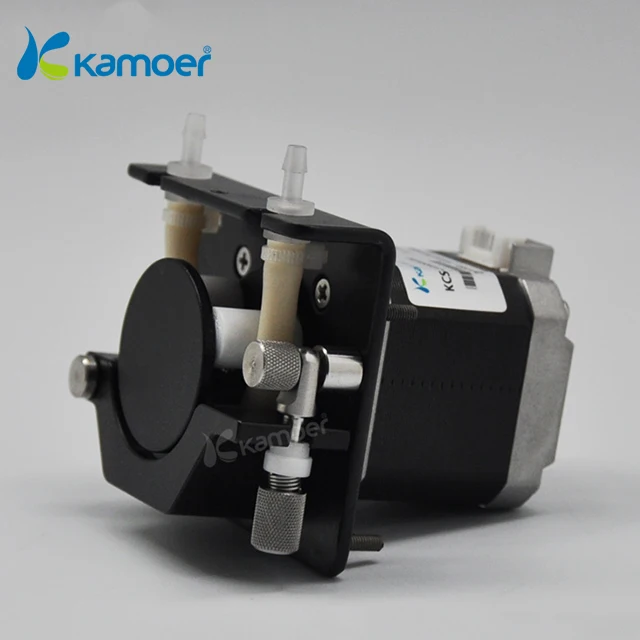
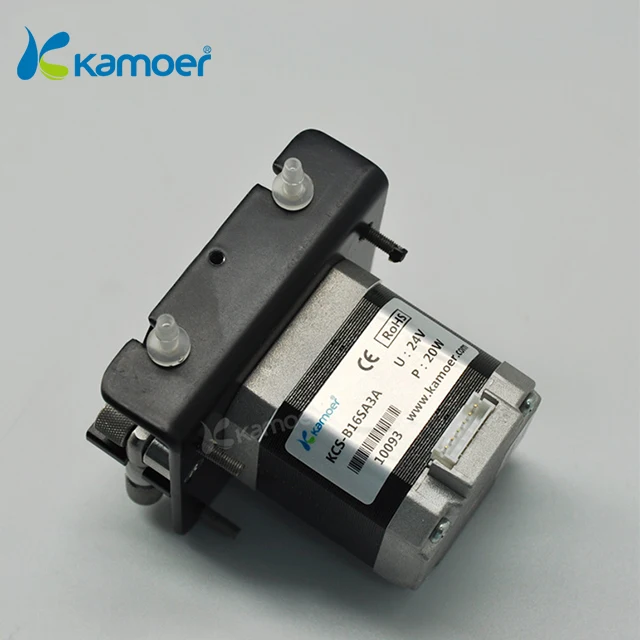
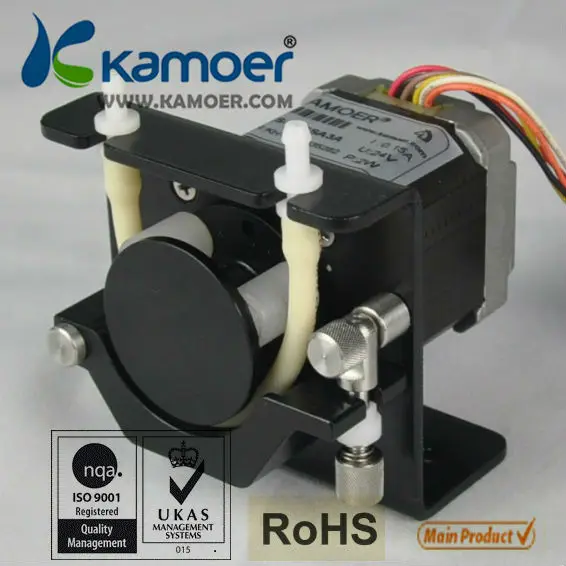
Kamoer 12V Stepper Motor Peristaltic Pump for Auto Analyzer
Kamoer peristaltic pump
A peristaltic pump is a type of positive displacement pump used for pumping a variety of fluids. The fluid is contained within a flexible tube fitted inside a circular pump casing (though linear peristaltic pumps have been made). A rotor with a number of "rollers", "shoes", "wipers", or "lobes" attached to the external circumference of the rotor compresses the flexible tube. As the rotor turns, the part of the tube under compression is pinched closed (or "occludes") thus forcing the fluid to be pumped to move through the tube. Additionally, as the tube opens to its natural state after the passing of the cam ("restitution" or "resilience") fluid flow is induced to the pump. This process is called peristalsis and is used in many biological systems such as the gastrointestinal tract. Typically, there will be two or more rollers, or wipers, occluding the tube, trapping between them a body of fluid. The body of fluid is then transported, at ambient pressure, toward the pump outlet. Peristaltic pumps may run continuously, or they may be indexed through partial revolutions to deliver smaller amounts of fluid.
History——Peristaltic pump
The peristaltic pump was first patented in the United States by Eugene Allen in 1881. It was popularized by heart surgeon Dr. Michael DeBakey while he was a medical student in 1932.
Key design parameters
The pumped fluid contacts only the inside surface of the tubing thereby negating concern for other valves, O-rings or seals that might be incompatible with fluid being pumped. Therefore, only the composition of the tubing that the pumped medium travels through is considered for chemical compatibility.
The tubing needs to be elastomeric to maintain the circular cross section after millions of cycles of squeezing in the pump. This requirement eliminates a variety of non-elastomeric polymers that have compatibility with a wide range of chemicals, such as PTFE, polyolefins, PVDF, etc. from consideration as material for pump tubing. The popular elastomers for pump tubing are nitrile (NBR), Hypalon, Viton, silicone, PVC, EPDM, EPDM+polypropylene (as in Santoprene), polyurethane and natural rubber. Of these materials, natural rubber has the best fatigue resistance, and EPDM and Hypalon have the best chemical compatibility. Silicone is popular with water-based fluids, such as in bio-pharma industry, but have limited range of chemical compatibility in other industries.
Extruded fluoropolymer tubes such as FKM (Viton, Fluorel, etc.) have good compatibility with acids, hydrocarbons, and petroleum fuels, but have insufficient fatigue resistance to achieve an effective tube life.
For a given rpm of the pump, a tube with larger inside diameter (ID) will give higher flow rate than one with a smaller inside diameter. Intuitively the flow rate is a function of the cross section area of the tube bore.
(3) Flow rate
Flow rate is an important parameter for a pump. The flow rate in a peristaltic pump is determined by many factors, such as:
Tube ID - higher flow rate with larger ID
Pump head OD - higher flow rate with larger OD
Pump head RPM - higher flow rate with higher RPM
Advantages——Peristaltic pump
u No contamination. Because the only part of the pump in contact with the fluid being pumped is the interior of the tube, it is easy to sterilize and clean the inside surfaces of the pump.
u Low maintenance needs. Their lack of valves, seals and glands makes them comparatively inexpensive to maintain.
u They are able to handle slurries, viscous, shear-sensitive and aggressive fluids.
u Pump design prevents backflow and syphoning without valves.
Typical applications——Peristaltic pump
How does a fluid pump work?
A fluid pump is a system that allows liquid to overcome gravity. Nearly all pumps share a few common pieces: and inlet and outlet for the fluid, a method of making the fluid move and a motivating force. While the inner construction and the motivation for the pump may change, most of them work using a process called siphoning. This is basically the tendency a fluid has to keep moving once it starts moving. In many cases, a pump gets the fluid going and then siphoning does a lot of the pump’s work for it.
In order to understand how a fluid pump works, it is important to understand siphoning. When fluid in a pipe begins to move, the fluid behind it will move along with it, even if that means it flows uphill. This is caused through a number of factors, but it is mostly based on pressure differences. As the liquid flows forward, it moves away from liquid in parts of the pipe that don’t flow as well. For example, the liquid in a straight section of pipe will begin to flow away from the liquid in a vertical section.
As this fluid moves away, a low-pressure area is created behind it. The water in the vertical pipe will then have a high-pressure area one side, the pressure of the fluid behind it, and a low-pressure area on the other. This will cause the fluid to move forward as soon as the pressure difference overcomes the force of gravity on the fluid. The sequence will continue indefinitely, creating steadily flowing liquid, as long as the pressure remains constant.
In many ways, a common fluid pump just adds additional motivation to this natural process. Most of the time, a fluid pump has four main parts. The input pipe and outlet pipe are simply fixed pipes that contain the fluid. In order for siphoning to work well, these pipes have as little air in them as possible. Excess air will keep the pipe pressure higher, so the siphoning requires more force to move the fluid.
The other two parts of a fluid pump are the more important parts. One is a power source and the other is a way of generating additional force or preventing force from dropping on the backside of the system. These parts are widely different in different types of pumps. For instance, a totally mechanical pump may use gravity for a power source and a one-way valve to block backpressure. A simple electric pump will use electricity for power; the power will spin a wheel in the pump, which increases the force of the flowing water and allows the siphoning to work more effectively.
Features——Peristaltic pump
u Unique design
u Low cost
u High quality manufacturing and materials
u Simple structure, less spare parts
u Quick tube replacement (no tools requirement)
u Cover lock for bi-directional operation
u Quiet operation (low decibel)
u Dry turn accepted
u High quality Silicone tubing /Pharmed BPT as standard
u Long maintenance free operation life
u Wide customization options
u Step motor
Options——Peristaltic pump
u Voltage (V): DC 12V, 24V
u Flow rate: according to your exact requirement
Customization options (Please indicate the detailed requirements)
u Increase the shell
u Tube length
u Tube material
u Supporting R&D equipment
u Others
Deatailed Specification——Peristaltic pump


Kamoer Fluid Tech(Shanghai) Co.Ltd. is set research and development, production, sales and service in one. Products include: peristaltic pump, peristaltic pump, diaphragm pump, vacuum pump, liquid dispensing system, etc .Accessories: pump tube, plastic fittings, micro-valves and other precision instruments.
Kamoer has strong technical force,advanecd technology, good business reputation, excellent product quality, research and development of high-tech products and a number of independent patents, we can provide customers with micro-fluid field of quality products and technical services, to win the majority of Customer recognition and praise, and many enterprises to establish a long-term relations of cooperation. Company products are widely used in scientific research laboratories, bio-pharmaceuticals, food and beverage, fine chemicals, environmental protection and many other areas.

why choose us:
• Kamoer Fluid Tech(Shanghai) Co.,Ltd is a professional manufacture for ride on micro pump.
• We have obtained CE,ISO,RoSH certificate and a assessed supplier by Alibaba.
• Kamoer has developed into a powerful and high-tech company through precise market orientation, superior quality, competitive price and dedicated service,and we has owned design team.
• Our products are selling all over the world.
• Kamoer has professional production process
• Has professional teams
• We have top sales team, R&D team,QC team , PMC team and logistic team
• Professional and flexible product service
• quick lead time
• experiential selling service
• Welcome to visit our factory,
• Contact us now to get the latest price .
• We will reply you at the first time.
1) Q:What is the minimum order?A: Yes, our company mainly deals with wholesale deals,The MOQ as 1 piece.
2) Q:What payment methods your company accept?A:We accept most ofthe payment methods,but mainly accept T/T,L/C,Western Union,Paypal and MoneyGram.
3) Q:How long is the warranty time for your products?A:Our officially promised warranty time is one whole year after delivery at best.
4) Q:Do you give any discount ?A:I'll surely try my best to help you get those by the best price and good service at the same time.
5) Q:I would like to ask you if it's possible to have my logo on the product.A:We hope you know that our company Kamoer perfectly support customized logo service. But, we also hope you know that it's an extraservice,so a little bit extra service fee is needed.
Packaging:in cartons or other standard packing ways for Kamoer 12V Stepper Motor Peristaltic Pump for Auto Analyzer
Delivery:shipped in 5 working days after payment

New products from manufacturers at wholesale prices