Activated alumina bead for keep vegetables fresh
US $1.25-$1.40
Share on (1561051784):
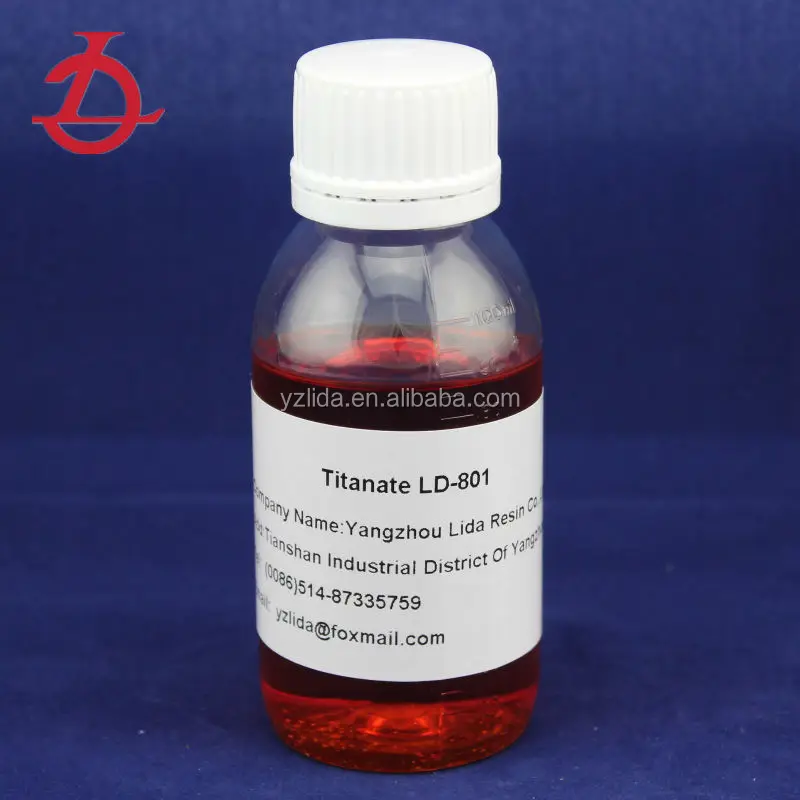
Acetylacetone Titanium LD-801
Corresponding foreign brands: TILCOM PI-2 of UK’s Tioxide UK Limited, P-12 of ICI
Main chemical composition:Bis (acetylacetone) titanate Diisopropyl. CAS NO.:17927-72-9
First, physical and chemical properties
Appearance: light yellow to light red transparent liquid
Titanium content: 9.0% Refractive index (ND): 1.481
Density ρ(25℃): 0.990 Viscosityη(25℃): 6MPa.S
It can be slightly soluble in normal organic solvents, acetone and mineral acid; partly soluble in water, easily soluble in isopropanol, benzene and toluene. When stored under a low temperature, sometimes there may be peacemeal or overall crystallizing-out.
Second, application
LD-801’s main ingredients is acetylacetone titanium in chelate form stable under room temperature, with the volatilization of solvents, acetylacetone titanium can have cross-linking reaction with active radicals (-OH, -COOH, -NH2, -CONH2, -SH) existed in the substrates and printing inks and interconnect materials to make bridging and increase the molecular weight, in order to improve heat resistance, chemical resistance, water resistance, dry and other properties. Meanwhile, with the help of bridging made by titanate, the resins and substrates can improve the adhesive force of printing inks and coatings finally.
Third, application area
After the reaction between phenolic antioxidant and titanium chelate, the color gets deeper, in order to avoid such problems, measures can be taken like, use aluminum chelate in white ink, transparent ink and light-colored paint.
LD-801 is a kind of strong chelating agent which can easily react with metal, so it’s better to pack it in plastic drums.
Fourth, product properties
1. Improve ink and coating’s adhesive force to the substrates(pretreated plastic, aluminum foil, metal, glass ).
2. Improve the scratch resistance, water resistance, solvent resistance and boiling resistance of inks and coatings.
3. Improve the drying speed and the surface brightness of printing inks and coatings, also can enhance pigments’ dispersion.
Fifth, usage
1. Usually substrates (plastic, aluminum foil, metal, glass) need pre-treatment, such as electric spark, discharging or chemical treatment, the treated substrates will produce –OH, –COOH and other active groups.
2. Resins like PA, NC, PU, PVB, CAB, CAP, EVA, PVB have such active groups as –OH, –COOH, –NH2.
3. The additive amount is 0.5-3% (resin solid content).
4. Adding time: it is recommend to add at the final process of printing ink and coating manufacturing under 40℃. The substrates must be pre-treated and the surface tension should be over 36-38 dyne.
5. It requires 1 minute’s drying at the temperature of 60℃ after printing inks’ printing process to make titanate react with the substrates.


New products from manufacturers at wholesale prices