Food Grade Additives CMC 98% E466 Carboxymethyl Cellulose Sodium
- Category: Food & Beverage >>>
- Supplier: Foodchem International Corporation
Share on (1600366298415):
Product Overview
Description
Product Description
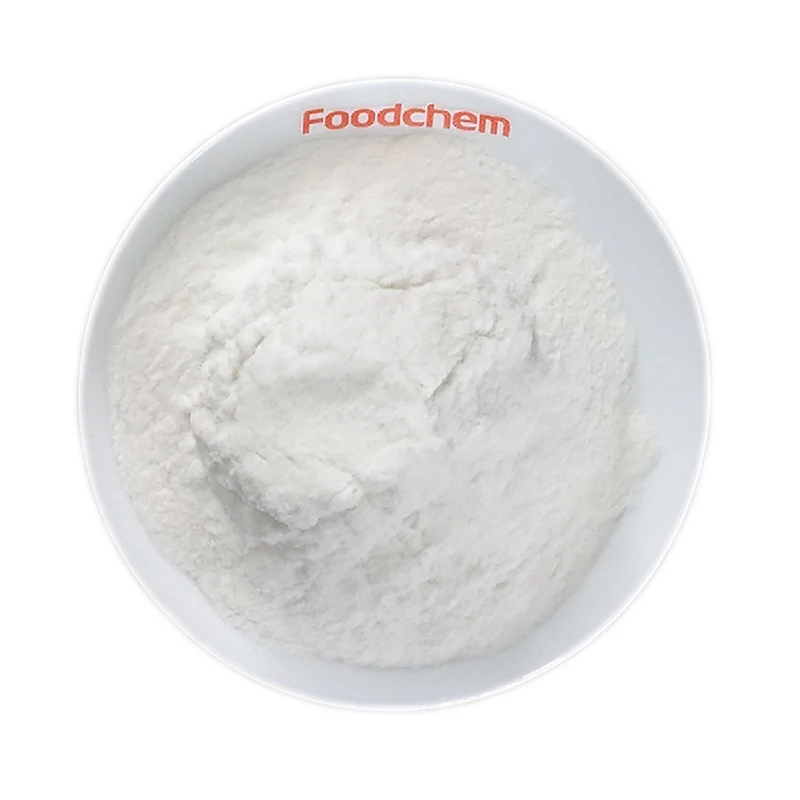
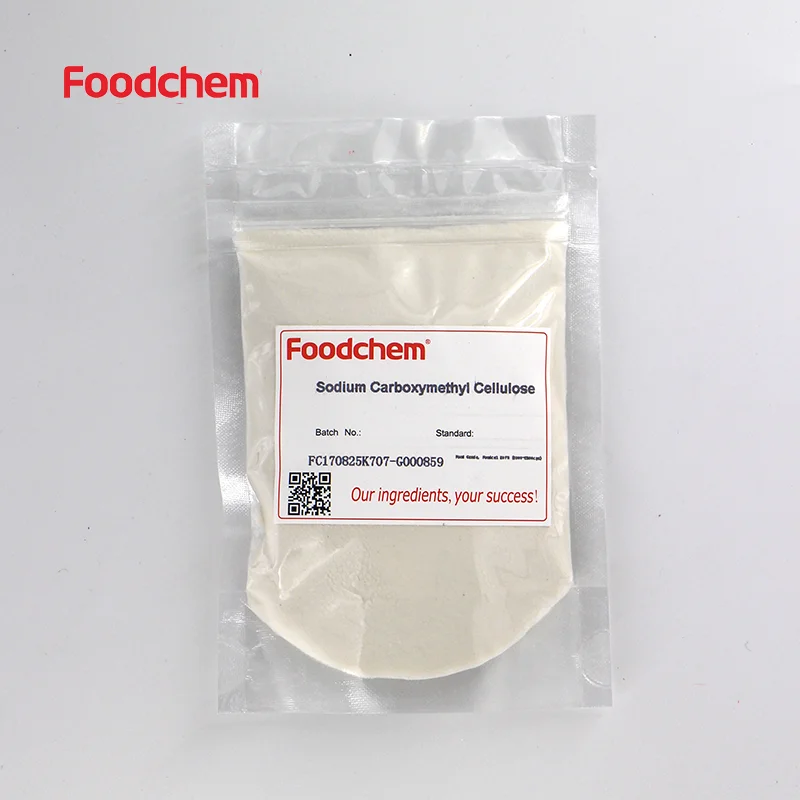
Product Name: Sodium carboxymethyl cellulose(CMC)
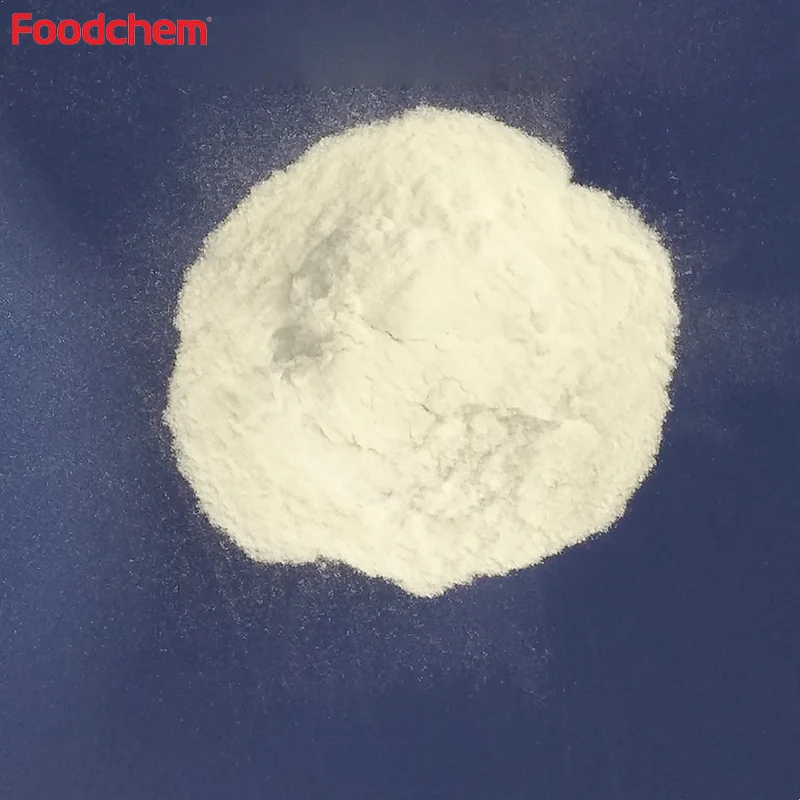
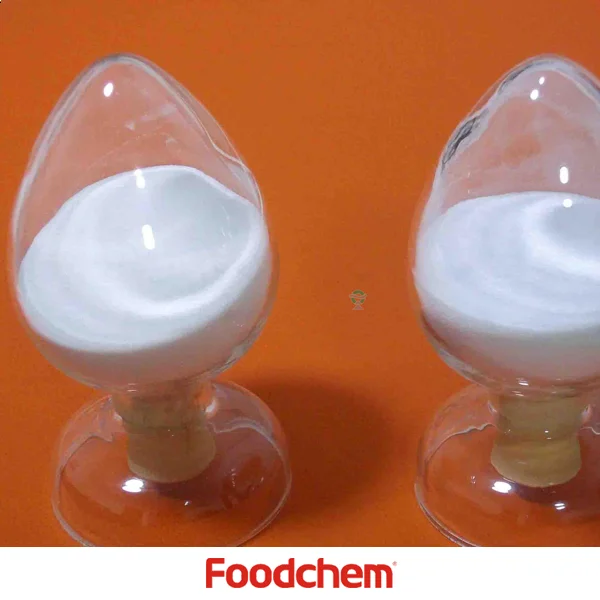
Appearance: White or cream color powder
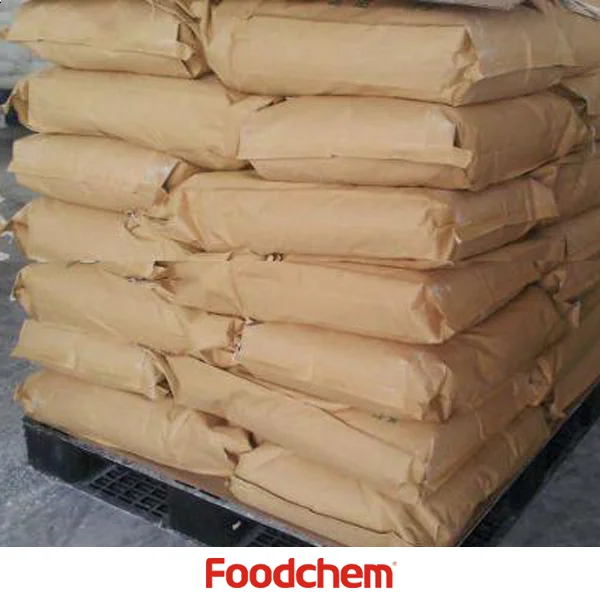
Packaging: 25 KG/BAG
Shelf life: 24 months
Storage: Kept in dry, cool, and shaded place with original packaging, avoid moisture, store at room temperature.
Packaging: 25 KG/BAG
Shelf life: 24 months
Storage: Kept in dry, cool, and shaded place with original packaging, avoid moisture, store at room temperature.


Applications:
Carboxy methyl cellulose (CMC) or cellulose gum is a cellulose derivative with carboxymethyl groups (-CH2-COOH) bound to some of the hydroxyl groups of the glucopyranose monomers that make up the cellulose backbone. It is often used as its sodium salt, sodium carboxymethyl cellulose.
CMC is used in food science as a viscosity modifier or thickener, and to stabilize emulsions in various products including ice cream. As a food additive, it has E number E466. It is also a constituent of many non-food products, such as K-Y Jelly, toothpaste, laxatives, water-based paints, detergents, textile sizing and various paper products. It is used primarily because it has high viscosity, is non-toxic, and is hypoallergenic. In laundry detergents it is used as a soil suspension polymer designed to deposit onto cotton and other cellulosic fabrics creating a negatively charged barrier to soils in the wash solution. CMC is used as a lubricant in non-volatile eye drops (artificial tears). Sometimes it is methyl cellulose (MC) which is used, but its non-polar methyl groups (-CH3) do not add any solubility or chemical reactivity to the base cellulose.
CMC is also used as a thickening agent. CMC is also used in the oil drilling industry as an ingredient of drilling mud, where it acts as a viscosity modifier and water retention agent. Poly-anionic cellulose or PAC is derived from cellulose and is also used in oilfield practice. CMC is definitely a Carboxylic Acid, where PAC is Ether. CMC and PAC, although they are manufactured from same raw materials (cellulose, amount and type of materials used leads different final products. The first and the leading difference between CMC and PAC exist in radicalization step. CarboxyMethyl Cellulose (CMC) is both chemically and physically distinguished from Polyanionic Cellulose.
CMC is also used in ice packs to form a eutectic mixture resulting in a lower freezing point and therefore more cooling capacity than ice.
Aqueous solutions CMC have also been used to disperse carbon nanotubes. It is thought that the long CMC molecules wrap around the nanotubes, allowing them to be dispersed in water.
EnzymologyCMC has also been used extensively to characterize enzyme activity from endoglucanases (part of cellulase complex). CMC is a highly specific substrate for endo-acting cellulases as its structure has been engineered to decrystallize cellulose and create amorphous sites that are ideal for endglucanase action. CMC is desirable because the catalysis product (glucose) is easily measured using a reducing sugar assay such as 3,5-Dinitrosalicylic acid. Using CMC in enzyme assays is especially important in regard to screening for cellulase enzymes that are needed for more efficient cellulosic ethanol conversion. However, CMC has also been misused in earlier work with cellulase enzymes as many had associated whole cellulase activity with CMC hydrolysis. As the mechanism of cellulose depolymerization has become more understood, it should be noted that exo-cellulases are dominant in the degradation of crystalline (e.g. Avicel) and not soluble (e.g. CMC) cellulose.
CMC is used in food science as a viscosity modifier or thickener, and to stabilize emulsions in various products including ice cream. As a food additive, it has E number E466. It is also a constituent of many non-food products, such as K-Y Jelly, toothpaste, laxatives, water-based paints, detergents, textile sizing and various paper products. It is used primarily because it has high viscosity, is non-toxic, and is hypoallergenic. In laundry detergents it is used as a soil suspension polymer designed to deposit onto cotton and other cellulosic fabrics creating a negatively charged barrier to soils in the wash solution. CMC is used as a lubricant in non-volatile eye drops (artificial tears). Sometimes it is methyl cellulose (MC) which is used, but its non-polar methyl groups (-CH3) do not add any solubility or chemical reactivity to the base cellulose.
CMC is also used as a thickening agent. CMC is also used in the oil drilling industry as an ingredient of drilling mud, where it acts as a viscosity modifier and water retention agent. Poly-anionic cellulose or PAC is derived from cellulose and is also used in oilfield practice. CMC is definitely a Carboxylic Acid, where PAC is Ether. CMC and PAC, although they are manufactured from same raw materials (cellulose, amount and type of materials used leads different final products. The first and the leading difference between CMC and PAC exist in radicalization step. CarboxyMethyl Cellulose (CMC) is both chemically and physically distinguished from Polyanionic Cellulose.
CMC is also used in ice packs to form a eutectic mixture resulting in a lower freezing point and therefore more cooling capacity than ice.
Aqueous solutions CMC have also been used to disperse carbon nanotubes. It is thought that the long CMC molecules wrap around the nanotubes, allowing them to be dispersed in water.
EnzymologyCMC has also been used extensively to characterize enzyme activity from endoglucanases (part of cellulase complex). CMC is a highly specific substrate for endo-acting cellulases as its structure has been engineered to decrystallize cellulose and create amorphous sites that are ideal for endglucanase action. CMC is desirable because the catalysis product (glucose) is easily measured using a reducing sugar assay such as 3,5-Dinitrosalicylic acid. Using CMC in enzyme assays is especially important in regard to screening for cellulase enzymes that are needed for more efficient cellulosic ethanol conversion. However, CMC has also been misused in earlier work with cellulase enzymes as many had associated whole cellulase activity with CMC hydrolysis. As the mechanism of cellulose depolymerization has become more understood, it should be noted that exo-cellulases are dominant in the degradation of crystalline (e.g. Avicel) and not soluble (e.g. CMC) cellulose.
Specification
Items | Standards | ||||
Appearance | White to cream colored powder | ||||
Particle Size | Min 95% pass 80 mesh | ||||
Purity(dry basis) | 99.5% Min | ||||
Viscosity (1% solution, dry basis, 25℃) | 1500- 2000 mPa.s | ||||
Degree of substitution | 0.6- 0.9 | ||||
pH (1% solution) | 6.0- 8.5 | ||||
Loss on drying | 10% Max | ||||
Lead | 3 mg/kg Max | ||||
Arsenic | 2 mg/kg Max | ||||
Mercury | 1 mg/kg Max | ||||
Cadmium | 1 mg/kg Max | ||||
Total heavy metals (as Pb) | 10 mg/kg Max | ||||
Yeasts and moulds | 100 cfu/g Max | ||||
Total plate count | 1000 cfu/g | ||||
E.coli | Netative in 5 g | ||||
Salmonella spp. | Netative in 10g | ||||
Recommend Products


Packing & Delivery
Packaging: 25 kg/bag or according to client request
Delivery Detail: 2 weeks after confirm order.Some of the products can be supplied within 7 days on the strength of EDC warehouse.
Delivery Detail: 2 weeks after confirm order.Some of the products can be supplied within 7 days on the strength of EDC warehouse.


Our Advantages
1. TOP 3 Food enterprises in China with over 15+ years of experience.
2. Arrange the orders and shipping with customer requests in time, according to the different countries export policy provide complete customs clearance documents.
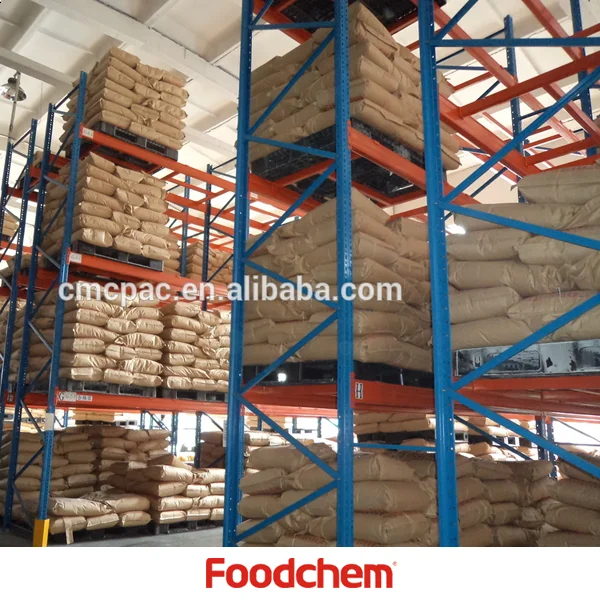
3. 1000 m2 owned office and 3000 m2 warehouse which assure you of work efficiency and storage.
4. Variety of products: more than 500 products with competitive price and we can in charge of all if our products have quality problems.
5. Provide a price trend, ensure the clients can know about marketing information in time.
2. Arrange the orders and shipping with customer requests in time, according to the different countries export policy provide complete customs clearance documents.
3. 1000 m2 owned office and 3000 m2 warehouse which assure you of work efficiency and storage.
4. Variety of products: more than 500 products with competitive price and we can in charge of all if our products have quality problems.
5. Provide a price trend, ensure the clients can know about marketing information in time.

Company Profile
Founded in 2006, Foodchem is now a Chinese leading company in innovation, marketing, and distribution of food additives and ingredients.
With over 500 products and a world-class supplier base, Foodchem offers one-stop-shop solutions to more than 5,000 customers in global food & beverage, cosmetics, animal nutrition and chemical industry which covers 120 countries and regions in the world.
With over 500 products and a world-class supplier base, Foodchem offers one-stop-shop solutions to more than 5,000 customers in global food & beverage, cosmetics, animal nutrition and chemical industry which covers 120 countries and regions in the world.


FAQ
1. What's your payment terms?
T/T or L/C.
2. What's your delivery time?
Usually we will arrange the shipment in 7 -15 days.
3. How about the packing?
Usually we provide the packing as 25 kg / bag or carton. Of course, if you have special requirements on them, we will according to you.
4. How about the validity of the products?
According to the products you ordered.
5. What documents you provide?
Usually, we provide Commercial Invoice, Packing List, Bill of loading, COA , Health certificate and Origin certificate. If your markets have any special requirements, let us know.
6. What is loading port?
Usually is Shanghai,Qingdao or Tianjin.
T/T or L/C.
2. What's your delivery time?
Usually we will arrange the shipment in 7 -15 days.
3. How about the packing?
Usually we provide the packing as 25 kg / bag or carton. Of course, if you have special requirements on them, we will according to you.
4. How about the validity of the products?
According to the products you ordered.
5. What documents you provide?
Usually, we provide Commercial Invoice, Packing List, Bill of loading, COA , Health certificate and Origin certificate. If your markets have any special requirements, let us know.
6. What is loading port?
Usually is Shanghai,Qingdao or Tianjin.

We Recommend


New Arrivals
New products from manufacturers at wholesale prices