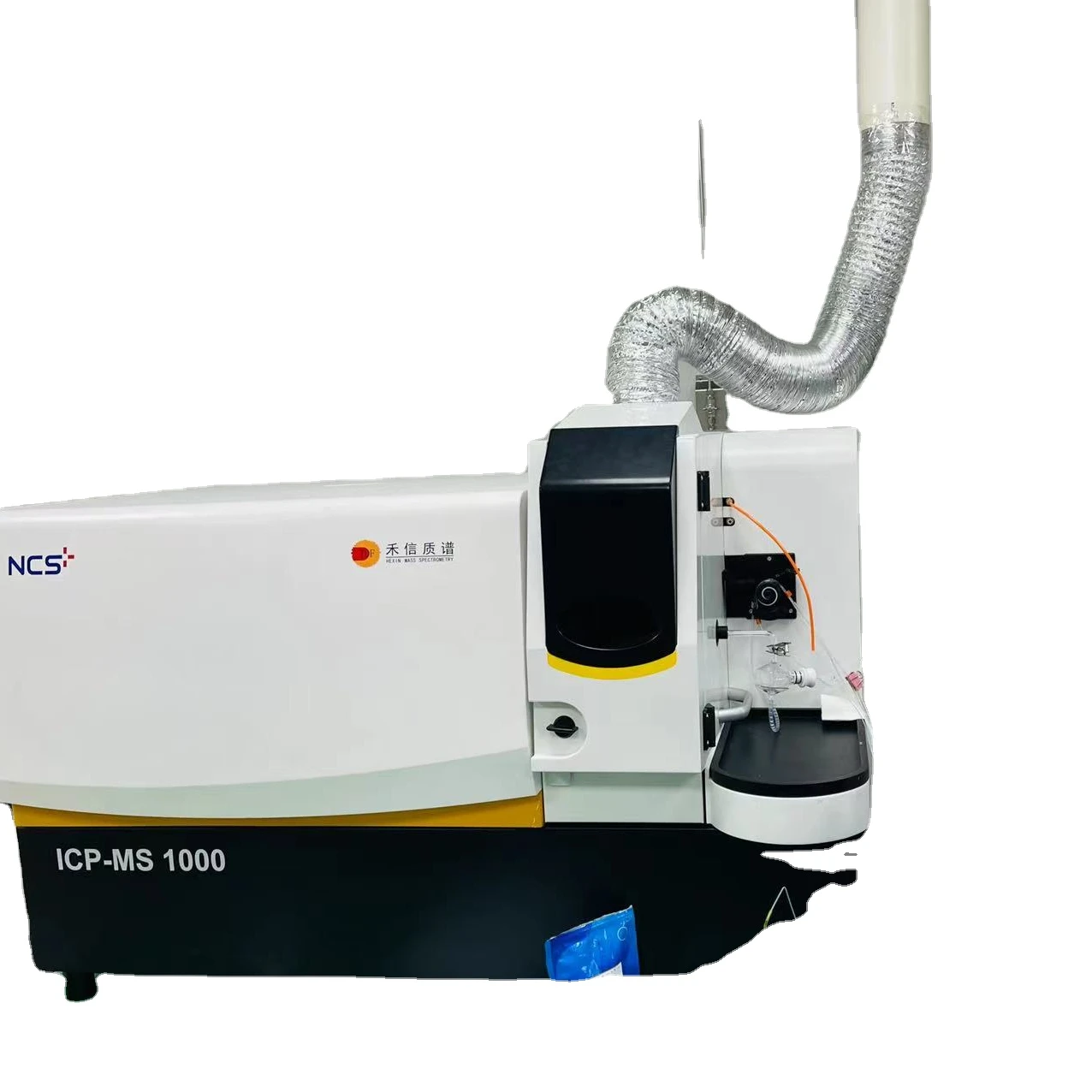
ICP MS 1000 inductively coupled plasma mass spectrometer
- Category: >>>
- Supplier: Shenzhen GHF Technology Co. Limited
Share on (1600527778826):
Product Overview
Description
Inductively coupled plasma mass spectrometer
Technical parameter
1, Technical requirements
The instrument shall be applicable to the elemental analysis of various samples in different application fields and meet the analysis requirements of metals, environment, food, geology, biological samples, chemical materials, etc.
1. Instrument working environment
1.1 working environment temperature: 15 ~ 30 ℃ (temperature change < 2 ℃ / h)
1.2 humidity of working environment: (20 ~ 80)% R.H. (no condensation)
2. Instrument hardware parameters
The invested products must be high-end models of the same type of products of the manufacturer.
2.1 sample injection system
2.1.1 atomizer: provide high-efficiency concentric atomizer to ensure high sensitivity and good salt resistance of the instrument. PFA atomizer with high salt resistance and HF resistance can be provided to meet the needs of users for different sample pretreatment, which is convenient for users to directly analyze the samples digested by HF without acid rush without damaging the atomizer;
2.1.2 atomization chamber: provide an efficient and stable small volume swirl type atomization chamber (Scott dual channel quartz atomization chamber can be selected), which can reduce the introduction of matrix solvent, inhibit the yield of Polyatomic Ion interferents, eliminate the influence of temperature fluctuation on stability, and ensure the good stability of the instrument. It can be equipped with semiconductor refrigeration fog chamber system with adjustable temperature;
2.1.3 torch tube: it is equipped with quartz torch tube which can be disassembled flexibly, and the gas path quick plug design is adopted to facilitate cleaning and maintenance;
2.1.4 peristaltic pump: equipped with a four channel peristaltic pump system with adjustable pump speed to speed up the introduction and flushing of samples, make the instrument have higher analysis efficiency and ensure stronger injection expansion ability; The pump body shall be made of inert material to prevent the corrosion of the roller caused by acid dripping.
2.2 plasma source
2.2.1 solid state light source technology: in order to obtain higher plasma central channel temperature and improve the ionization efficiency of the sample, the instrument adopts an all solid state RF generator driven by 27.12 MHz working frequency. The power is continuously adjustable in the range of 600-2000w, and the adjustment accuracy is 1W; One button ignition and flameout operation; (please provide software screenshot of power range)
2.2.2 the gas path of the instrument host is controlled by high-precision mass flowmeter (including the gas path of plasma part and the gas path of collision reaction tank part), and the flow is continuously adjustable:
Cooling gas: 0.00l/min ~ 20.00l/min, accuracy: 0.01l/min;
Auxiliary gas: 0.00l/min ~ 2.00l/min, accuracy: 0.01l/min;
Carrier gas precision: 0.00l/min ~ 0.00l/min;
Collision gas: 0.00ml/min ~ 10.00ml/min, accuracy: 0.01ml/min.
2.2.3 plasma position control: the three-dimensional (x, y, z direction) position is accurately controlled by computer, with positioning accuracy of 0.01mm and good reproducibility. All adjustment parameters are automatically stored in the analysis method by the workstation software.
2.3 vacuum system
2.3.1 the mechanical pump system is simple and easy to maintain; The pumping speed of mechanical pump reaches 40m3 / h to ensure the reliable operation of vacuum system; Three independent vacuum gauges are used to accurately and real-time detect the vacuum degree at different positions;
2.3.2 the design of three-stage vacuum system adopts two turbomolecular pumps with high pumping speed (260L / s), and the vacuum degree can meet the analysis requirements within 15 minutes at the fastest.
2.4 interface and ion transmission system
2.4.1 the double cone interface design is convenient for maintenance. The maintenance of the two cones can be carried out without unloading vacuum. The cleaning operation is simple and convenient, and the matrix has good tolerance;
2.4.2 the design of double off-axis ion transmission channel can completely separate photons and non ionized neutral particles, realize ultra-low noise background and ensure the best analysis signal-to-noise ratio of the main quadrupole mass analyzer; Maintenance free ion transmission deflection lens, collision reaction cell and quadrupole mass analyzer;
2.4.3 equipped with collision reaction cell, which can effectively remove polyatomic interference ions (such as aro +) and enter the main quadrupole mass analyzer to ensure the best interference removal effect under high enough sensitivity.
2.5 quadrupole quality analysis and detection system
2.5.1 quality range: 2-255u; Stability of mass axis: ≤± 0.05u/8h; Mass resolution ≤ 0.8u;
2.5.2 the quadrupole power supply adopts frequency matching tuning without traditional mechanical capacitance tuning and adjustment of mechanical capacitance, so as to ensure the long-term automatic and stable operation of the quadrupole, safe operation and reduce the use and maintenance cost; Matching frequency ≥ 2.1mhz;
2.5.3 quadrupole power supply with temperature control function to ensure long-term stability of performance; The temperature can be seen in real time to judge whether it reaches the stable operation state, and the temperature fluctuation shall not exceed 0.1 ℃; (please provide software screenshot of temperature fluctuation range)
2.5.4 the dual-mode detection electronic multiplier with ≥ 9 orders of magnitude can automatically switch between analog and pulse modes without manual PA calibration.
2.6 others
2.6.1 the software monitors the instrument power supply, quadrupole power supply, vacuum system, plasma state and other system states in real time, and actively prompts in case of errors;
2.6.2 support the equipment of liquid chromatography, and the software has a technical support module: it can be conveniently combined with liquid chromatography for elemental speciation analysis;
2.6.3 it can support laser denudation solid direct injection system: it can directly analyze solid samples without complex pretreatment.
3. Instrument performance requirements
3.1 sensitivity in standard mode:
3.1.1 low mass number (be): ≥ 15 MCPs / ppm
mass number in 3.1.2: ≥ 200 MCPs / ppm (please provide the report issued by the testing department at or above the provincial / ministerial level)
3.1.3 high quality number (BI): ≥ 120 MCPs / ppm (please provide the report issued by the testing department at or above the provincial / ministerial level)
3.2 instrument detection limit
3.2.1 light weight element (be): ≤ 5ppt
3.2.2 medium mass number element (in): ≤ 0.5ppt
3.2.3 high quality number element (BI): ≤ 1ppt
3.3 oxide ions (Bao + / Ba +)≤ 3%; Double charged particles (Ba + + / Ba +)≤ 3%;
3.4 short term stability (RSD): ≤ 3%; Long term stability (RSD): ≤ 5%;
3.5 dynamic range: ≥ 9 orders of magnitude;
3.6 background noise: ≤ 1cps (220amu).
4. Computer and software parameters
4.1.1 operating system: win10 and other multi task and multi-user system software; Brand commercial computers and printers. Computer configuration: not less than i5 processor, more than or equal to 4G memory, 20 inch display; Printer configuration: A4 format, multi-function printer;
4.1.2 working software of full-automatic analysis function (automatic ignition, automatic error prompt, customized user report, automatic startup and shutdown of instrument, torch position adjustment, plasma parameters, ion lens, voltage optimization, switching between standard counting mode and collision pool working mode, etc.);
4.1.3 the software integrates automatic sampler control and supports the operation of automatic sampler with more than 250 holes


We Recommend


New Arrivals
New products from manufacturers at wholesale prices