Product Overview
Description
Product Description
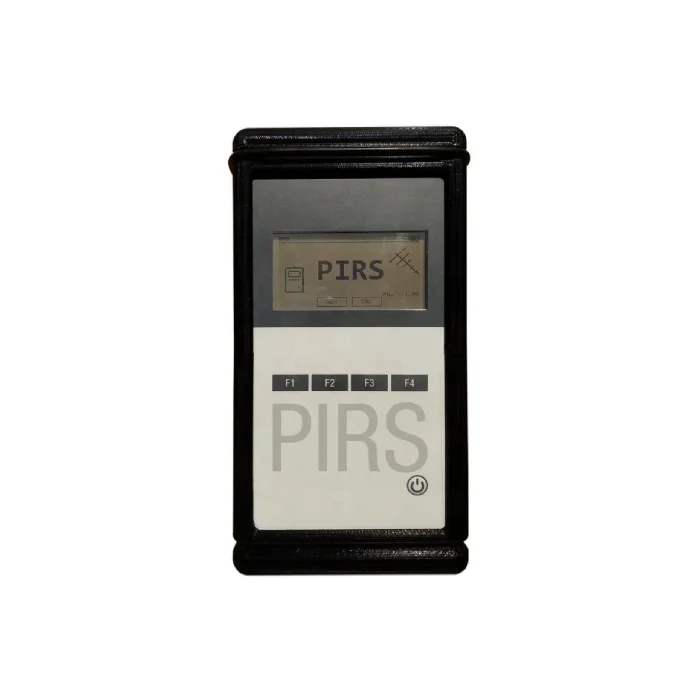
The PIRS is an innovative system for generating amplified and feedback CW signals.
It can be used in radiated immunity tests (precompliance according to IEC 61000-4-3) and to generate electric field intensity signals from 1 V/m to 30 V/m in shielded environments, TEM and GTEM cells, anechoic or semi anechoic chambers.
Thanks to its battery power supply and its 8-hour autonomy (in generation and continuous amplification), it can be used with extreme ease in any environment, especially in "Situ" to perform radiated immunity tests on large systems and devices which are difficult to transport inside semi/anechoic chambers. .
It can be used in radiated immunity tests (precompliance according to IEC 61000-4-3) and to generate electric field intensity signals from 1 V/m to 30 V/m in shielded environments, TEM and GTEM cells, anechoic or semi anechoic chambers.
Thanks to its battery power supply and its 8-hour autonomy (in generation and continuous amplification), it can be used with extreme ease in any environment, especially in "Situ" to perform radiated immunity tests on large systems and devices which are difficult to transport inside semi/anechoic chambers. .

After programming a list of frequencies through the PC software, the PIRS (thanks to its feedback circuit) can generate every single tone in CW, vary its amplitude up to the achievement of the target set by the operator (in dBm if a power meter is used or in V/m if a broadband electromagnetic field meter is used) to compile the table that will ultimately be saved within its non-volatile memory.
This procedure called calibration or table compilation is carried out using a RF power meter or a broadband electromagnetic field meter.
This procedure called calibration or table compilation is carried out using a RF power meter or a broadband electromagnetic field meter.
Application field
PIRS + Antenna
The possibility of storing the different lists of frequencies in the internal memory of the PIRS during the field calibration, as well as the possibility of having the power signal at the "N"connector output allows the operator to take advantage of all the power generated and directly available to the transmitting antenna connector, without attenuations due to the coaxial cable which sometimes can even exceed 6 meters in length (height 4 meters of mast + section to reach the amplifier room)
PIRS + TEM
Also in this case the "almost" total absence of the coaxial cable gives the system the possibility of fully using the power available at the PIRS "N" connector.
PIRS + GTEM
The PIRS can be connected directly to the connector of a GTEM cell.
Also in this case the "almost" total absence of the coaxial cable gives the system the possibility of fully using the power available at the PIRS "N" connector.
Also in this case the "almost" total absence of the coaxial cable gives the system the possibility of fully using the power available at the PIRS "N" connector.
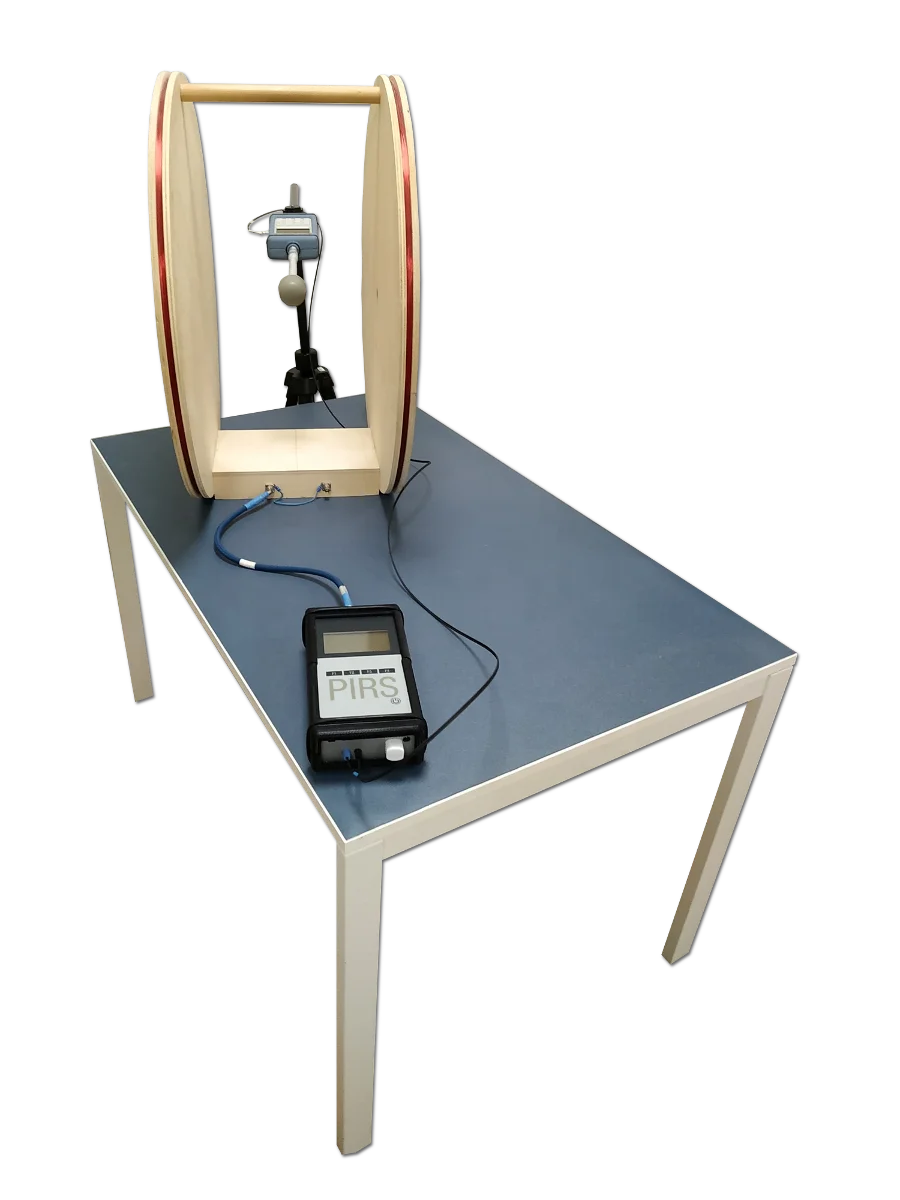
PIRS + Helmholtz
By means of a Helmholtz coil it is instead possible to carry out the test setup for the broadband isotropic sensors for measuring the magnetic part of the electromagnetic field.

The PIRS system can generate CW signals from 10 kHz to 3 GHz, in amplitude variations from a minimum of 3 dBm (0.002 watt) up to a maximum of 36 dBm (4 watts)
The graph below shows all the Pout min/max output power variation values in the operating range of the system.
The graph below shows all the Pout min/max output power variation values in the operating range of the system.
Measurement
The two operating modes allow the PIRS to create one or more tables to be saved in memory, to then perform the test without feedback circuit.
In this way the operator can have several tables (up to 128), each obtained at different intensity levels in V/m and/or with multiple frequency ranges depending on the test requirements.
The two methods differ in the setup and measuring instruments to be used for feedback.
In this way the operator can have several tables (up to 128), each obtained at different intensity levels in V/m and/or with multiple frequency ranges depending on the test requirements.
The two methods differ in the setup and measuring instruments to be used for feedback.

Calibration with broadband Field Meter
This method is mainly used to create the electromagnetic quiet zone in which the device under test (DUT) must be inserted to then be subjected to the radiated immunity test.
The PIRS can perform this test in precompliance mode according to IEC 61000-4-3 standard as it is not able to generate modulated signals in AM but only in CW mode (sine wave).
The PIRS can perform this test in precompliance mode according to IEC 61000-4-3 standard as it is not able to generate modulated signals in AM but only in CW mode (sine wave).
In the test setup, the PIRS must be positioned on the first non-magnetic and non-metallic tripod (NMR-01 type) to limit the
undesired reflections of the transmitted electromagnetic wave as much as possible and then connected with the coaxial cable to the transmitting antenna. On the second tripod and at a predetermined distance the broadband field meter must be installed with an appropriate isotropic sensor.
undesired reflections of the transmitted electromagnetic wave as much as possible and then connected with the coaxial cable to the transmitting antenna. On the second tripod and at a predetermined distance the broadband field meter must be installed with an appropriate isotropic sensor.
The feedback circuit is made by the fiber optic connection between the broadband field meter output and the PIRS optical input.
The antenna and the broadband isotropic sensor must cover the same frequency range as the list entered in the PIRS.
The antenna and the broadband isotropic sensor must cover the same frequency range as the list entered in the PIRS.

At the end of calibration, the entire list of frequencies with the relevant signal amplitude values will be complete and immediately saved automatically to be used in the final radiated immunity test.

Calibration with the radio frequency power meter
Semi-Automatic PET Bottle Blowing Machine Bottle Making Machine Bottle Moulding Machine
PET Bottle Making Machine is suitable for producing PET plastic containers and bottles in all shapes.
PET Bottle Making Machine is suitable for producing PET plastic containers and bottles in all shapes.
The PIRS will automatically fill in the "Power Meter" column with the dBm values transmitted from the power meter to the "N" connector to satisfy the test set point at 3 V/m. In practice, however, the propagation of the electromagnetic wave in the far field must be considered. The software (when filling in the table) will warn the user if this condition is met.

Tecnichal Specification

Company Introduction
MPB provides solutions for EMF / EMC / RF testing applications, through R&D, design, production, sale and rental of high
technology electronic devices, training courses and consulting. In the field since 1998, MPB has acquired a know-how to be spent on any type of need in the field of reference.
Our R&D department works every day to develop new ideas, continously pursuing new solutions for the telecommunications world and for signal measurements in EMC, EMI, EMF.
technology electronic devices, training courses and consulting. In the field since 1998, MPB has acquired a know-how to be spent on any type of need in the field of reference.
Our R&D department works every day to develop new ideas, continously pursuing new solutions for the telecommunications world and for signal measurements in EMC, EMI, EMF.
The MPB instrumentation is designed, manufactured and calibrated at our laboratories, equipped with ISO 14025 calibrated test equipment as well as suitable test and calibration environments such as anechoic chamber, TEM and GTEM cells, Helmoltz coils overing the range DC-40 GHz
The choice of a customer-oriented business model and ever-changing quality has helped make our company innovative and reliable over the years.
The choice of a customer-oriented business model and ever-changing quality has helped make our company innovative and reliable over the years.


Our Services
Calibration standard and accredited
Calibration is the act of checking the functioning an electronic instrument to verify its features according to the manufacturer's original technical specifications. To do so we make a comparison of measures with a reference instrument defined sample. In order to do that we compare measures obtained with a sample instrument. If during the calibration phase the equipment does not show its original specifics, then it is necessary to repair it. This phase is called
calibration. The certificate is the statement that the instrument is compliant with the manufacturer's specifics.
Repair
MPB can repair a wide range of electronic equipment: Radio frequency, Microwave and testing systems EMC.
All our electronic equipment's repairs are performed with new and original spare parts. After the repair the measuring equipment is subject at least to 24 hours test cycles. The documentation available for our laboratory and the know-how gained in many years of activity, give our specialized technicians the opportunity to perform repairs also with obsolete instrumentation, where finding spare parts is very difficult.
Design
MPB has consolidated through the years his know-how in the area of electromagnetic fields, being therefore able to develop a R & D department. In order to reach the new goal, the company has invested in a lab equipment and in a highly quantified staff. Our lab is fully equipped with high quality precision instruments, such as the TEM cell, the GTEM cell and an anechoic chamber, which allows to develop and to test solutions up to 40 GHz.
calibration. The certificate is the statement that the instrument is compliant with the manufacturer's specifics.
Repair
MPB can repair a wide range of electronic equipment: Radio frequency, Microwave and testing systems EMC.
All our electronic equipment's repairs are performed with new and original spare parts. After the repair the measuring equipment is subject at least to 24 hours test cycles. The documentation available for our laboratory and the know-how gained in many years of activity, give our specialized technicians the opportunity to perform repairs also with obsolete instrumentation, where finding spare parts is very difficult.
Design
MPB has consolidated through the years his know-how in the area of electromagnetic fields, being therefore able to develop a R & D department. In order to reach the new goal, the company has invested in a lab equipment and in a highly quantified staff. Our lab is fully equipped with high quality precision instruments, such as the TEM cell, the GTEM cell and an anechoic chamber, which allows to develop and to test solutions up to 40 GHz.
We Recommend

New Arrivals
New products from manufacturers at wholesale prices