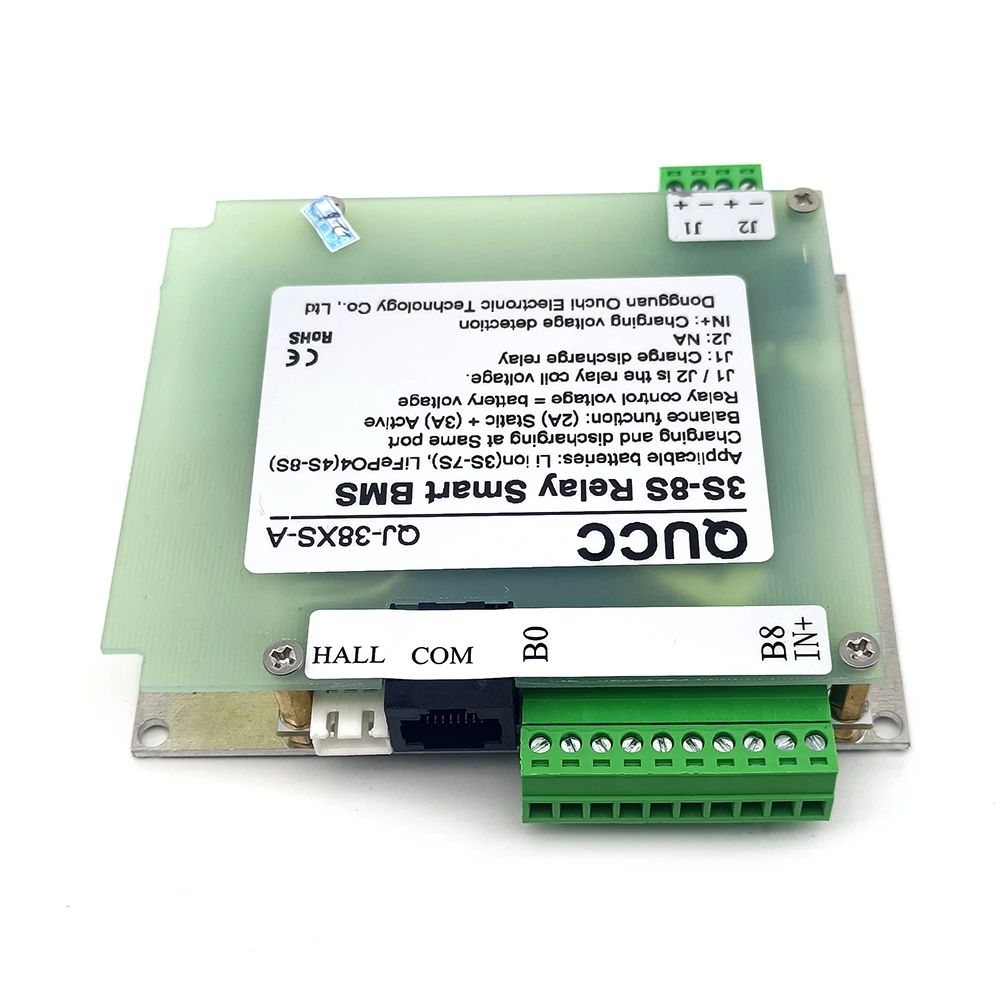
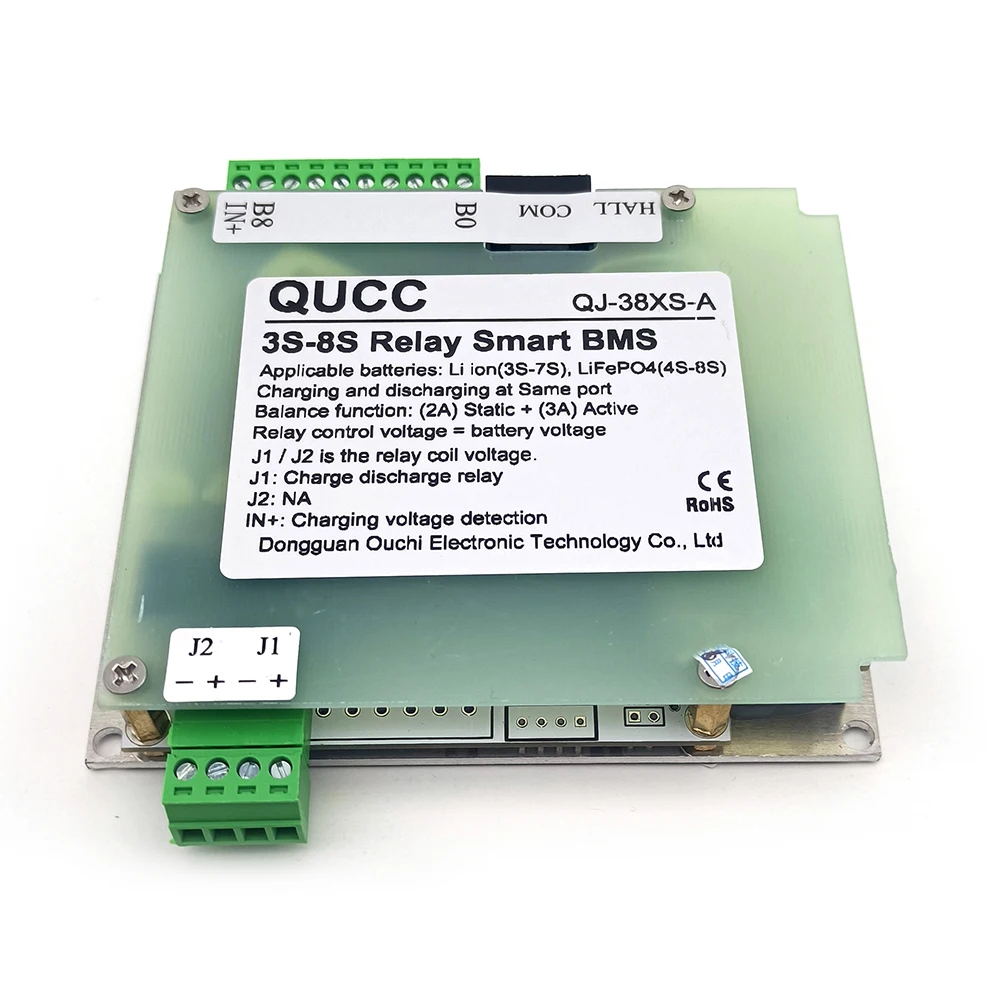
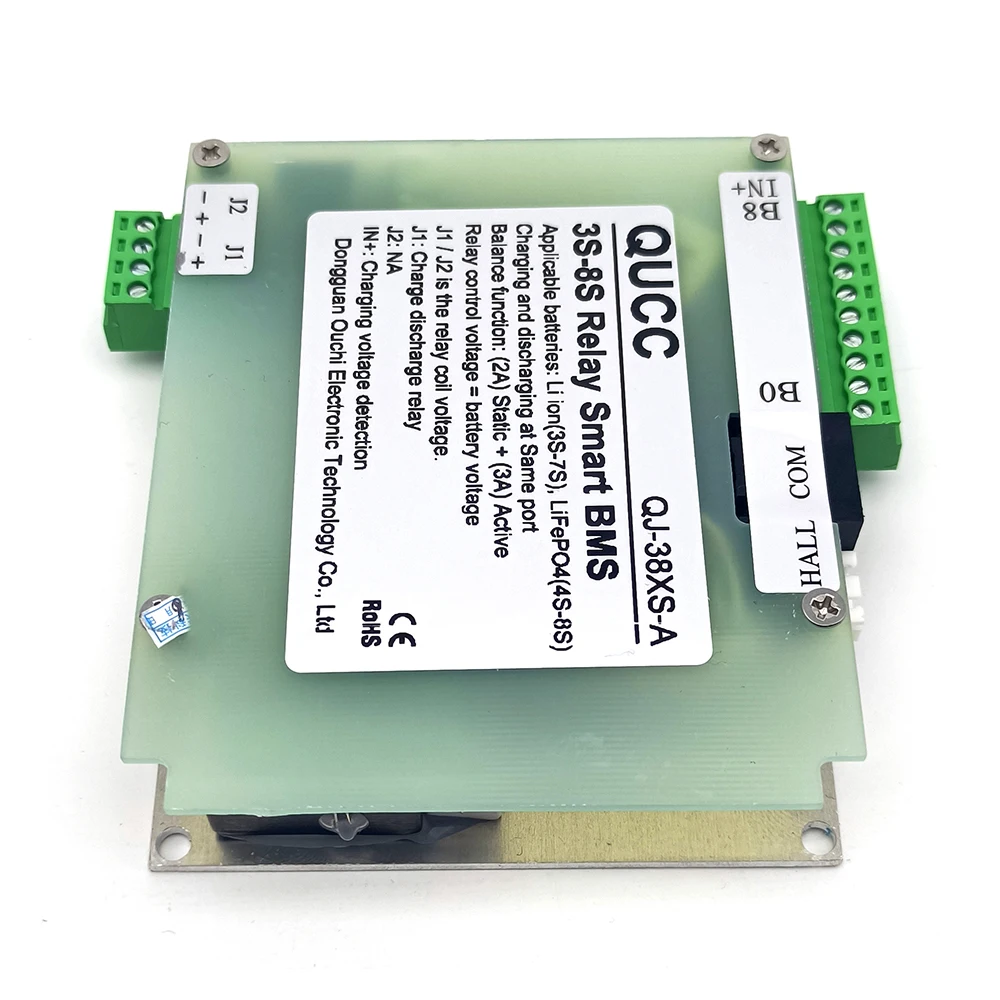
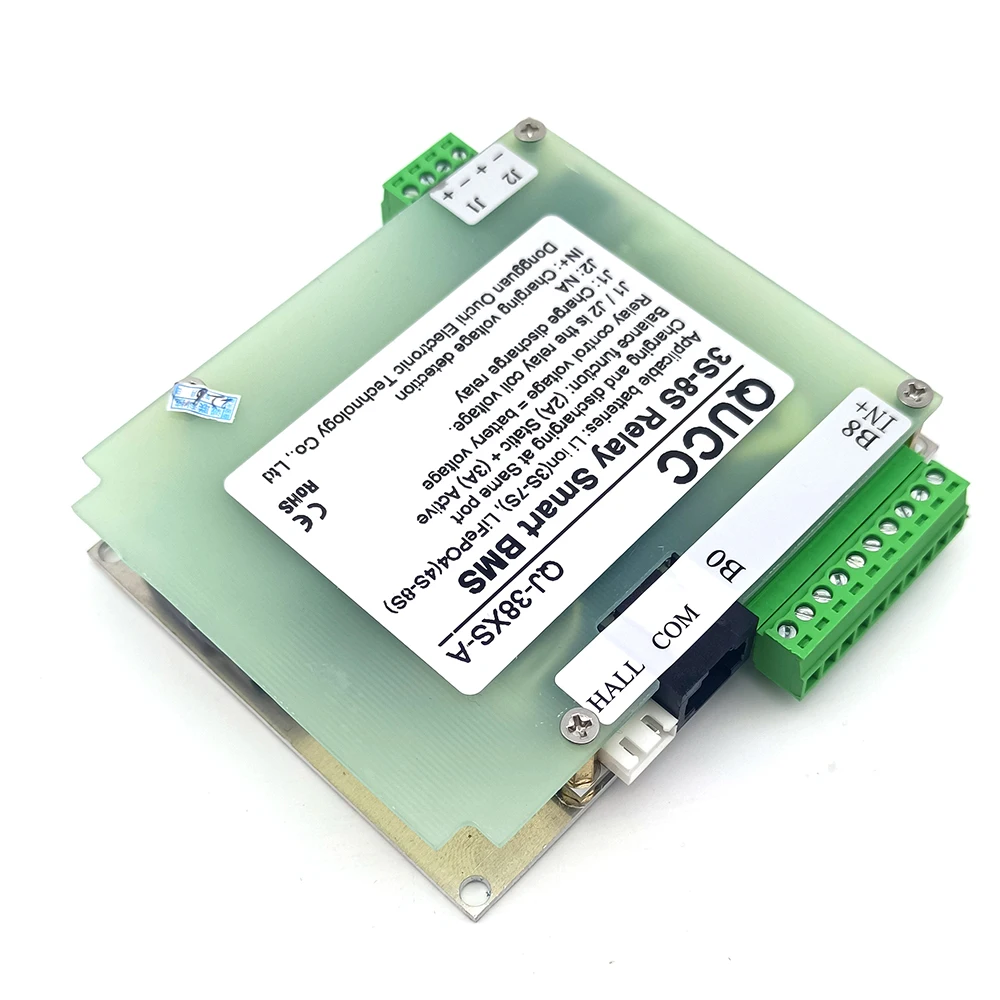
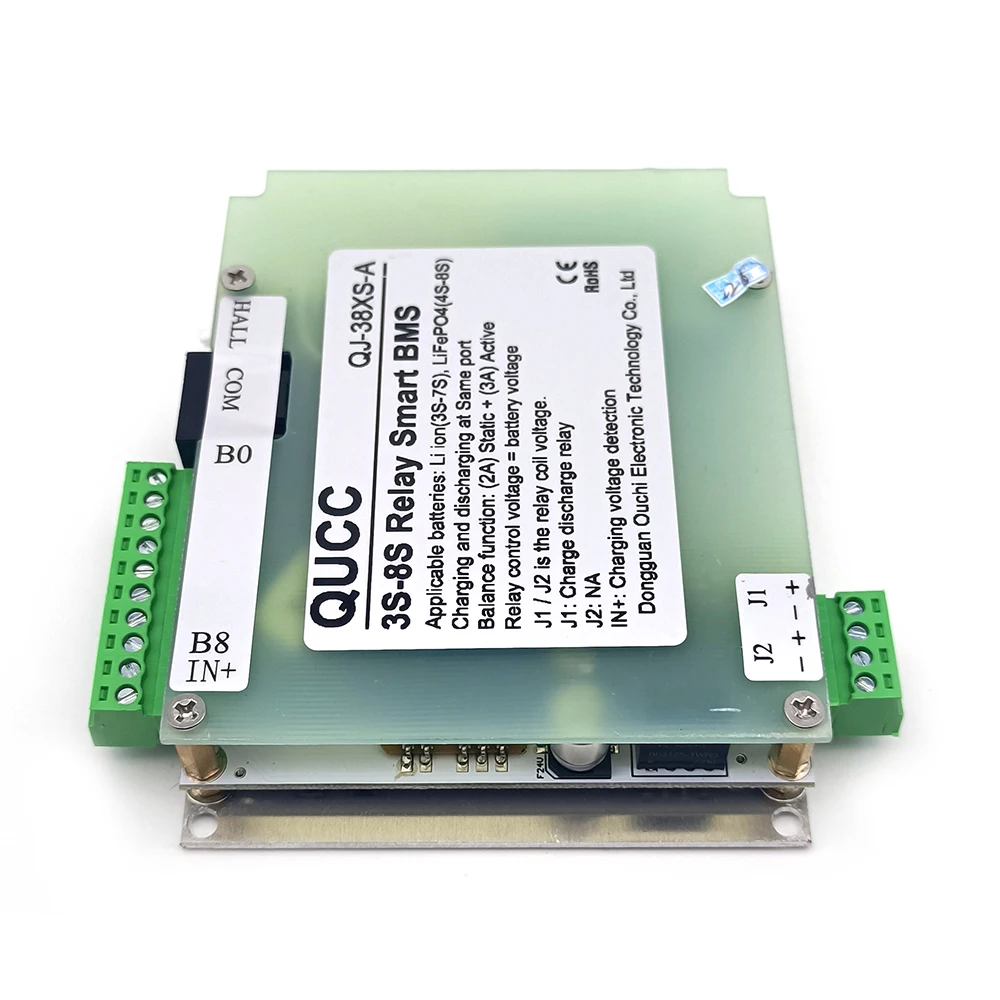
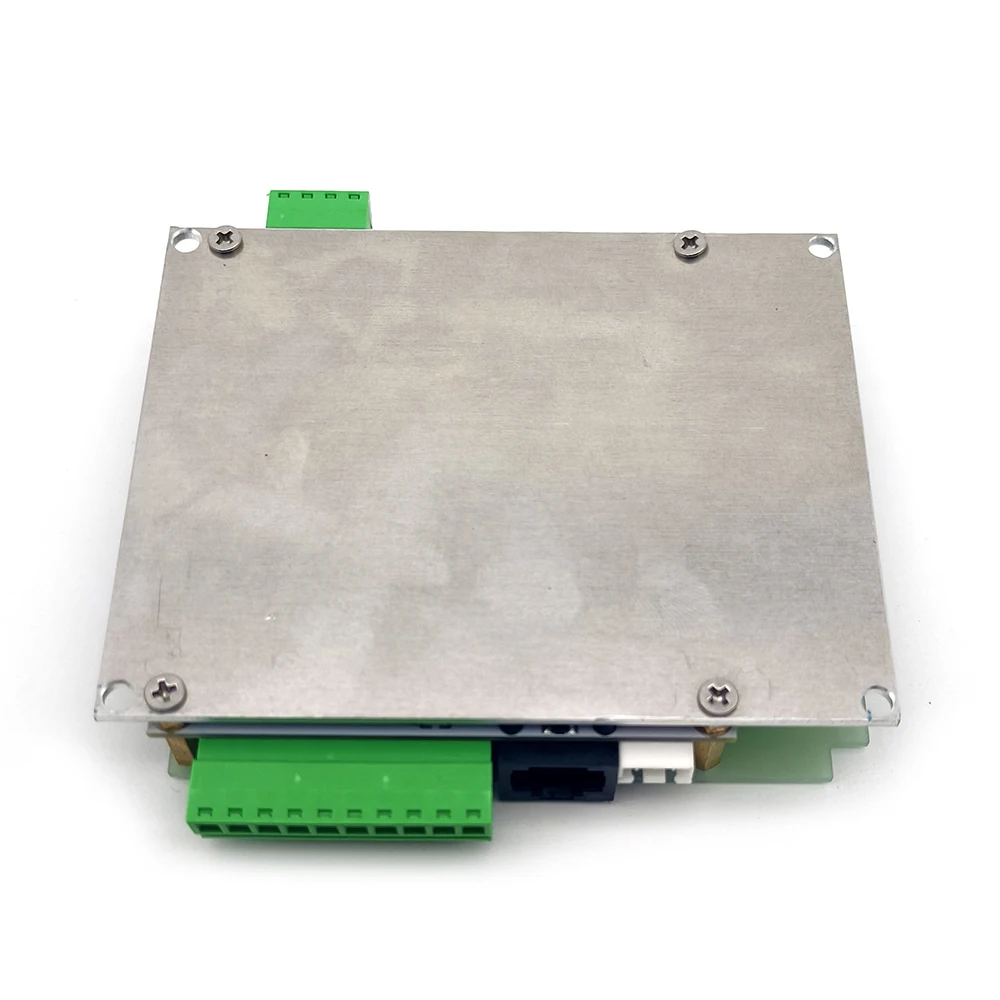
Qucc 3S~8S A 12V 24V Active balancing 5A Same port High voltage DC relay 500A Smart BMS Li ion Lifepo4 Battery SOC coulometer
- Category: >>>
- Supplier: Dongguan Ouchi Electronic Technology Co. Ltd.
Share on (1600573380922):
Product Overview
Description
Product category
Type | Functional differences |
3S~8S-A BMS | ·1-way relay control (charging, discharging). ·Li-ion 3.7V(3S-7S)/Lifepo4 3.2V(4S-8S). |
3S~8S-B BMS | ·2-way relay control (charging, discharging). ·Li-ion 3.7V(3S-7S)/Lifepo4 3.2V(4S-8S). |
10S~16S-A BMS | ·1-way relay control (charging, discharging). ·Li-ion 3.7V(10S-15S)/Lifepo4 3.2V(12S-16S). ·Relay control voltage (DCDC)*1 |
10S~16S-B BMS | ·2-way relay control (charging, discharging). ·Li-ion 3.7V(10S-15S)/Lifepo4 3.2V(12S-16S). ·Relay control voltage (DCDC)*2 |
Notes
The control modes of a and B are different, and the built-in programs are different. Do not change the use mode at will. Incorrect use will damage the BMS.
Product Paramenters
Parameters | Indicators | ||
Current switch conductor | High voltage DC relay | ||
Support battery | Li-ion、Lifepo4 | ||
Discharge current | 500A According to relay selection | ||
peak current | 2000A According to relay selection | ||
Charging current | 500A According to relay selection | ||
Internal resistance | 10mΩ | ||
Input / output mode | Same port | ||
BMS switch | Display control | ||
Working power consumption | 50mA | ||
Sleep power consumption | 30μA | ||
Balance current | Active balance 3a, static balance 2A | ||
Communication function | RJ45 display communication | ||
Single cell voltage | Acquisition range | 0~5V | |
Detection error | ≤±0.1% | ||
Total battery pressure | Acquisition range | Battery voltage range | |
Detection error | ≤±0.2% | ||
Charge discharge current | Acquisition range | Hall Current Sensor 600A | |
Detection error | ±1 % | ||
temperature | Acquisition range | -40~125℃ | |
Detection error | ±1℃ | ||

Options include products
3S-8S-A, Hall current sensor, relay,display
Products Description


Company Profile
FAQ
What is the difference between high voltage DC relay (contactor) and MOS transistor?
1. relay: high voltage resistance, high current withstand, not integrated in BMS, easy to replace, less affected by temperature rise, high power consumption, large size, not suitable for small capacity batteries.
2.mos: low voltage withstand, multiple increased current withstand in parallel, such as uneven current distribution, long-term use will damage, low power consumption, small size, and affected by temperature rise.
3. both relay and MOS have their own advantages. MOS is selected for low current and relay is selected for high current.
2.mos: low voltage withstand, multiple increased current withstand in parallel, such as uneven current distribution, long-term use will damage, low power consumption, small size, and affected by temperature rise.
3. both relay and MOS have their own advantages. MOS is selected for low current and relay is selected for high current.
Why do some products have one relay and two relays?
1. a relay product controls charging and discharging. When the battery is fully charged, it is controlled to turn off. In order to prevent overcharging, when there is voltage on the voltage detection line, the relay will not open, and the charger needs to be unplugged before discharging.
When the battery is discharged, the control is turned off. To prevent excessive discharge, the relay is turned on only when the detection line has voltage to charge the battery.
2. for the products of two relays, one controls charging and the other controls discharging. The charging relay is closed only after it is fully charged. In other cases, it is open. The discharging relay is closed only after it is discharged. In other cases, it is open.
When the battery is discharged, the control is turned off. To prevent excessive discharge, the relay is turned on only when the detection line has voltage to charge the battery.
2. for the products of two relays, one controls charging and the other controls discharging. The charging relay is closed only after it is fully charged. In other cases, it is open. The discharging relay is closed only after it is discharged. In other cases, it is open.
Why does the smart BMS support Li ion and LiFePO4?
1. because such chips can compile programs, different voltage range parameters can be set through supporting app or PC software.
2. the specification option exists because we have set the voltage parameters in advance.
2. the specification option exists because we have set the voltage parameters in advance.
What are the functions of this BMS display?
1. you can modify parameters, control BMS shutdown, and read battery information collected by BMS.
2. there are two types of display screens: factory style (parameters can be modified) and customer style (parameters cannot be modified). Parameters can be modified by default.
2. there are two types of display screens: factory style (parameters can be modified) and customer style (parameters cannot be modified). Parameters can be modified by default.
We Recommend

New Arrivals
New products from manufacturers at wholesale prices