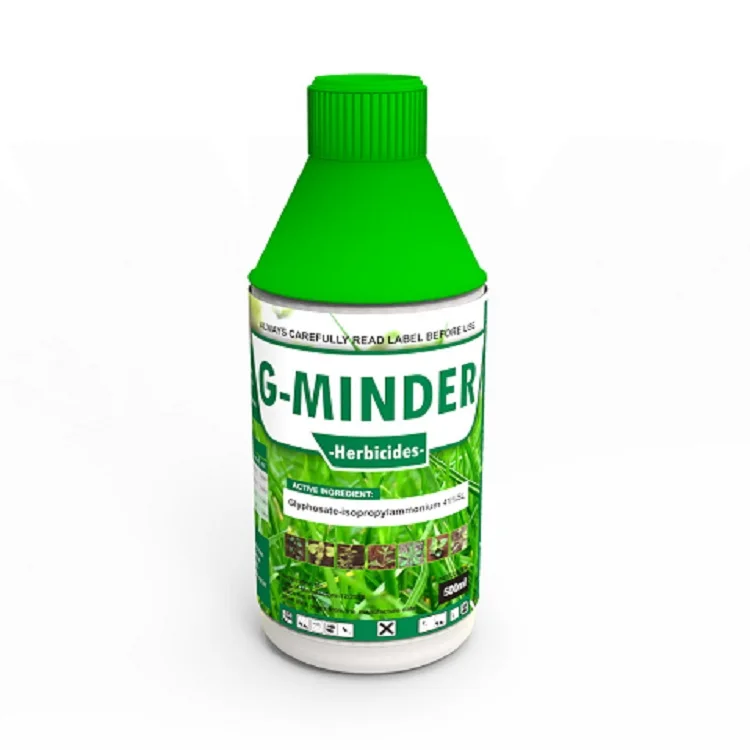
Factory Price Roundup Glyphosate Weed Killer Herbicide Glyphosate 480g/l SL herbicides for agriculture
- Category: >>>
- Supplier: Greenriver Industry Co. Ltd.
Share on (1600747816469):
Product Overview
Description
Products Description

Glyphosate IPA 480g/L SL
Glyphosate is one of the most widely used herbicides in the global market. People apply it in agriculture and forestry, on lawns and gardens, and for weeds in industrial areas. Some products containing glyphosate control aquatic plants.

Glyphosate IPA 480g/L SL
Glyphosate is a non-selective herbicide, meaning it will kill most plants. It prevents the plants from making certain proteins that are needed for plant growth. Glyphosate stops a specific enzyme pathway, the shikimic acid pathway. The shikimic acid pathway is necessary for plants and some microorganisms.

Inhibits 5-enolpyruvylshikimate-3-phosphate synthase (EPSPS), an enzyme of the aromatic acid biosynthetic pathway. This prevents synthesis of essential aromatic amino acids needed for protein biosynthesis.

Non-selective systemic herbicide, absorbed by the foliage, with rapid translocation throughout the plant. Inactivated on contact with soil.
Uses: Control of annual and perennial grasses and broad-leaved weeds, pre-harvest, in cereals, peas, beans, oilseed rape, flax and mustard; control of annual and perennial grasses and broad-leaved weeds in stubble and post-planting/pre-emergence of many crops; as a directed spray in vines and olives; in orchards, pasture, forestry and industrial weed control. As an aquatic herbicide.


Greenriver manufacture and supply effective and Good quality glyphosate in China.
Specification
Active ingredient | Glyphosate | ||||
Chemical name | N-(phosphonomethyl)glycine | ||||
Classification | Herbicide / Agrochemical | ||||
Biochemistry | Inhibits 5-enolpyruvylshikimate-3-phosphate synthase (EPSPS), an enzyme of the aromatic acid biosynthetic pathway. This prevents synthesis of essential aromatic amino acids needed for protein biosynthesis. | ||||
Mode of action | Non-selective systemic herbicide, absorbed by the foliage, with rapid translocation throughout the plant. Inactivated on contact with soil. | ||||
Usage | Control of annual and perennial grasses and broad-leaved weeds, pre-harvest, in cereals, peas, beans, oilseed rape, flax and mustard, at c. 1.5-2 kg/ha; control of annual and perennial grasses and broad-leaved weeds in stubble and post-planting/pre-emergence of many crops; as a directed spray in vines and olives, at up to 4.3 kg/ha; in orchards, pasture, forestry and industrial weed control, at up to 4.3 kg/ha. As an aquatic herbicide, at c. 2 kg/ha. | ||||
Mammalian Toxicology | Oral Acute oral LD50 for rats 5600, mice 11 300, goats 3530 mg/kg. Skin and eye Acute percutaneous LD50 for rabbits >5000 mg/kg. Eye irritant; non-irritating to skin (rabbits). Inhalation LC50 (4 h) for rats >4.98 mg/l air. | ||||
Company Profile

FAQ
Q1. I want more styles, how can I get latest catalogue for your reference?
A: You can contact us by Email, we will give you our latest catalogue according to your information.
Q2. Can you add our own logo on the product?
A: Yes. We offer the service of adding customers’ logo. There are many types of this service. If you have this need, kindly send us you own logo you are welcome.
Q3. How does your factory do regarding quality control?
A: "Quality is priority? We always attach great importance to quality controlling.
1) Skillful workers care every details in handling the producing and packing processes;
2) Quality Control Department specially responsible for quality checking in each process.
Q4. How Can I order?
You can directly place an order on our shop in Alibaba web. Or you can tell us the product name, packing and quantity you need, then we will send you the quotation.
A: You can contact us by Email, we will give you our latest catalogue according to your information.
Q2. Can you add our own logo on the product?
A: Yes. We offer the service of adding customers’ logo. There are many types of this service. If you have this need, kindly send us you own logo you are welcome.
Q3. How does your factory do regarding quality control?
A: "Quality is priority? We always attach great importance to quality controlling.
1) Skillful workers care every details in handling the producing and packing processes;
2) Quality Control Department specially responsible for quality checking in each process.
Q4. How Can I order?
You can directly place an order on our shop in Alibaba web. Or you can tell us the product name, packing and quantity you need, then we will send you the quotation.
We Recommend
New Arrivals
New products from manufacturers at wholesale prices