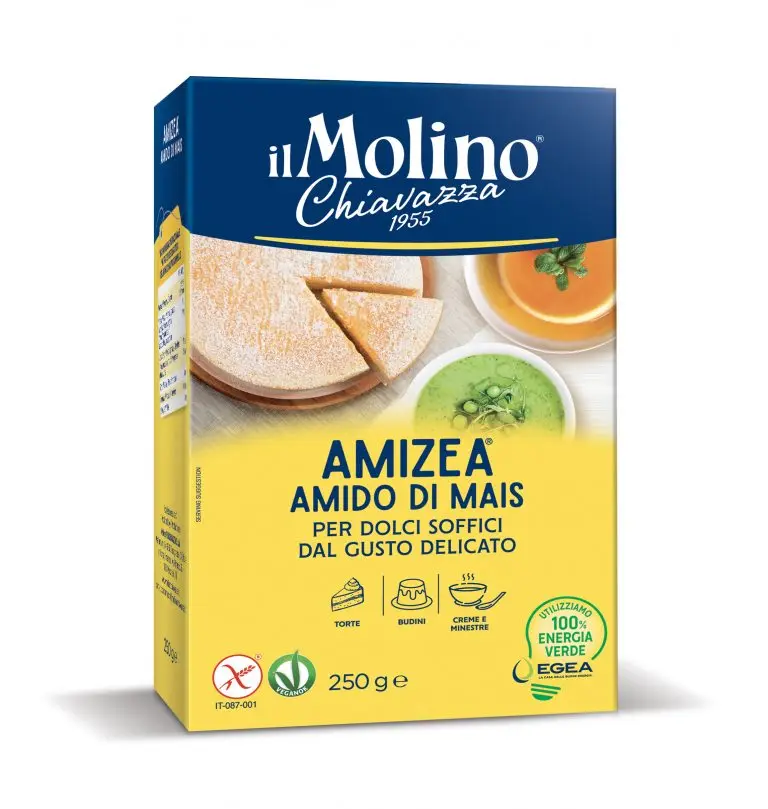
High Quality 100% Natural AMIZEA CORN STARCH 250 g Ideal for Professional Uses Made in Italy Ready for Shipping
- Category: >>>
- Supplier: Molino F.LLI Chiavazza - S.P.A.
Share on (1600910205335):
Product Overview
Description

Product Description
THE PRODUCT:
The corn starch AMIZEA is an indispensable ingredient in kitchen. Its neutral taste does not cover the flavour of foods, its elevated viscosity is particularly appreciated in many domestic preparations. Product gluten free.
It can be used to thicken creams, puddings, chocolates or sauces, gravies and soups. It is sufficient to add 1-2 table spoons. In baby-foods it is possible to add 6-7% of corn starch AMIZEA in the milk. When you make a cake, the corn starch can replace in part (until 50%) wheat flour; in this way it is possible to obtain softer cakes and more friable biscuits.
THE PACKAGING:
Amizea - corn starch is available in packets of about 250 g for homemade cooking.
THE PACKAGING:
Amizea - corn starch is available in packets of about 250 g for homemade cooking.
Specification
item | value |
Storage Type | Ambient Temperature |
Specification | AMIZEA - CORN STARCH 250 g |
Manufacturer | Molino Chiavazza |
Ingredients | AMIZEA - CORN STARCH 250 g |
Content | AMIZEA - CORN STARCH 250 g |
Address | St. Racconigi 5, 12030 Casalgrasso (CN) |
Instruction for use | Available in packets of about 250 g for homemade cooking. |
Weight (kg) | 0.25Kg |
Shelf Life | 15 Months |
Place of Origin | Italy |
Company Profile

Molino Chiavazza is one of the most important national grain processing industries in Italy and a leading producer of flours for domestic consumers and professional use, packaged with own brands or private labels.
Today, the "Molino" brand is the fourth player in the Italian market in the segment of packaged flour. If we consider also the products made for private label, the production capability of Molino Chiavazza is more than 34.000 tons for the year. This represents near the 20 % of the national packaged flour.
The company was founded in 1955 and it has developed gradually over time. Nowadays, it has two main production plants.
One in Casalgrasso (CN) where are located the wheat milling plant, the administrative offices and the lab analysis. The milling plant has a wheat milling capability of about 400 tons per day and the packaging plant for flours and semolina destined at the final costumer has seven production lines and it has a daily capability of about 300 tons of product packaged.
The other one is located in Pancalieri (TO) where the company produce, packaging and marketing special flours, semolina, rising agents, extruded cereal products and mix for bakery products, bread, cream, cakes and puddings.
In 2015, has been created a new department for packaging products intended for people with gluten intolerance. In 2021 a new packaging line for dry yeast has been realized.
Both plants are certificates high level BRC, IFS and FSSC22000.
Today, the "Molino" brand is the fourth player in the Italian market in the segment of packaged flour. If we consider also the products made for private label, the production capability of Molino Chiavazza is more than 34.000 tons for the year. This represents near the 20 % of the national packaged flour.
The company was founded in 1955 and it has developed gradually over time. Nowadays, it has two main production plants.
One in Casalgrasso (CN) where are located the wheat milling plant, the administrative offices and the lab analysis. The milling plant has a wheat milling capability of about 400 tons per day and the packaging plant for flours and semolina destined at the final costumer has seven production lines and it has a daily capability of about 300 tons of product packaged.
The other one is located in Pancalieri (TO) where the company produce, packaging and marketing special flours, semolina, rising agents, extruded cereal products and mix for bakery products, bread, cream, cakes and puddings.
In 2015, has been created a new department for packaging products intended for people with gluten intolerance. In 2021 a new packaging line for dry yeast has been realized.
Both plants are certificates high level BRC, IFS and FSSC22000.
FAQ
1. What is the difference between soft and hard wheat?
For the purposes of food use, wheat is divided into two species: soft and hard. The former, which have a floury appearance when cut and are easily flaked, are mainly used for the production of flour for bread-making or, in general, for bakery products. The latter, which when fractured are amber-coloured and have a vitreous fracture, are used to obtain semolina and semolina destined for the production of alimentary pasta.
For the purposes of food use, wheat is divided into two species: soft and hard. The former, which have a floury appearance when cut and are easily flaked, are mainly used for the production of flour for bread-making or, in general, for bakery products. The latter, which when fractured are amber-coloured and have a vitreous fracture, are used to obtain semolina and semolina destined for the production of alimentary pasta.
2.What is gluten?
Gluten is a plastic protein complex that is organised in the dough in a dense network capable of supporting the other components and giving volume to baked goods. The importance of wheat arises from the presence in the endosperm of two proteins, gliadin and glutenin, which in contact with the water in the dough give rise to gluten.
Gluten is a plastic protein complex that is organised in the dough in a dense network capable of supporting the other components and giving volume to baked goods. The importance of wheat arises from the presence in the endosperm of two proteins, gliadin and glutenin, which in contact with the water in the dough give rise to gluten.
3.What is meant by 'strong' or 'weak' flour?
Taking the breadmaking quality of the flour (i.e. its intended use) as a reference, it is usual to identify three categories:
Strong flours, used in the production of preparations that have a long processing cycle (leavened products, panettone,...)
Medium strength flours; used in breadmaking
Weak flours; used to produce dry biscuits and industrial breadsticks.
Taking the breadmaking quality of the flour (i.e. its intended use) as a reference, it is usual to identify three categories:
Strong flours, used in the production of preparations that have a long processing cycle (leavened products, panettone,...)
Medium strength flours; used in breadmaking
Weak flours; used to produce dry biscuits and industrial breadsticks.
4.What is the difference between semolina, granite and flour?
Flours are made up of impalpable flours. Semolina and granite, on the other hand, consist of harder, non-floured endosperm particles made from hard and soft grains respectively.
Flours are made up of impalpable flours. Semolina and granite, on the other hand, consist of harder, non-floured endosperm particles made from hard and soft grains respectively.
5.What is the shelf-life of a product?
Shelf-life is the commercial life (shelf-life) of a product stored under appropriate conditions.
Shelf-life is the commercial life (shelf-life) of a product stored under appropriate conditions.

Packing & Delivery
To better ensure the safety of your goods, professional, environmentally friendly, convenient and efficient packaging services will be provided.


Certifications

We Recommend

Bread Flour 50 kg | Maida Flour
US $395.00-$407.00


Best Grade Corn Flour/Barley Flour/ Wheat Flour For Sale
US $1.02-$1.69


New Arrivals
New products from manufacturers at wholesale prices