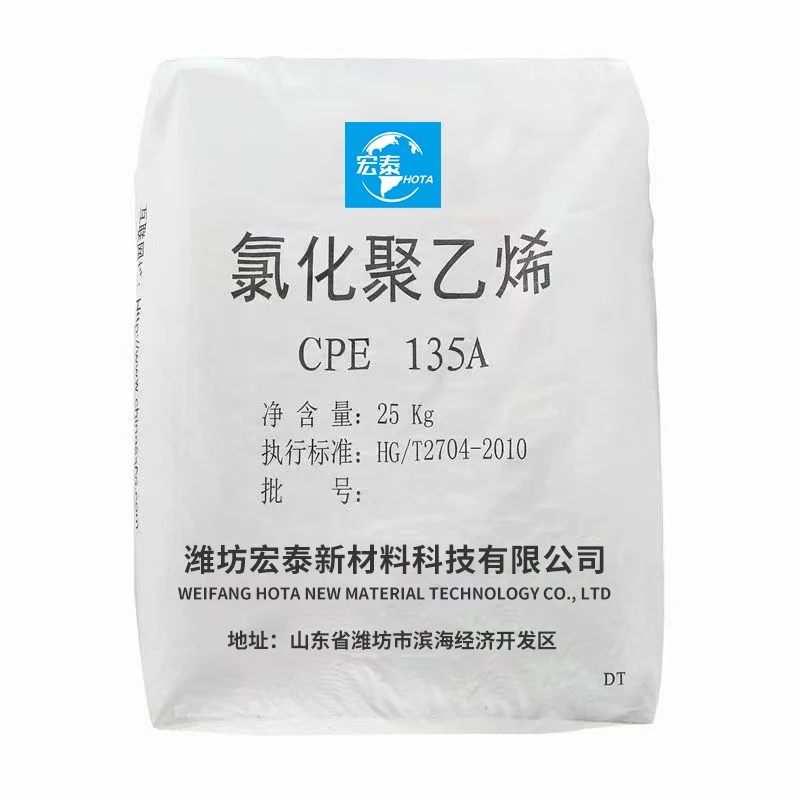
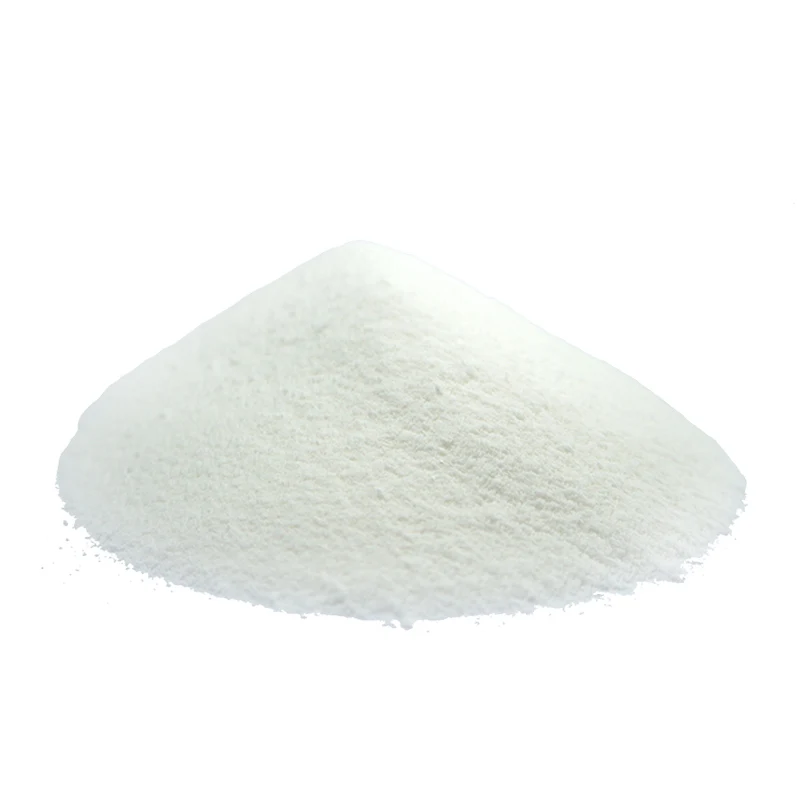
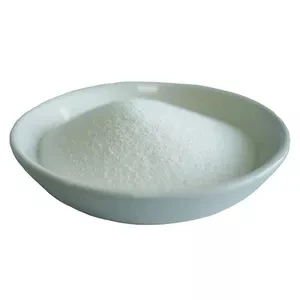
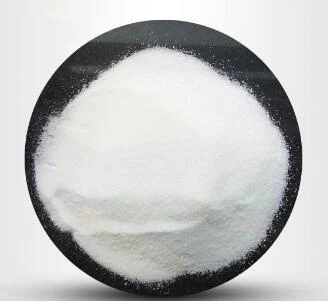
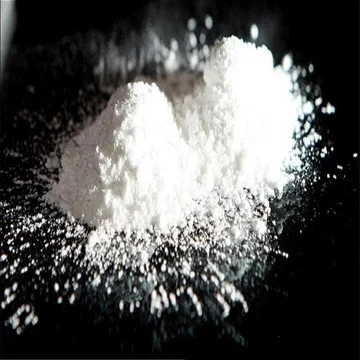
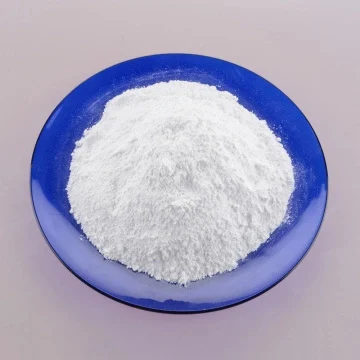
Plastic raw material Chlorinated Polyethylene CPE Resin for Polyvinyl chloride pvc pipe
- Category: >>>
- Supplier: Weifang Hota New Material Technology Co. Ltd.
Share on (1601002575547):
Product Overview
Description
Product Description

Chlorinated polyethylene (PE-C or CPE) is an inexpensive variation of polyethylene, where chlorine is substituted for some of the hydrogen atoms. CPE has a chlorine content from 34 to 44%.
Due to its soft, rubbery texture, CPE is added to polyvinyl chloride to increase its impact and weather resistance. Furthermore, it is used for softening PVC foils, without risking plasticizer migration.

CPE135A/B/C SPECIFICATIONS:
| Item | Unit | Index |
| Chlorine content | % | 35±1 |
| Remains crystallinity | % | ≤ 5 |
| Volatile Matter content | % | ≤0.3 |
| Rate of filtration (26 mesh) | % | ≥99 |
| Shore Hardness A | ° | ≤57 |
| Thermal decomposition temperature | ≥165 | |
| Mooney viscosity | ML | 75±5 |
| Stretch hardness | Mpa | ≥8.0 |
| Elongation at break | % | ≥800 |

Chlorinated polyethylene can be crosslinked with peroxides to form an elastomer which is used in cable and rubber industries. When chlorinated polyethylene is added to other polyolefins, it reduces the flammability. Chlorinated polyethylene is sometimes used in power cords as an outer jacket.
CPE resin is a polymer material made of high-density polythene resin through chlorination reaction. According to its application, CPE resin can be classified as CPE for plastic impact modification and CM for rubber.
CPE is an excellent and cost-effective impact modifier and can significantly improve the impact strength and temperature resistance of rigid plastic pipe and fittings.
CPE has good flame resistance and is compatible with ABS. Thus, it can be used to make ABS flame resistant.
CPE is also widely used in semi-rigid and soft plastic products. As a non-migratory plasticizer for macro molecule, it can improve the product flexibility and aging and temperature resistance.
Chlorinated Polyethylene CM can be used for producing high-grade waterproofing coiled materials and magnetic rubber, among others.
Chlorinated Polyethylene CM can be used for producing cables and cord sheaths (mine, marine, and locomotive cables), conveyor belts, corrosion-resistant sealing, and rubber hoses for cars (such as oil-conveying pipe, AC hose and brake and steering fluid conveying pipe), rubber dams, and rubber track plates, among others.
Chlorinated Polyethylene CM has good filling characteristic for iron oxide magnetic powder; the magnetic material with CM will have low temperature flexibility. Thus, it is widely used as a sealing strip for refrigerators and magnetic cards, among others.
CPE polymers can range from rigid thermoplastics to flexible elastomers, making them highly versatile. These polymers are used in a variety of end-use applications such as wire and cable jacketing, roofing, automotive and industrial hose and tubing, molding and extrusion, and as a base polymer.
CPE blends well with many types of plastics such as Polyethylene, EVA, and PVC. Such blends can be formed into final products with adequate dimensional stability without the need of vulcanization. The excellent additive/filler acceptability characteristics of CPE can provide a benefit in blends where compound performance and economics are critical.
CPE resin is a polymer material made of high-density polythene resin through chlorination reaction. According to its application, CPE resin can be classified as CPE for plastic impact modification and CM for rubber.
CPE is an excellent and cost-effective impact modifier and can significantly improve the impact strength and temperature resistance of rigid plastic pipe and fittings.
CPE has good flame resistance and is compatible with ABS. Thus, it can be used to make ABS flame resistant.
CPE is also widely used in semi-rigid and soft plastic products. As a non-migratory plasticizer for macro molecule, it can improve the product flexibility and aging and temperature resistance.
Chlorinated Polyethylene CM can be used for producing high-grade waterproofing coiled materials and magnetic rubber, among others.
Chlorinated Polyethylene CM can be used for producing cables and cord sheaths (mine, marine, and locomotive cables), conveyor belts, corrosion-resistant sealing, and rubber hoses for cars (such as oil-conveying pipe, AC hose and brake and steering fluid conveying pipe), rubber dams, and rubber track plates, among others.
Chlorinated Polyethylene CM has good filling characteristic for iron oxide magnetic powder; the magnetic material with CM will have low temperature flexibility. Thus, it is widely used as a sealing strip for refrigerators and magnetic cards, among others.
CPE polymers can range from rigid thermoplastics to flexible elastomers, making them highly versatile. These polymers are used in a variety of end-use applications such as wire and cable jacketing, roofing, automotive and industrial hose and tubing, molding and extrusion, and as a base polymer.
CPE blends well with many types of plastics such as Polyethylene, EVA, and PVC. Such blends can be formed into final products with adequate dimensional stability without the need of vulcanization. The excellent additive/filler acceptability characteristics of CPE can provide a benefit in blends where compound performance and economics are critical.

Company Information

Our Services

Packaging & Shipping

FAQ
Q: Are you trading company or manufacturer?
A: We are manufacturer.
Q: Can i get some samples?
A: Yes, free samples(5-10 Kg)are available for most of our products, you only need to pay the shipping cost.
Q: How long is your delivery time?
A: The time of delivery is usually around 7-10 days
Q: What's your payment terms?
A: TT /LC/ DP/CASH
Q: What documents you provide?
A: Usually, we provide Commercial Invoice, Packing List, Bill of loading, COA, if your markets have any special requirements, let us know.
We Recommend
New Arrivals
New products from manufacturers at wholesale prices