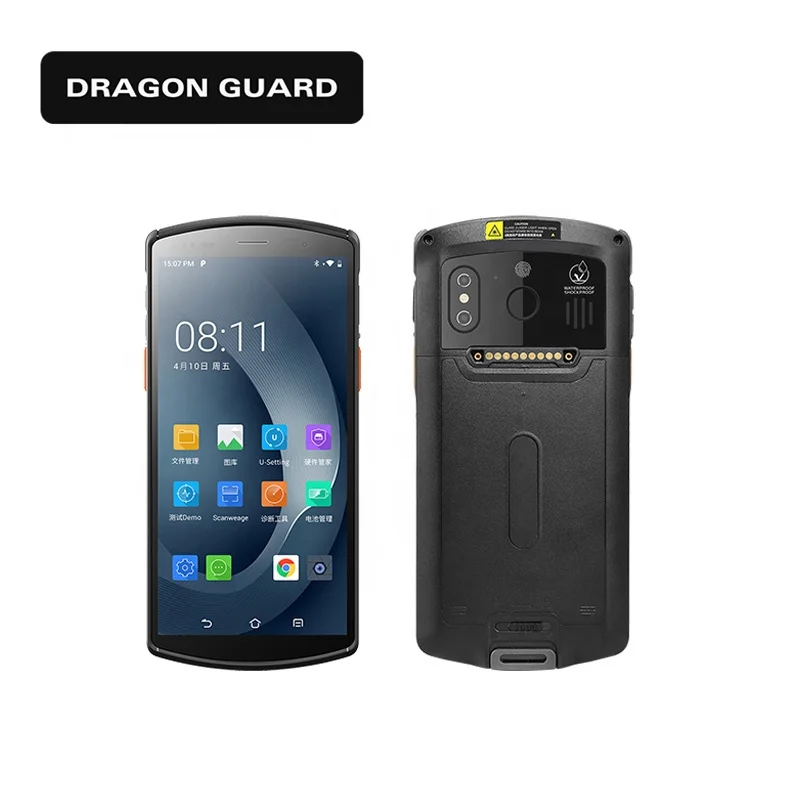
DRAGON GUARD RIRW01 Manufacturer Wholesale 13.56MHz HF Access Control RFID Handheld Reader and Writer
- Category: >>>
- Supplier: Xuzhou Dragon Guard Industrial Co. Ltd.
Share on (1601014235115):
Product Overview
Description


Product Paramenters

RFID RIRW01 Reader and Writer
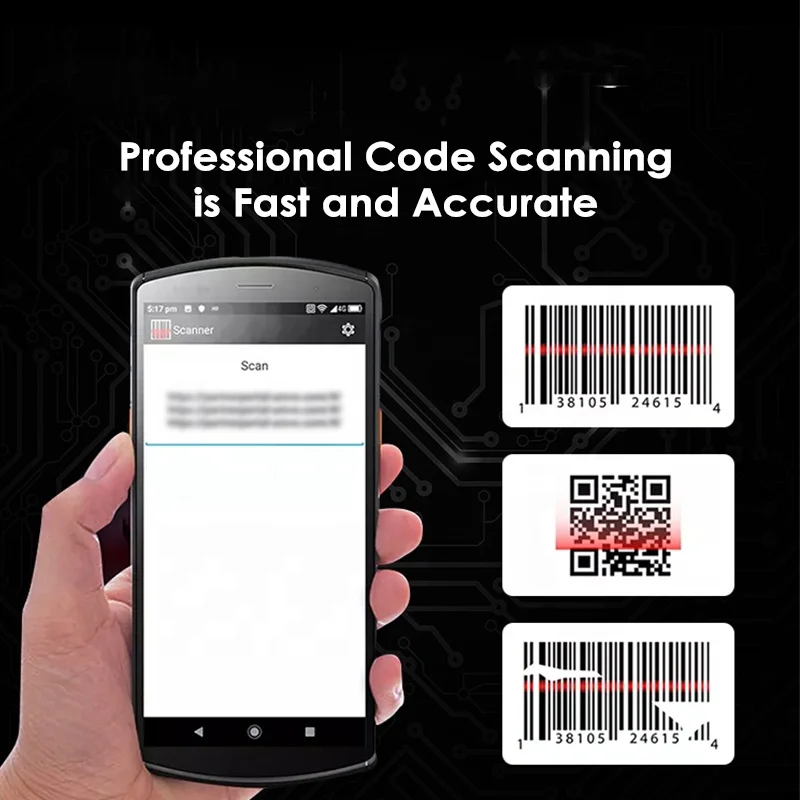
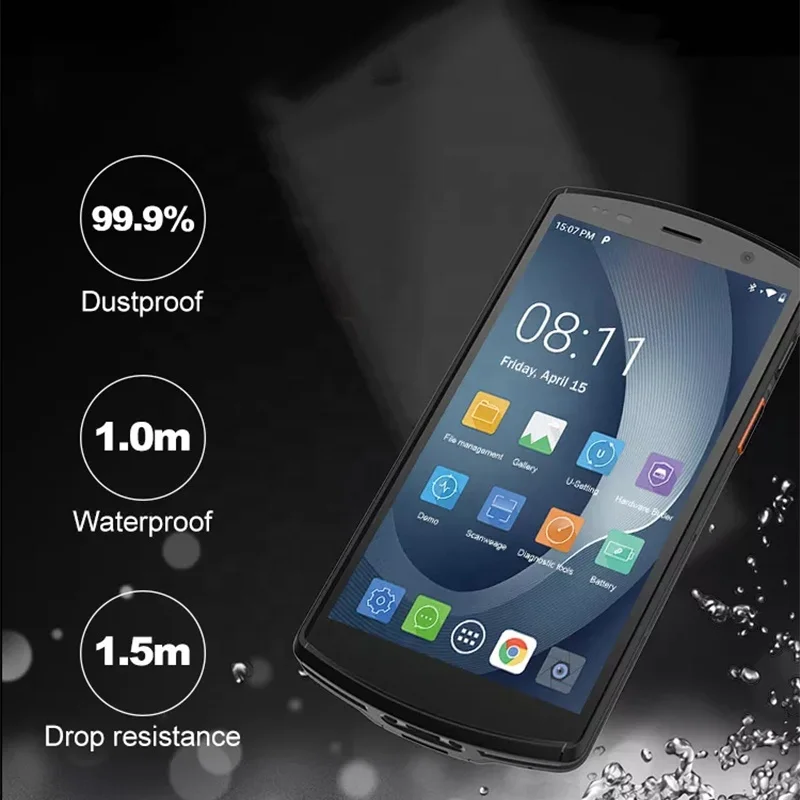
RIRW01 is an Android 11.0 mobile device, that has been IP67 rated and 1.5m drop tested. Featuring a 1D/2D barcode imager, NFC,
RFID, triple camera and biometric fingerprint module to gather all the information that your enterprise needs, in any form, from any
point.
RFID, triple camera and biometric fingerprint module to gather all the information that your enterprise needs, in any form, from any
point.
RIRW01 is available in 3 versions Mobile computer, biometric fingerprint and integrated RFID version.
Item | Specifications |
O.S. | Android 11(R) |
Processor | Octa-core 2.45GHz |
Memory | RAM: 4GB ROM: 64GB RAM: 6GB ROM: 64GB (optional) |
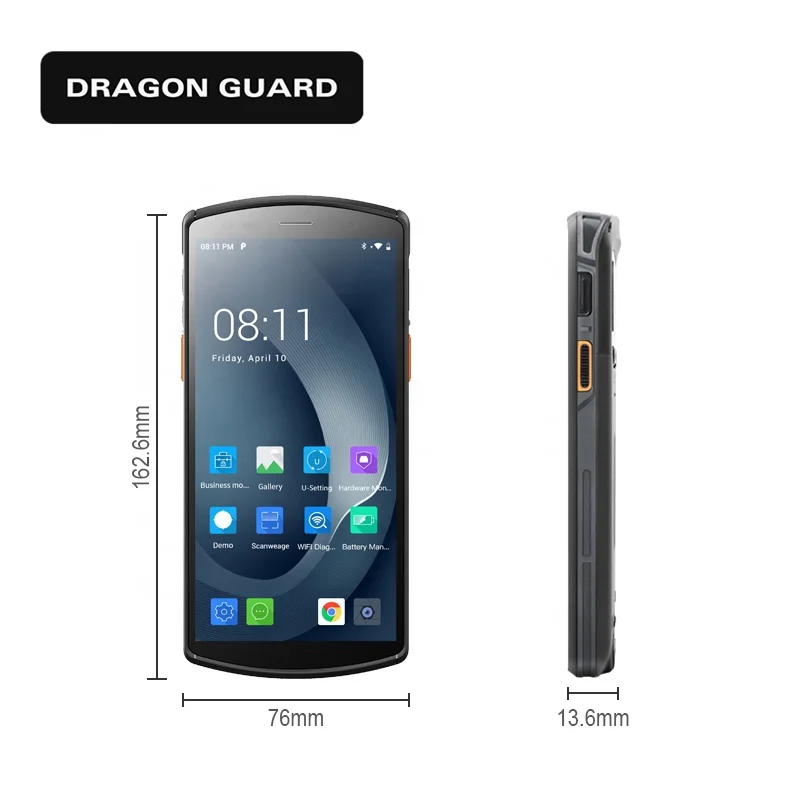
Dimensions | 162.6*76*13.6mm |
Weight | 265g |
Display | 5.7 inch display, 720*1440 |
Network | WWAN,Bluetooth,WIFI,NFC |
Positioning | Dual-band GPS(L1+L5)、A-GPS、BeiDou、GLONASS 、Galileo |
Operating Temp. | -20°C to 60°C |
Storage Temp. | -40°C to 70°C |
Humidity | 5%RH~95%RH (No condensation) |
Product display
Recommend Products
Custom Service
It can be customized according to the format you need,
More styles to meet you.

Product application
Jewelry management
Manage product inventory,help salespeople quickly find specific products, provide decision-making analysis for merchants, and
enhance the customer experience.
enhance the customer experience.
Clothing inventory
Learn the data information of product sales, poor sales and customer preferences, and provide data support for product display and
product procurement.
product procurement.
Smart library
Through RFID technology, the limitation of traditional library time and space is broken, so that citizens can enjoy public
cultural services more conveniently.
cultural services more conveniently.
The vehicle management
Standardization Administration of The People's Republic of China has issued six national recommended standards for electronic
identification of motor vehicles, which is also the key point for the popularization of electronic license plates.
identification of motor vehicles, which is also the key point for the popularization of electronic license plates.
The medical field
Real-time reading of patient position information, operation status, the operation of the whole process tracking. Manage drug
inventory, prevent fakes and improve work efficiency.
inventory, prevent fakes and improve work efficiency.
Warehouse management
Inventory visualization: integrate all logistics inventory data to provide real-time status information query. Efficient
automation: cars, goods, pallets and people are fully and efficiently monitored, and the moving position is clear at a glance.
automation: cars, goods, pallets and people are fully and efficiently monitored, and the moving position is clear at a glance.

Commodity inventory management
Replenishment efficiency increased Inventory availability rate increased
Shortage rate reduced Reduced stranded supplies
Shortage rate reduced Reduced stranded supplies
Decrease in inventory funds Warehousing manpower expenditure decreased
Reduction of cargo loss Improve work efficiency.
Reduction of cargo loss Improve work efficiency.
Manufacturing Technique

Product packaging

FAQ
1.Why choose us?
18-year manufacturer.
Strict QC factory—at least 4 QCs during production, product performance are ensured.
Strong technical team—quick to solve problems, creative to design new items, latest RFID items are from us.
Big capacity—cost-effective and flexible to adjust production for volume and urgent orders.
2. What is RFID?
RFID is an acronym for Radio Frequency Identification. It's an automatic identification method that stores and remotely retrieves data from an RFID inlay. Unlike barcodes where the information must be visible to the scanner, RFID inlays are hidden under the facestock of the label.
3. How does RFID Work?
RFID systems combine two components: an RFID inlay and an RFID reader. The RFID inlay transmits data in the form of radio waves to the reader through its antenna. The reader converts the data and interprets it.
4. What's an RFID label?
An RFID label is a label with an RFID inlay. This means you can print on them as well as attach RFID technology to packages,products, and more.
5. What are the components of an RFID label?
RFID labels are composed of an RFID inlay, antenna, facesheet, adhesive, and liner. The inlay is the hardware of the RFID
technology. It's made up of a microchip and antenna. The facesheet is the part you see, the adhesive is the tack, and the liner is what keeps your labels from sticking before you're ready to use them.
6. How are RFID labels encoded and read?
RFID labels are programmed by RFID-enabled printers, printer attachments, or RFID encoders. Special RFID readers are needed to communicate with the inlay. They send radio waves to the antenna and then pass the collected information to the computer for processing.
7. What's passive RFID?
Passive RFID doesn't have a battery. It operates by converting the RFID reader's radio waves into electricity. It's a common and economical type of RFID.
8. What does UHF mean?
UHF is an acronym for Ultra High Frequency. It refers to the frequency at which the RFID reader operates and reads the RFID labels. UHF RFID labels can be operated from farther distances and transmit data faster.
9. What does EPC mean?
EPC is an acronym for Electronic Product Code. It's specific to one individual object and therefore is commonly use to distinguish identical items.
10. What are the differences between RFID labels and barcodes?
RFID labels can be read through packaging and/or at a distance whereas barcodes need to be seen to be scanned.
RFID labels can be encoded with information multiple times, barcodes can only be printed on once. Overall, RFID labels offer more flexibility and specificity for tracking individual items.
18-year manufacturer.
Strict QC factory—at least 4 QCs during production, product performance are ensured.
Strong technical team—quick to solve problems, creative to design new items, latest RFID items are from us.
Big capacity—cost-effective and flexible to adjust production for volume and urgent orders.
2. What is RFID?
RFID is an acronym for Radio Frequency Identification. It's an automatic identification method that stores and remotely retrieves data from an RFID inlay. Unlike barcodes where the information must be visible to the scanner, RFID inlays are hidden under the facestock of the label.
3. How does RFID Work?
RFID systems combine two components: an RFID inlay and an RFID reader. The RFID inlay transmits data in the form of radio waves to the reader through its antenna. The reader converts the data and interprets it.
4. What's an RFID label?
An RFID label is a label with an RFID inlay. This means you can print on them as well as attach RFID technology to packages,products, and more.
5. What are the components of an RFID label?
RFID labels are composed of an RFID inlay, antenna, facesheet, adhesive, and liner. The inlay is the hardware of the RFID
technology. It's made up of a microchip and antenna. The facesheet is the part you see, the adhesive is the tack, and the liner is what keeps your labels from sticking before you're ready to use them.
6. How are RFID labels encoded and read?
RFID labels are programmed by RFID-enabled printers, printer attachments, or RFID encoders. Special RFID readers are needed to communicate with the inlay. They send radio waves to the antenna and then pass the collected information to the computer for processing.
7. What's passive RFID?
Passive RFID doesn't have a battery. It operates by converting the RFID reader's radio waves into electricity. It's a common and economical type of RFID.
8. What does UHF mean?
UHF is an acronym for Ultra High Frequency. It refers to the frequency at which the RFID reader operates and reads the RFID labels. UHF RFID labels can be operated from farther distances and transmit data faster.
9. What does EPC mean?
EPC is an acronym for Electronic Product Code. It's specific to one individual object and therefore is commonly use to distinguish identical items.
10. What are the differences between RFID labels and barcodes?
RFID labels can be read through packaging and/or at a distance whereas barcodes need to be seen to be scanned.
RFID labels can be encoded with information multiple times, barcodes can only be printed on once. Overall, RFID labels offer more flexibility and specificity for tracking individual items.
We Recommend
New Arrivals
New products from manufacturers at wholesale prices