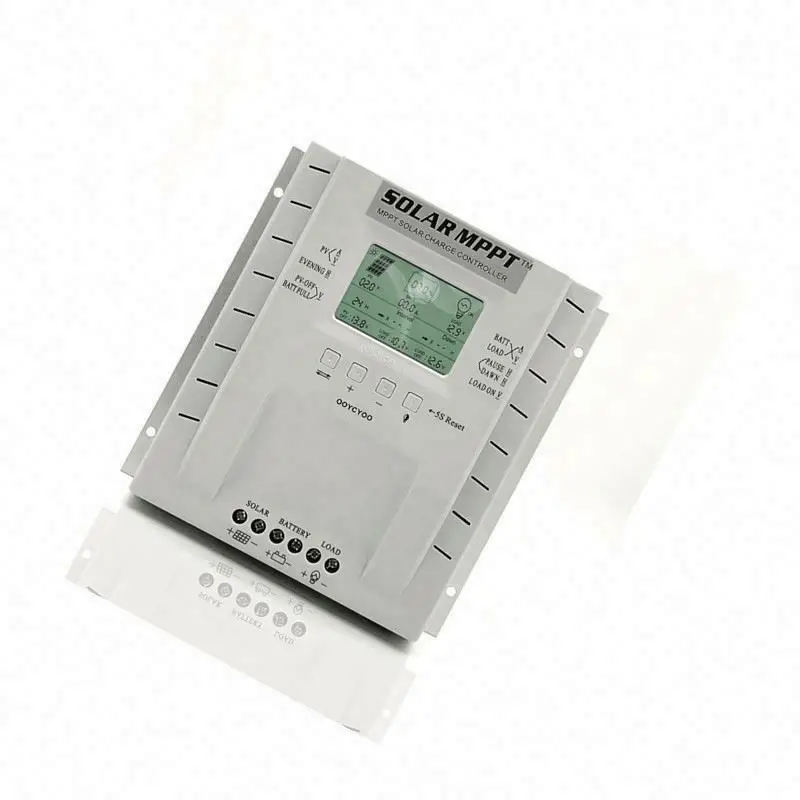
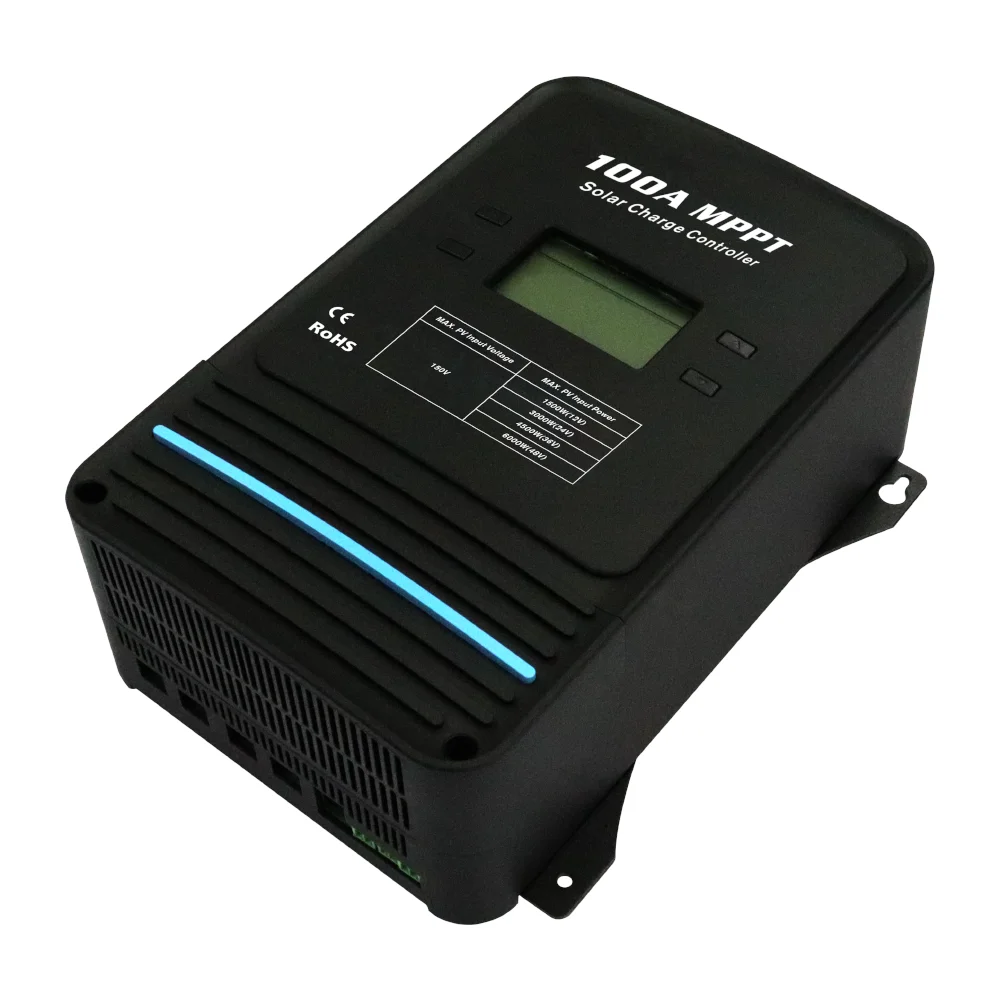
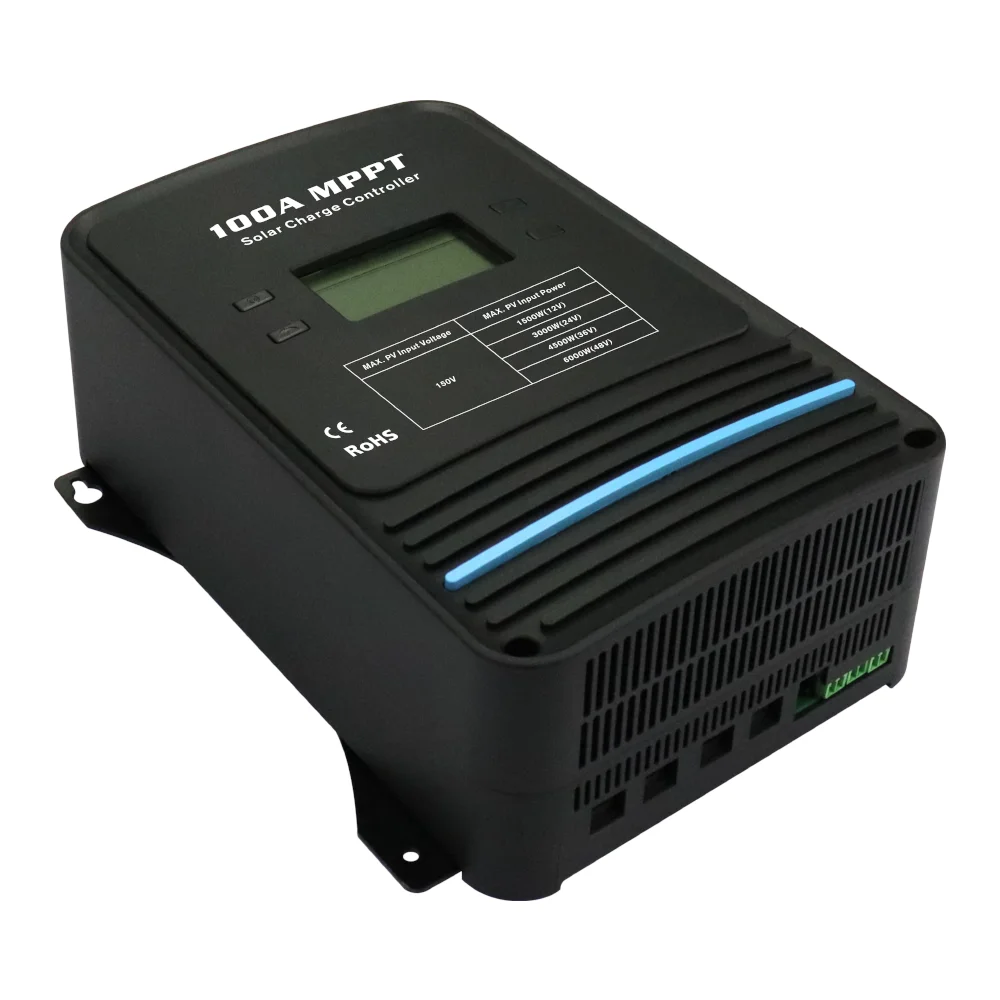
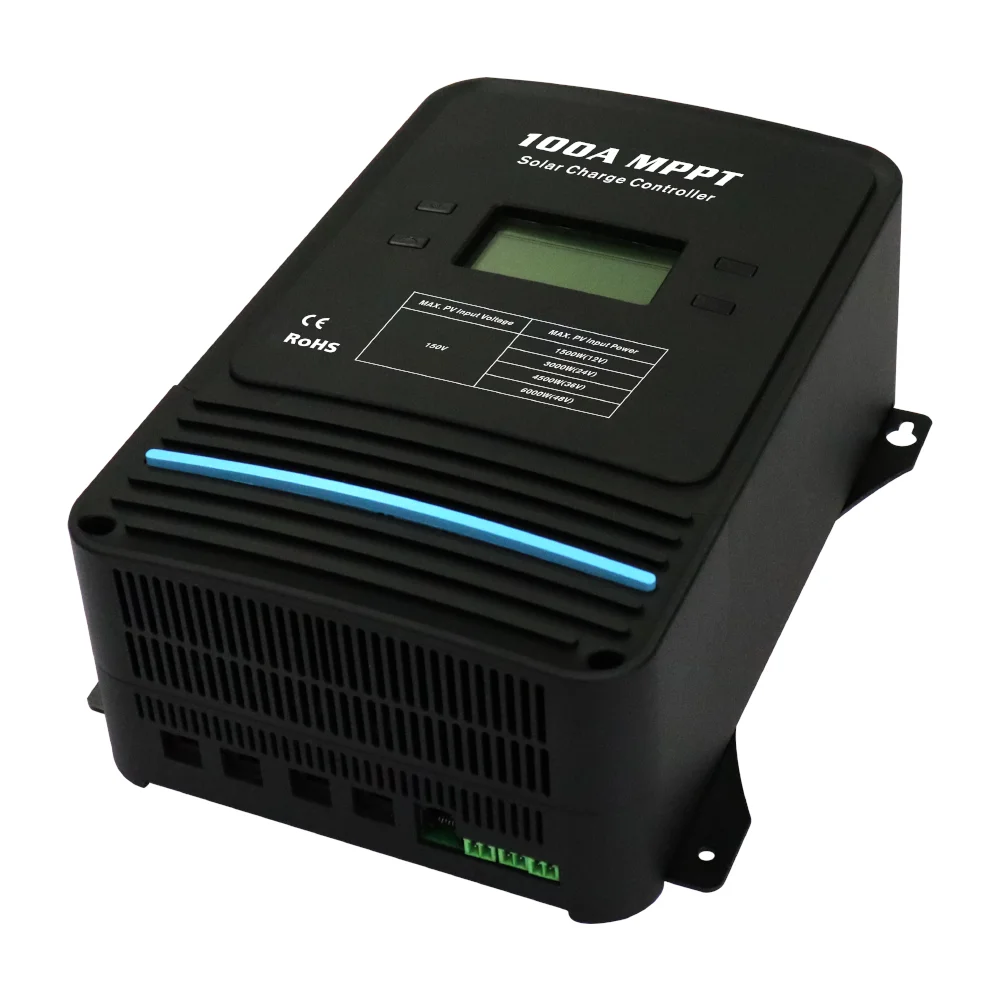
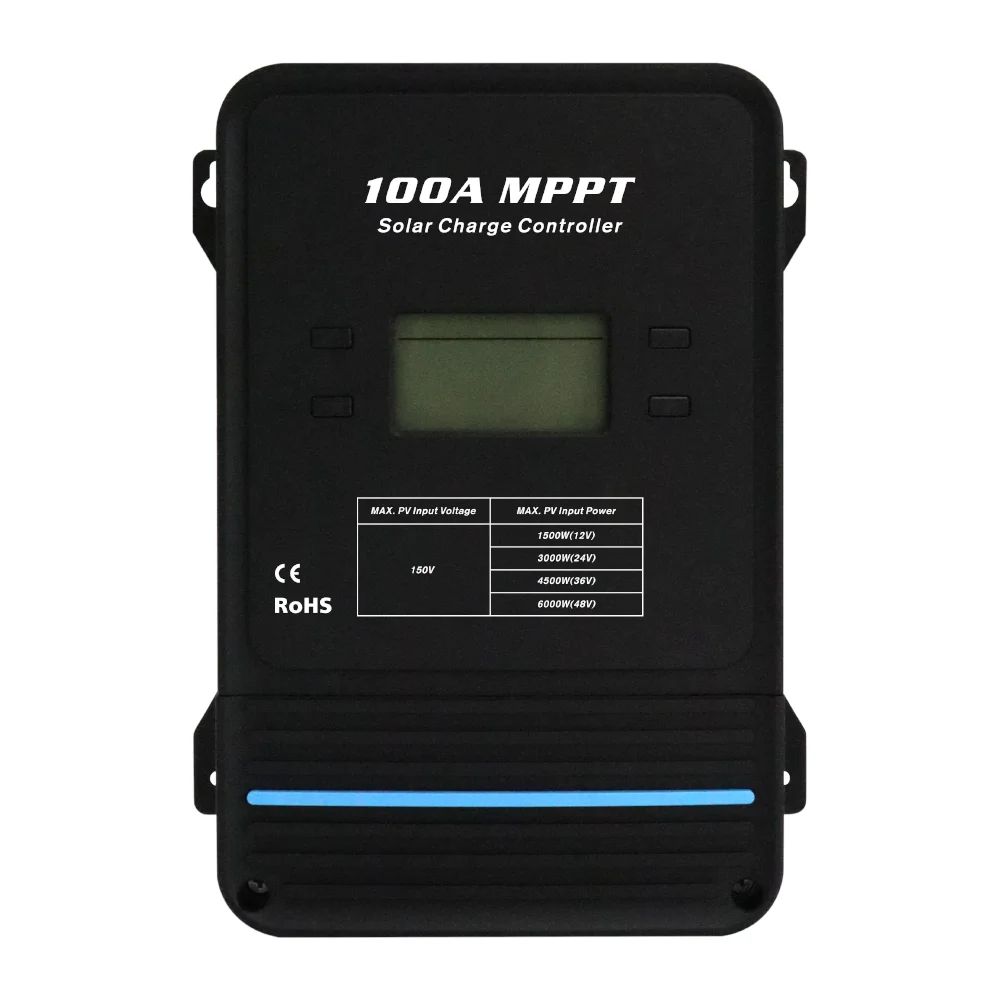
Solar controller 12v 24v 48v 60A 80A 100A 120A LCD Display Solar Power System controller PWM Mppt Charge Controller
- Category: >>>
- Supplier: Helios New Energy Co. Ltd.
Share on (1601048812775):
Product Overview
Description
Details Images


Product features:
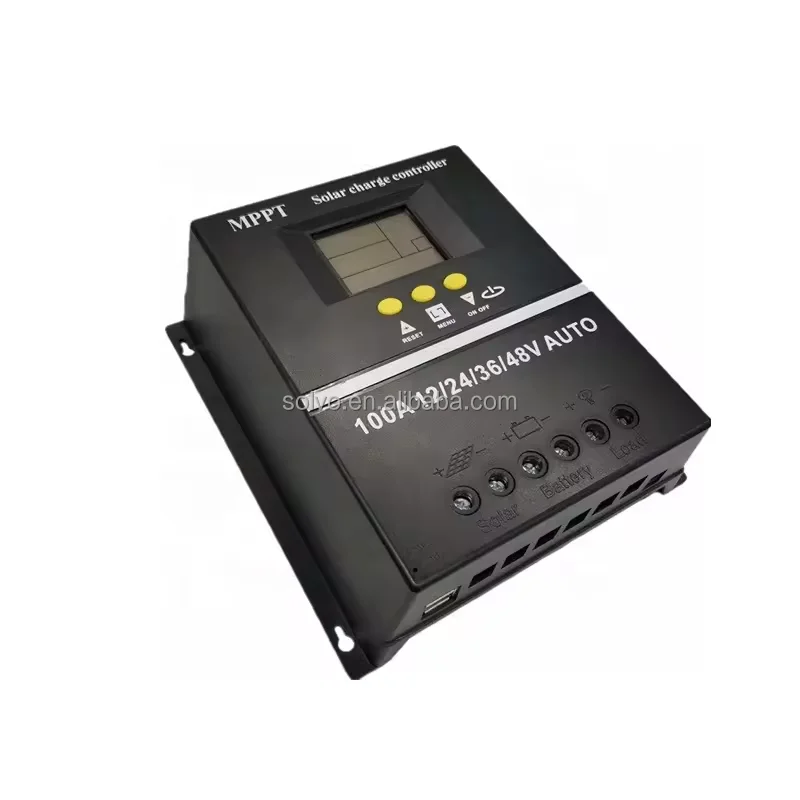
· 80A/100A MPPT solar charge controller.
· 3-stage charging optimizes battery performance.
· Suitable for battery types such as Lead-acid AGM/GEL/FLD & Lithium battery.
· Support 12V/24V/36V/48V automatic detection, lithium battery requires the user to set the system voltage.
· Suitable for battery types such as Lead-acid AGM/GEL/FLD & Lithium battery.
· Support 12V/24V/36V/48V automatic detection, lithium battery requires the user to set the system voltage.
· The external port can be used by multiple devices in parallel (max 9 devices in parallel).
· Supports RS485 communication with Modbus protocol, support customer customization protocol and communication media.
· Industrial grade design with full range of electronic protections, such as Controller Over-temperature, Environmental Over-temperature, Battery&PV Reverse, Battery&PV Over-voltage protection.
Product Paramenters
Controller Parameter | Value | |||
Model Number | M4880F | M48100F | ||
Battery System Voltage | 12V/24V Auto ( Manual(Li/USE) GEL/FLD/SEL/USE) | 12V/24V Auto ( Manual(Li/USE) GEL/FLD/SEL/USE) | ||
No-load Loss | 30mA | |||
Charging Mode | 3-stage: Constant Current(MPPT), Constant Voltage, Floating | |||
Max PV Input Power | 1200W/12V; 2400W/24V 3600W/36V; 4800W/48V | 1500W/12V; 3000W/24V 4500W/36V; 6000W/48V | ||
Max PV Input Voltage | <150 Voc | |||
Rated Solar Charge Current | 80A | 100A | ||
Light Control Voltage | 5V*n | |||
Light Control Delay Time | 10s | |||
Type | MPPT | |||
System Wiring Grounded | Negative Grounded | |||
Charging Efficiency | ≥98.1% | |||
Communication Port | RS485 | |||
Auto Temperature Compensation | -3mV/2V/ºC | |||
Operating Altitude | ≤ 3000 m | |||
BT communication | Optional | |||
Parallel Machines Method | Support 9 parallel machines | |||
Protection Function | ||||
Temperature Protection | 80°C | |||
Fan-on Temperature | >45°C | |||
Fan-off Temperature | <40°C | |||
Properties | ||||
Size | 252*201*80.3mm | |||
Net Weight | 2.28kg | 2.49kg | ||
IP Protection | IP32 | |||
Operating Temperature | -25℃ ~ +55℃ | |||
Storage Temperature | -40℃ ~ +75℃ | |||
Company Profile
Helios New Energy Co., Ltd
Helios New Energy Co.,Ltd is a high tech enterprise for R&D, manufacture, and marketing of solar products, mainly focus on areas of solar DC charge & lighting, and other PV energy storage applications. Our company has been well experienced in technology of solar DC charge, especially on. PWM & MPPT solar charge controllers. We’ve put our unique concept in R&D work for solar controller products that are widely used in solar stand alone power system, solar telecommunication power station, solar RV power system, and other kinds of power system required solar DC charge source.
Helios NE never stop moving forward in the progress of research & development of solar DC technology. We will always keep pace with the latest technical trend in the world, and try to improve our products all the time. The quality is the life of Helios company, and our aim is to provide the world with the best solar DC products, along with the best service to our customers.
Office
Show room
Production line
QC working group
Certification

Exhibition
Jun.2021 Expo (SHHH)Exhibition
Nov.2021 Expo (GZ)Exhibition
Aug.2022 Expo (GZ)Exhibition
Feb.2023 Expo(USA)Exhibition
May.2023 Expo(Poland)Exbition
May.2023 Expo (SHH) Exhibition


Jun.2023 Expo (Germany) Exhibition
If you are exhibitors, welcome to our booth.
Packing & Delivery & Client Feedbacks
Packing:


Delivery:


Client feedbacks:

FAQ
1.What’s the difference between PWM and MPPT charge?
PWM and MPPT are 2 main ways for solar DC charge to the battery.
PWM, short for Pulse Width Modulation, is a technology to use a certain part of voltage from the PV modules, to charge according to the battery actual voltage. For example, if we use a 18V solar panel, to charge a 12V battery bank by a PWM controller, and supposed the battery now is on voltage of 12.8V, then PWM controller would take 12.8V from the panel to charge, but this voltage would change when the battery voltage changes, so we may also lose the part of PV voltage above the battery value. That’s why we always say PWM is lower in charge efficiency, and commonly we may have a rate of 70-80% as the PWM charge efficiency. Please notice that if you use 30 or 36V PV module to charge the 12V battery bank, then most of the PV voltages would be wasted because normally no higher than 16V PV voltage would be used for PWM charge on 12V battery system.
MPPT, short for Maximum Power Point Track, is a technology to track and use most of the PV power to charge the battery. There are
several kinds of MPPT tracking methods, but all are leading to make full use of solar power. The difference is about the
adjustment of the MPPT technology to different applications. As you can see, MPPT is to try to make full use of PV power, and this
is the biggest advantage over the PWM. Considering of the unavoidable power loss, the MPPT charge efficiency is supposed to be
over 95% averagely, and could be up to 98% in the peak time.
PWM, short for Pulse Width Modulation, is a technology to use a certain part of voltage from the PV modules, to charge according to the battery actual voltage. For example, if we use a 18V solar panel, to charge a 12V battery bank by a PWM controller, and supposed the battery now is on voltage of 12.8V, then PWM controller would take 12.8V from the panel to charge, but this voltage would change when the battery voltage changes, so we may also lose the part of PV voltage above the battery value. That’s why we always say PWM is lower in charge efficiency, and commonly we may have a rate of 70-80% as the PWM charge efficiency. Please notice that if you use 30 or 36V PV module to charge the 12V battery bank, then most of the PV voltages would be wasted because normally no higher than 16V PV voltage would be used for PWM charge on 12V battery system.
MPPT, short for Maximum Power Point Track, is a technology to track and use most of the PV power to charge the battery. There are
several kinds of MPPT tracking methods, but all are leading to make full use of solar power. The difference is about the
adjustment of the MPPT technology to different applications. As you can see, MPPT is to try to make full use of PV power, and this
is the biggest advantage over the PWM. Considering of the unavoidable power loss, the MPPT charge efficiency is supposed to be
over 95% averagely, and could be up to 98% in the peak time.
2.How to choose PWM or MPPT controller for my solar DC power system?
Many solar power system users may have headache about how to choose a controller for their solar power systems, PWM or MPPT?
Commonly, we have a few guidelines for this: * 1) If your system is very small, like PV lower than 100W, PWM may be better.
However, if you system has a high demand on charge amount, you also can choose MPPT, like some solar light with high LED power.
* 2) If your PV array’s voltage is much higher than the battery bank, like 12V battery, but 30V PV system, then no doubt you need
to use MPPT. Almost all thin film PV arrays (very high voltage) have to use MPPT.
* 3) If you use Sun Power cells assembled modules, then it’s better to use MPPT.
* 4) If your PV module voltage is very close to the battery voltage, like 30V module to a 24V battery bank, or 18V module to a
14.8V lithium battery, PWM charge may have an improved charge efficiency, sometime could be up to 90%. * please notice that the PV
voltage shouldn’t be lower than the battery charge voltage all the time while it’s working.
* 5) If the PV voltage is very close to the battery bank voltage, then MPPT may not work very well, and in some cases like that,
MPPT charge may never begin in the whole charge time.
* 6) If you still have no idea about how to choose, then please contact us.
Commonly, we have a few guidelines for this: * 1) If your system is very small, like PV lower than 100W, PWM may be better.
However, if you system has a high demand on charge amount, you also can choose MPPT, like some solar light with high LED power.
* 2) If your PV array’s voltage is much higher than the battery bank, like 12V battery, but 30V PV system, then no doubt you need
to use MPPT. Almost all thin film PV arrays (very high voltage) have to use MPPT.
* 3) If you use Sun Power cells assembled modules, then it’s better to use MPPT.
* 4) If your PV module voltage is very close to the battery voltage, like 30V module to a 24V battery bank, or 18V module to a
14.8V lithium battery, PWM charge may have an improved charge efficiency, sometime could be up to 90%. * please notice that the PV
voltage shouldn’t be lower than the battery charge voltage all the time while it’s working.
* 5) If the PV voltage is very close to the battery bank voltage, then MPPT may not work very well, and in some cases like that,
MPPT charge may never begin in the whole charge time.
* 6) If you still have no idea about how to choose, then please contact us.
↑ Back To Home
Recommend Products
We Recommend
New Arrivals
New products from manufacturers at wholesale prices