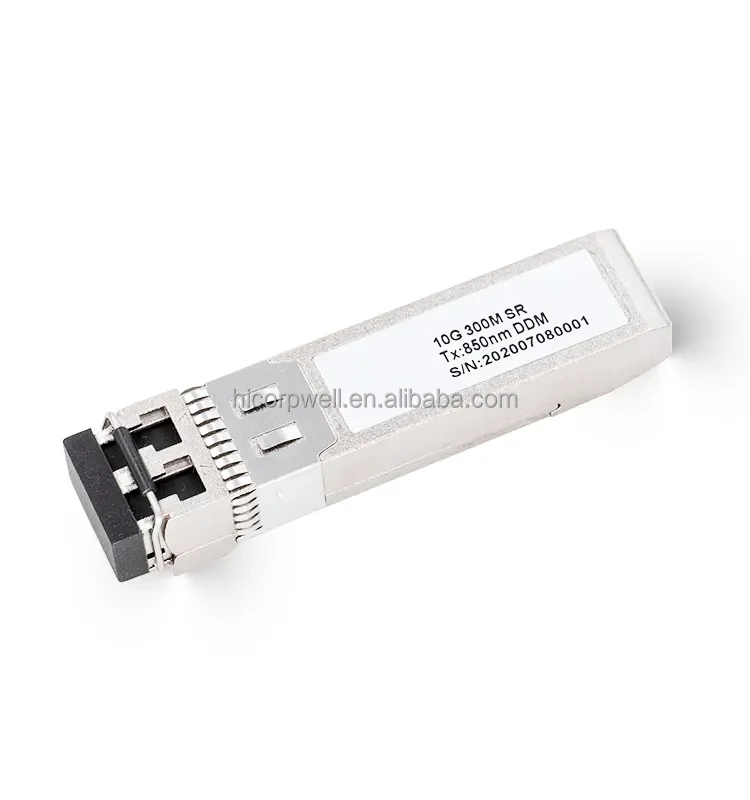
10GBase SR SFP Transceiver, SFP Multi Mode LC Module up to 300 Meters Compatible with Ciscoi Ericsson ,Netgear,D Link and More
- Category: >>>
- Supplier: Shenzhen Hicorpwell Technology Co. Ltd.
Share on (1601060960976):
Product Overview
Description
Product Overview
500m 10km 20km 40km 80km 100km 1G 10G SPF Modules SFP Optical Module Gpon Olt transceiver SFP SPF+ fiber optic module

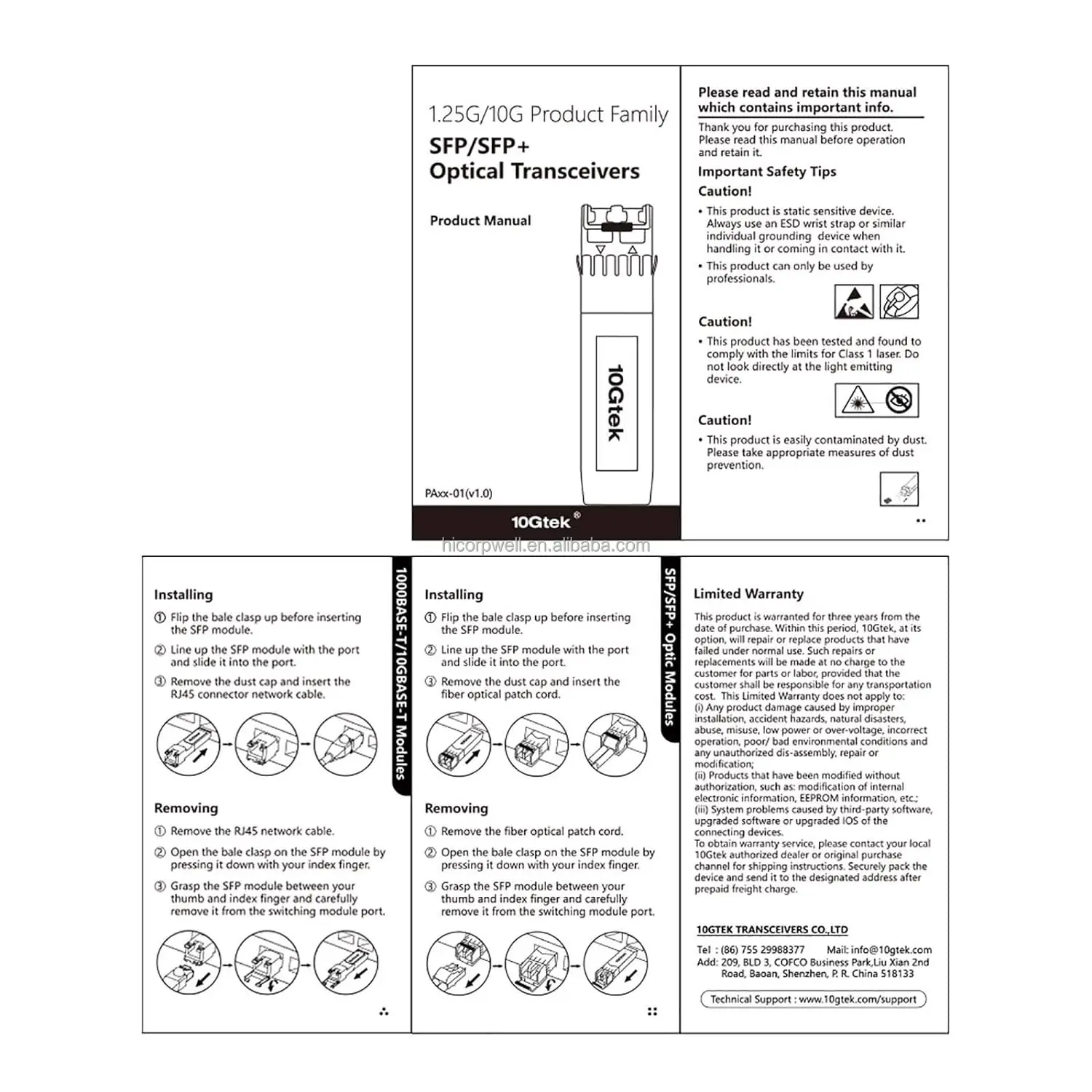
SFP stands for small form-factor pluggable. It’s also commonly called mini-GBIC (gigabit interface converter). SFP is a popular
transceiver for three main reasons. First is the small form factor. It’s size allows it to be used in tight networking spaces to provide fast communication between switches and important networking components. The second reason for its proliferation is the
variety of SFP connection options. SFP works with copper or fiber optics. The networks that can’t utilize SFP are scarce. Finally,
SFP is hot swappable. That makes it ideal for expanding or adjusting existing networks without having to redesign the entire cable
infrastructure.
transceiver for three main reasons. First is the small form factor. It’s size allows it to be used in tight networking spaces to provide fast communication between switches and important networking components. The second reason for its proliferation is the
variety of SFP connection options. SFP works with copper or fiber optics. The networks that can’t utilize SFP are scarce. Finally,
SFP is hot swappable. That makes it ideal for expanding or adjusting existing networks without having to redesign the entire cable
infrastructure.


1. Handle | 2. Receiver | 3. Transmitter | 4. Shell |
5. Label | 6. Dust cap | 7. Spring | 8. Module connector |

SFP Variety
SFP is designed to work with the bulk of modern networks. On the copper side, you will primarily find 1000BASE-T and 1000BASE-TX modules for gigabit Ethernet networking. SFP modules are excellent for bridging communications between switches in compact environments, provided everything is within 100 meters.
On the fiber optics side of the equation, options are massive. SFP modules are made to support singlemode
and multimode fiber. It works with simplex and duplex. Wavelength options range from 850 nm to 1550nm. Networking ranges are anywhere from around 500
meters to over 100 km. In all, there’s an SFP module for every job.
meters to over 100 km. In all, there’s an SFP module for every job.
Applications of SFP's
With all of this talk about SFP, the inevitable question arises. When is it useful? SFP has a wide reach of applications. For
copper modules, the most common use (as mentioned before) is bridging network switches. They provide fast copper connections without requiring bulky equipment.
In the realm of fiber optics, the applications cover anything that might involve high-speed and/or long-range cables.
copper modules, the most common use (as mentioned before) is bridging network switches. They provide fast copper connections without requiring bulky equipment.
In the realm of fiber optics, the applications cover anything that might involve high-speed and/or long-range cables.
High-definition audio transmission and reception, passive optical networks (PON), multiplexing and simplex networking are some of the most common uses of this technology. The variability of SFP allows it to provide modules for any of these connections, and it provides a range of options in cost, speed, range and accessibility.

Advanced SFP,
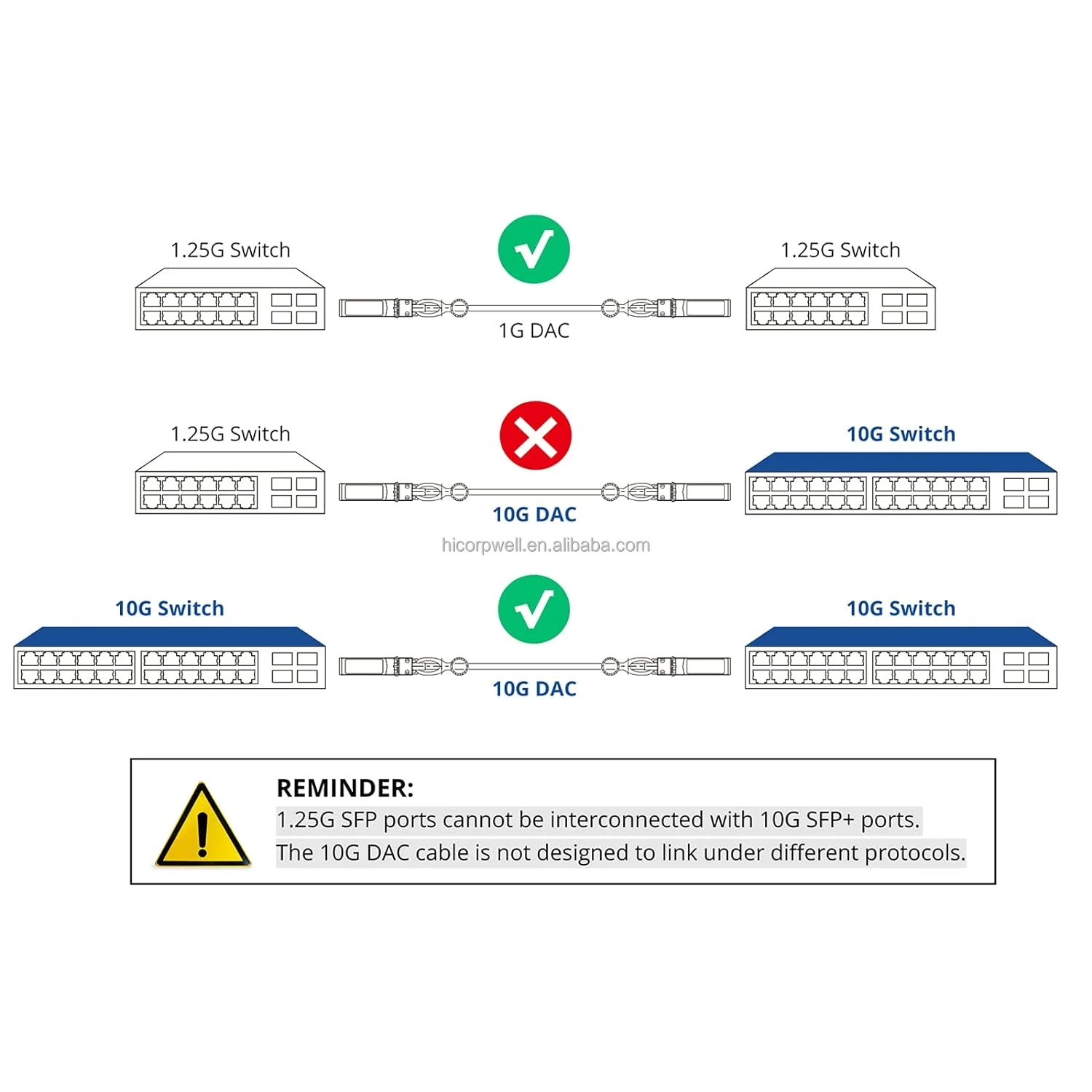
Since the development of SFP, modernized advancements have been added to the mix. Namely, SFP+ and QSFP are now available. SFP+ is a faster version of the same form factor. It supports speeds up to 10Gbps, and it typically works across shorter distances. SFP+
ports are usually compatible with SFP optics, but the reverse is not true. SFP+ cannot operate slower than 1Gbps.
ports are usually compatible with SFP optics, but the reverse is not true. SFP+ cannot operate slower than 1Gbps.
Complete mastery of SFP modules requires more learning that might fit in a single article, but this is enough to get started. What matters is that you understand how frequently SFP modules can be used to bridge communications between devices. From there, it’s a matter of matching the SFP design to the rest of the network.
FEATURES AT A GLANCE
All types of form factor pluggable devices are plugged into a special port on a switch or networking device, these transceivers used in various fields such as data communication and telecommunication.
Some of the pluggable transceivers are SFP, SFP+, XFP. XFP is a 10 GBit/s small form factor pluggable device, it usually operates at wavelengths of 850nm,1310nm or 1550nm. XFP also complies with the MSA agreement. SFP protocol specifications are based on IEEE802.3. SFP+ modules are smaller as compared with XFP and they comply with the protocol specification based on IEEE 802.3ae.
Some of the pluggable transceivers are SFP, SFP+, XFP. XFP is a 10 GBit/s small form factor pluggable device, it usually operates at wavelengths of 850nm,1310nm or 1550nm. XFP also complies with the MSA agreement. SFP protocol specifications are based on IEEE802.3. SFP+ modules are smaller as compared with XFP and they comply with the protocol specification based on IEEE 802.3ae.
XFP | SFP | SFP+ | |
Stands for | 10 Gigabit Small Form Factor Pluggable | Small Form-factor Pluggable | Small Form-factor Pluggable plus (standard form) |
Data rate | 10 G | 155M/622M/ 1.25G/ 2.5G/3G/ 4.25G | 6G/8.5G/10G |
Terms | Dual fiber Single Fiber/WDM CWDM DWDM | Dual fiber Single Fiber/WDM CWDM DWDM | Dual fiber Single Fiber/WDM CWDM DWDM |
Distance | 220m/300m/ 2km/10km/ 20km/40km/ 60km/80km/ 120km | 300m/2km/ 10km/15km/ 20km/40km/ 60km/80km/ 100km/120km/ 150km | 220m/300m/ 2km/10km/ 20km/40km/ 60km/80km |
Wavelengths | 850nm/1310nm/1550nm 1270nm/1330nm 1270nm-1610nm ITU17~ITU61 | 850nm/1310nm/1550nm 1310nm/1490nm/1550nm 1270nm-1610nm ITU17~ITU61 | 220m/300m/ 2km/10km/ 20km/40km/ 60km/80km/ 120km |
Successful Project

Difference Between Various Form Factor Pluggables
XFP which is a 10Gbit/s small form factor pluggable is a standard and doesn’t dependent on the protocol, it operates at wavelengths corresponding to 850nm, 1310nm, 1550nm. All XFP modules are hot swappable that’s means components can be replaced without shutting down the entire system.
SFP+ is an expansion of SFP standard, it can support speeds of 10Gbit/s or even higher. The modules under SFP+ includes copper
cable assemblies and cages connectors. It is very similar to the performance requirements of SFF-8431 and also supports 8G fiber
channel and 10G Ethernet applications.
SFP+ is an expansion of SFP standard, it can support speeds of 10Gbit/s or even higher. The modules under SFP+ includes copper
cable assemblies and cages connectors. It is very similar to the performance requirements of SFF-8431 and also supports 8G fiber
channel and 10G Ethernet applications.
SFP+ has various benefits when compared with its competitors, it is a compact module than XFP and also the cost is also less than that of XFP.
SFP is the short form of Small Form-factor Pluggable. It is a transceiver which we use widely in the field of networking and data communication. It is a hot pluggable and compact device and behaves as an interface between a networking device and its interconnecting cable. The cable could be a copper cable or it can be an optical fiber cable, it performs conversions between electrical and optical signals. SFP supports many standards such as Ethernet, SONNET, Fiber Channel etc. it can allow transport of gigabit and other fast Ethernet LAN packets over time division multiplexing based WANs, also it can help in transmission of E1/T1 streams over packet switched networks. SFP is an upgraded version of GBIC module i.e. Gigabit interface converter that’s why it is also called mini GBIC, it has very similar functionality as GBIC transceiver but has much smaller dimensions. The SFP permits greater port density (number of transceivers per inch along the edge of a mother board) than the GBIC.




We Recommend


New Arrivals
New products from manufacturers at wholesale prices