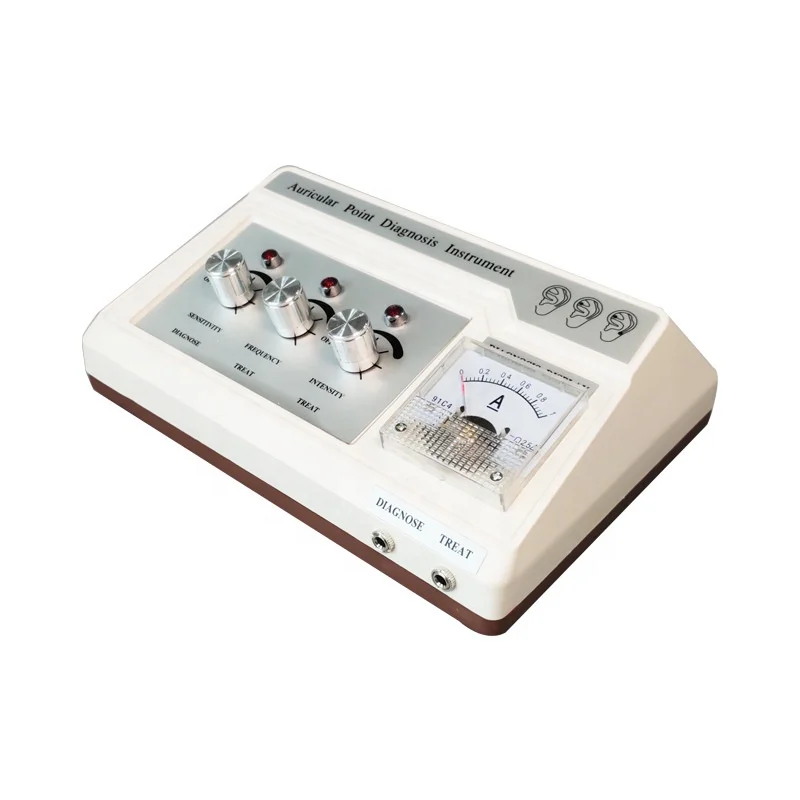
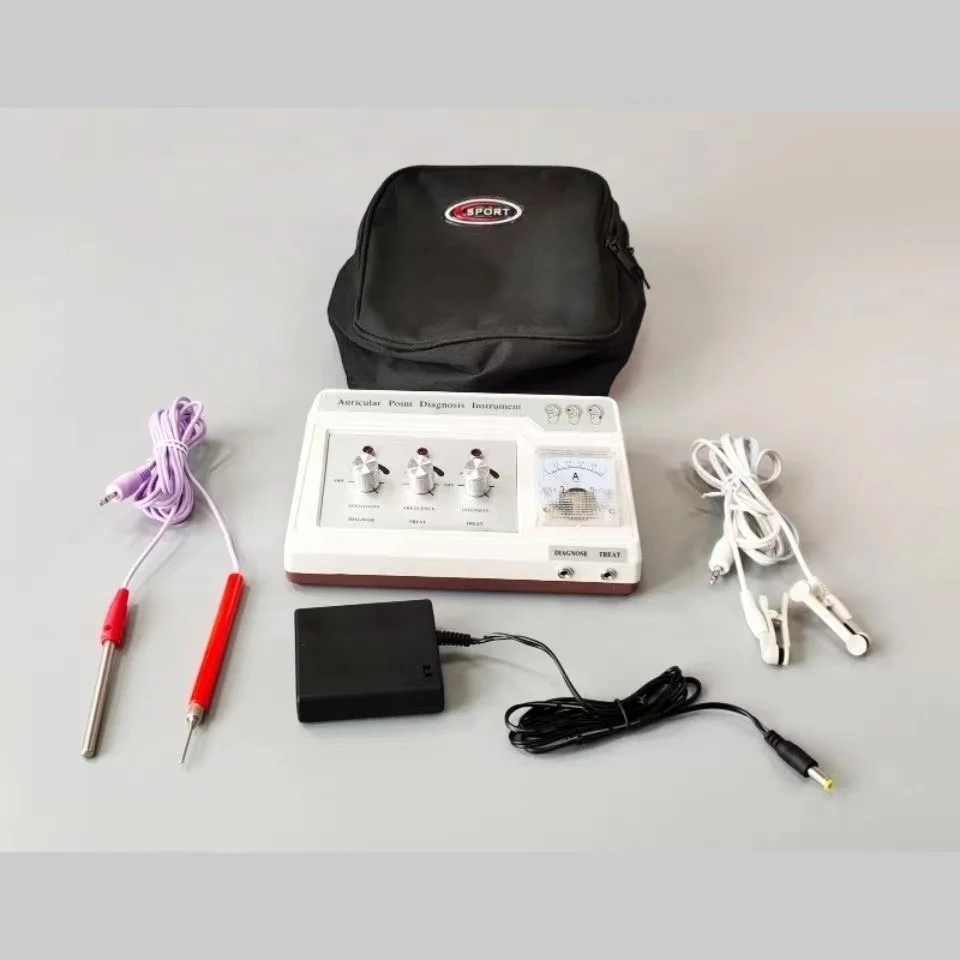
traditional Chinese therapy products electro acupuncture point stimulator diagnosis and treatment ear acupuncture instrument
- Category: >>>
- Supplier: Guangzhou Hearty Expresssion Medical Technology Co. Ltd.
Share on (1601175187553):
Product Overview
Description
Product Description
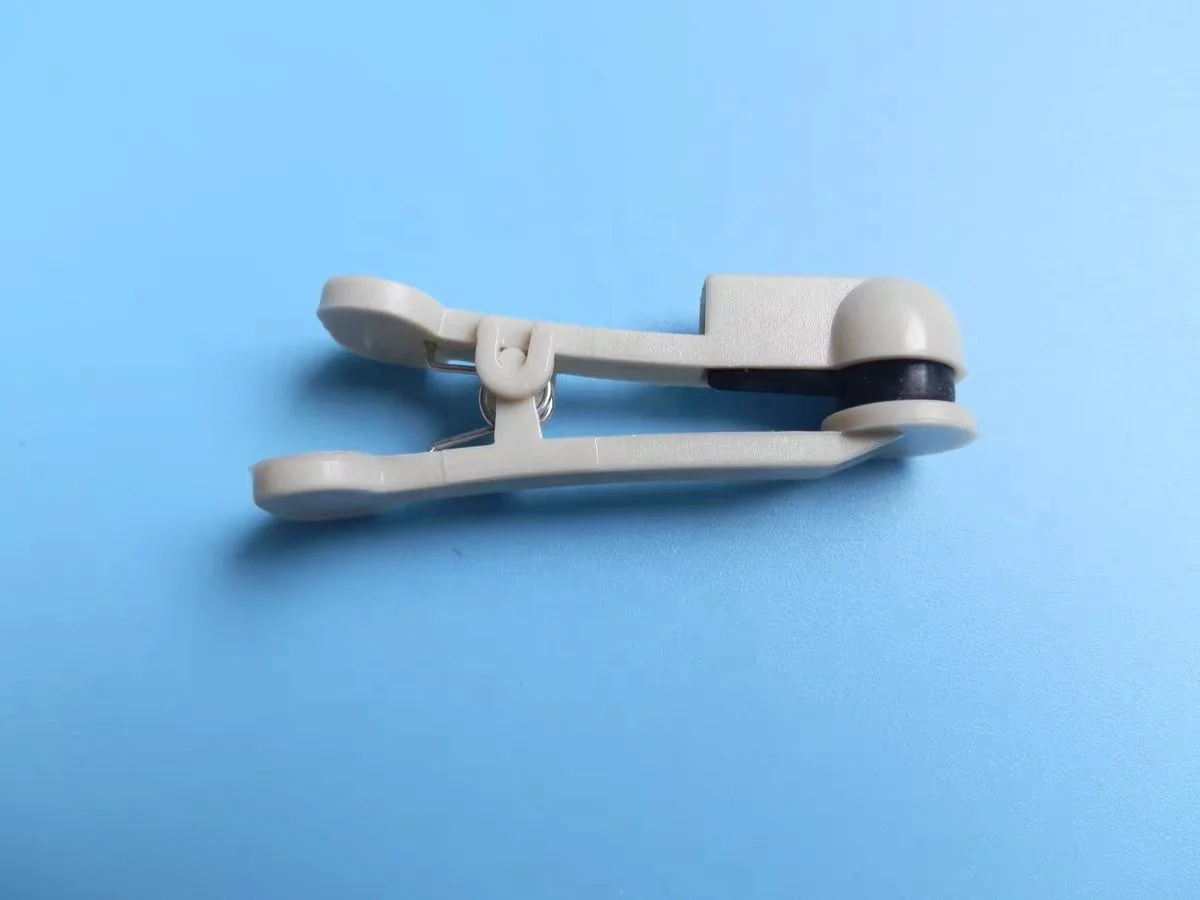
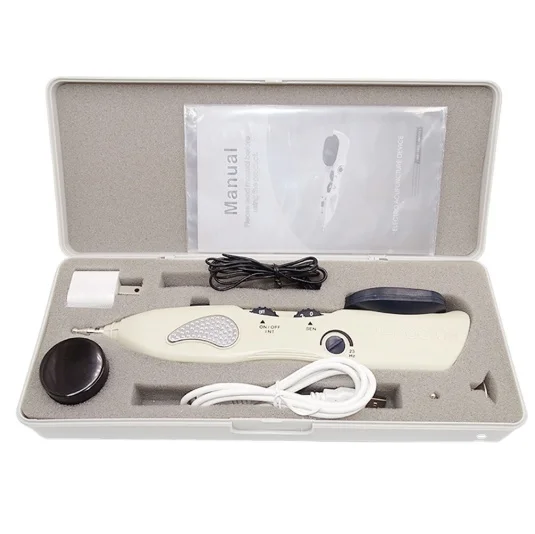
This ear acupoint diagnosis and treatment machine is specifically designed for the diagnosis and treatment of ear acupoints. The patient holds a probe, while the operator holds another probe to detect the strength and loudness of the ear acupoint signal on the auricle. Can be used to analyze the patient's condition. Ear clip can be used for operation, controlling frequency and strength.
All otology practitioners should have the necessary equipment.
All otology practitioners should have the necessary equipment.
When detecting, the patient holds the electrode rod in their hand and the doctor uses a probe to detect, or they hold the electrode rod in one hand and probe their ears with the other hand.
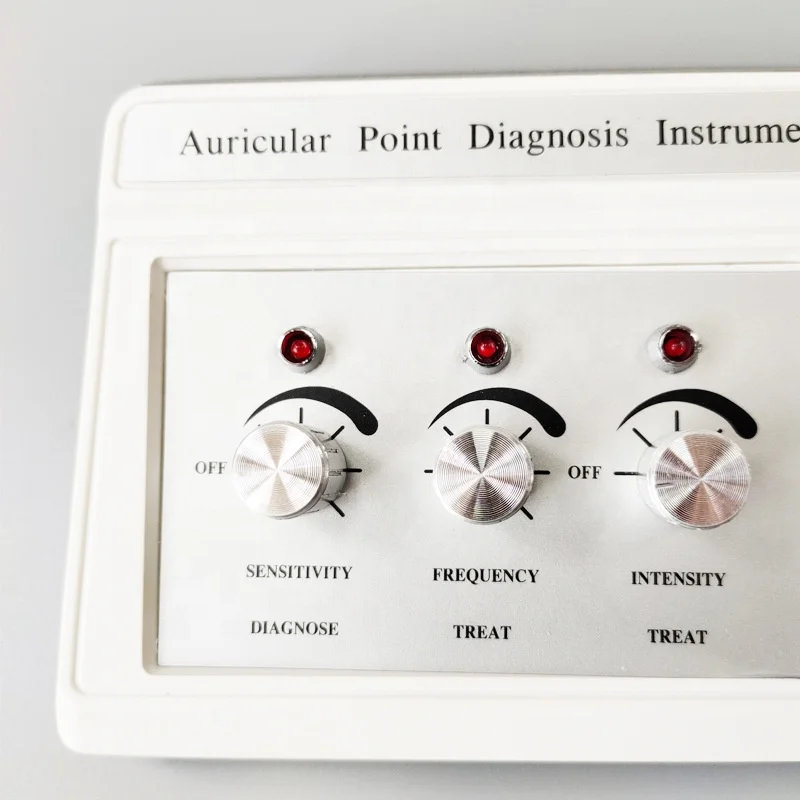
Turn on the leftmost knob DIAGNOSE and start the detection. If the sound is loud and continuous, it indicates that there is sub health or illness in the corresponding area.
Turn on the leftmost knob DIAGNOSE and start the detection. If the sound is loud and continuous, it indicates that there is sub health or illness in the corresponding area.
Advantages

Introduction of Professor Huang Lichun
Currently, Professor Huang Lichun is considered the world's most outstanding ear medicine expert and one of the top ear medicine physicians in China. Before coming to the United States, Professor Huang worked in 301 Military Hospital, the best hospital in Beijing, for 35 years. She once served as the director of the acupuncture and moxibustion Department of 301 Military Hospital. In 2002, she was awarded the Lifetime Research Achievement Award at the World International Symposium on Ear Acupuncture Therapy and Otology held in Puerto Rico. During the visit of Italian President Andrioti to China, she received her diagnosis and treatment. Professor Huang only used an ear acupoint detector to examine the ear acupoints and diagnosed cervical spondylosis in just 5 minutes. Cervical hyperplasia caused a right posterior headache. Apply Wangbuliu Xingzi to four ear acupoints, and after treatment, apply the techniques of finger work to generate heat, promote meridian circulation, and Qi to the affected area. The headache caused by cervical spondylosis immediately disappears. In gratitude for her miraculous diagnosis and treatment, the Italian President awarded him a gold medal. Professor Huang Lichun once led the Chinese military medical delegation to Cuba to teach Cuban doctors the skills of Chinese acupuncture and moxibustion otology, and was awarded the National Medal of Fighting Friendship by Cuban President Fidel Castro for his contributions.
Professor Huang Lichun has treated over 250.000 patients worldwide, including senior Chinese government leaders and generals, as well as government ambassadors from other countries, such as the presidents of Italy, Cuba, and North Korea. In the field she is engaged in, Professor Huang has been awarded the title of Senior Medical Expert by the Chinese government, enjoys government subsidies, and is recognized as a professional expert with a unique skill. In the United States, he is a professor at three traditional Chinese medicine schools and an academic advisor to many global medical organizations.
Professor Huang is a senior researcher in the field of otology, who has conducted extensive research and provided detailed records of his research findings. Professor Huang has published 20 books, including 8 textbooks on ear medicine and 4 monographs on ear medicine. Three of them have been translated into English; One book was translated into Spanish; A book has been translated into Portuguese. There are four traditional Chinese version works in Taiwan, and four simplified Chinese version works have been published in China. And there are two color atlases of ear acupoints, as well as a portable manual for ear acupoint treatment. The nearly 670 page English version of Otology has become a textbook for otology in major traditional Chinese medicine schools in the United States.
Professor Huang Lichun has treated over 250.000 patients worldwide, including senior Chinese government leaders and generals, as well as government ambassadors from other countries, such as the presidents of Italy, Cuba, and North Korea. In the field she is engaged in, Professor Huang has been awarded the title of Senior Medical Expert by the Chinese government, enjoys government subsidies, and is recognized as a professional expert with a unique skill. In the United States, he is a professor at three traditional Chinese medicine schools and an academic advisor to many global medical organizations.
Professor Huang is a senior researcher in the field of otology, who has conducted extensive research and provided detailed records of his research findings. Professor Huang has published 20 books, including 8 textbooks on ear medicine and 4 monographs on ear medicine. Three of them have been translated into English; One book was translated into Spanish; A book has been translated into Portuguese. There are four traditional Chinese version works in Taiwan, and four simplified Chinese version works have been published in China. And there are two color atlases of ear acupoints, as well as a portable manual for ear acupoint treatment. The nearly 670 page English version of Otology has become a textbook for otology in major traditional Chinese medicine schools in the United States.
Instruction
1、 Characteristics of this instrument
This instrument can perform non-invasive diagnosis and treatment, indicate good points in the form of sound, and can also
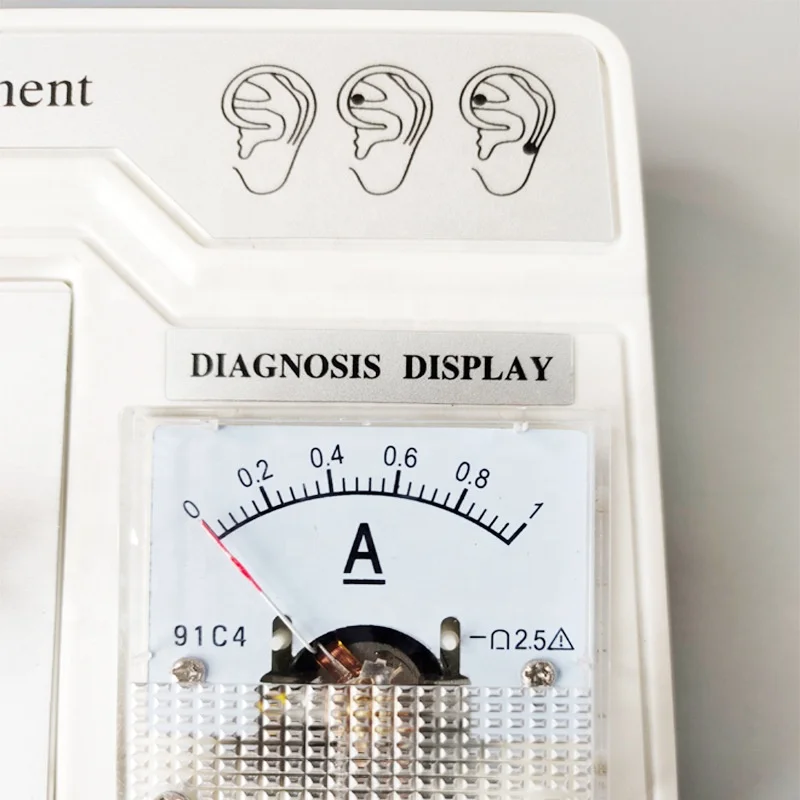
The ammeter method provides a relatively quantitative reading of good conductivity points.
This instrument is compact, lightweight, flexible, and easy to carry. It is not limited by environmental conditions during use and
is suitable for
Used for healthcare in grassroots, rural areas, pastoral areas, medical institutions at all levels, and individuals.
2、 Operation method
1. Preparation
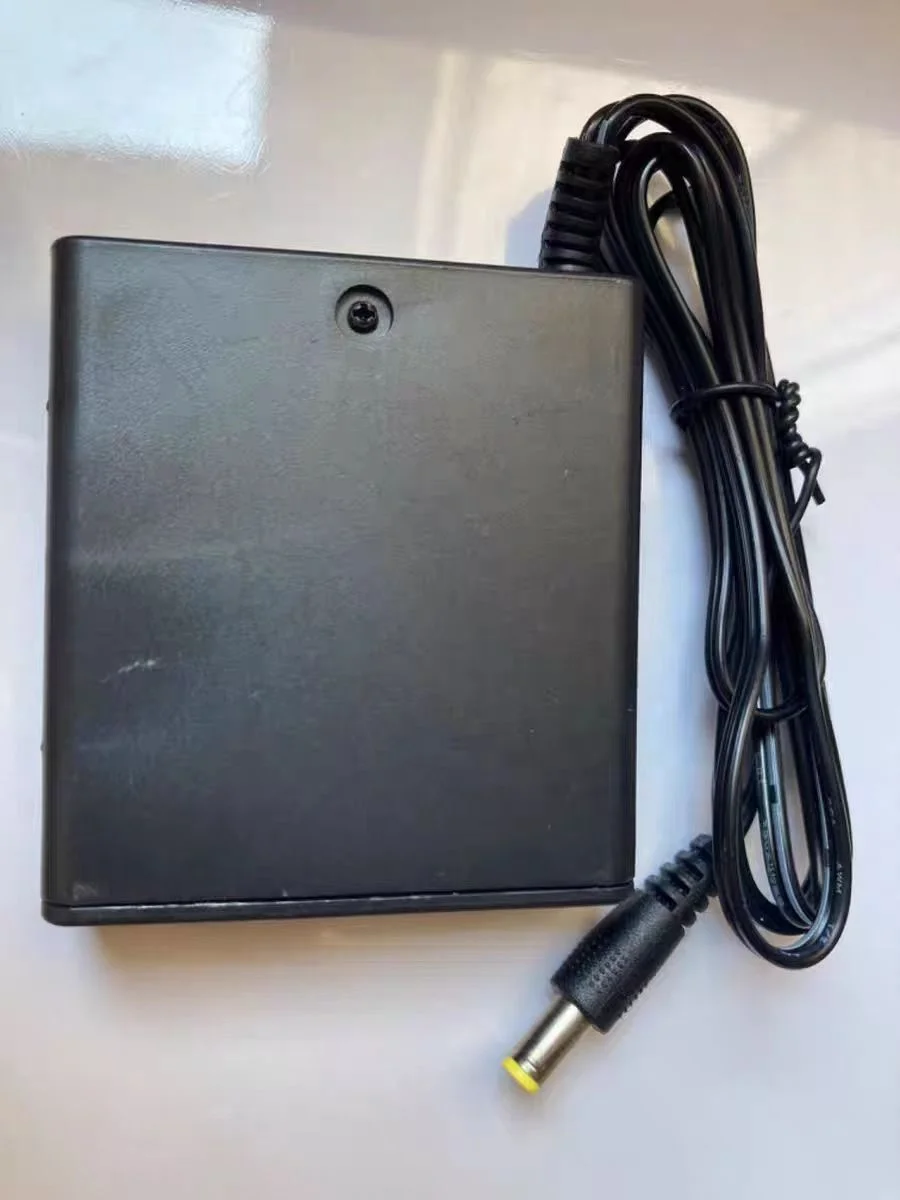
1.1 Check if the battery is installed
1.2 Turn all three knobs on the instrument panel counterclockwise to the mark facing "-";
1.3 Insert the plug of the detection cable into the host socket.
2. Operation
2.1 Turn on the diagnostic switch;
2.2 Touch the detection pole and the handheld pole, and the instrument speaker emits a sound to indicate that the detection
circuit is normal. If there is no sound
Sound can be adjusted by adjusting the sensitivity knob to produce a sound.
2.3 Sensitivity calibration: Have the subject hold the electrode, the examiner (doctor) hold the detection electrode, and use a
metal probe pen
Touch the tip of the subject's ear or palm, and if there is no sound, turn the sensitivity knob clockwise until it makes a sound,
The same subject only needs to be calibrated once, and since each person's skin resistance value is different, it is best to
calibrate each subject
Each one needs to be calibrated first and then detected.
2.4 Detection: The examiner holds a probe and the patient holds the electrode to determine a positive and good lead point.
Using changes in sound as the basis for judgment, based on two factors: the strength of the time response of the sound appearance
and the change in tone
Judging from various aspects, and assessing whether the acupoints are accompanied by tenderness, stabbing pain, deformation,
discoloration, peeling, papules, and blood
Tube filling and other references. Divide positive and good points into three types.
(1) Weak positive: The sound system appears slow and has a low pitch. No tingling sensation, indicated by (+, -).
(2) Positive: The sound system appears fast, with a high pitch and tenderness, indicated by (+).
(3) Strong positive: The sound system appears at a fast speed, with a high pitch and accompanied by stinging pain, represented by
(+--++).
The significance of 3 good leading points in diagnosis
3.1 Weak positive points are only used as a reference or suspicion in diagnosis, and are not used as a diagnostic basis.
3.2 Positive guide points, indicating that lesions in the corresponding parts of the body are occurring, developing, or
recovering, serve as
Diagnostic analysis acupoints.
3.3 Strong positive points: Indicating the main site of muscular diseases, which is the most pathological change of the disease in
the body
The main part, as a specific reference point, should be analyzed as a key point. Has value in localization and qualitative
diagnosis.
4. Detection techniques
4.1 When detecting, the pressure should be uniform and moderate, and should not be too heavy or too light. Excessive pressure can
easily lead to false positive points
Easy to miss good guidance points.
4.2 The duration of staying at each acupoint should be consistent to avoid stimulating the same acupoint multiple times to avoid
false positives.
4.3 The detection speed should not be too fast or too slow, as too fast may miss good guidance points.
3、 The use of ammeters
1. Turn on the diagnostic knob switch.
2. When the grip and probe of the measuring line are separated, the indication of the ammeter is zero.
3. When the grip and probe collide, the pointer indicates 100uA. If it is too large or too small, it can be turned clockwise\\
Or adjust the calibration knob in a counterclockwise direction/fine adjustment, following the principle of the pointer not hitting
the meter, and check it on the same patient
During the process, only adjust once to avoid confusion in the instructions.
4. The ammeter directly indicates the reading, which can be used by doctors to quantitatively interpret acupoints for the same
patient.
4、 Usage and operation methods during treatment
1. Turn on the treatment switch knob and frequency switch knob, and insert the treatment wire into the treatment socket. At this
time, the instrument
The treatment switch knob and frequency switch knob of the device are both effective in controlling the treatment output.
2. The sign of the instrument entering the treatment state is that the current output indicator light is on and the frequency
output indicator light is flashing.
3. This instrument is equipped with ear acupoint clips for non-invasive treatment of various acupoints in the ear, including
cervical spondylosis, lower back and leg pain, and gallbladder
Stones, headaches, neurasthenia, etc.
4. The "frequency" and output intensity can be adjusted during treatment, and the "frequency" can be rotated after determining
the treatment site
And the "output" knob. The treatment frequency of this instrument can vary from 1Hz-100Hz, and can be adjusted with
The patient tolerates to a certain degree.
5、 Precautions during use
1. This instrument is a pocket electronic instrument with an injection molding casing, which should be avoided from scorching
sun and high temperature
Baking should avoid moisture and rain, as well as strong vibrations and falls.
2. When detecting, it is not advisable to connect the handheld pole to the detection pole for a long time to avoid affecting the
lifespan of the component; During treatment
It is not advisable to hold the metal parts of two wires by hand to avoid electric shock.
3. When not in use, the function switch should be turned off and all three knobs on the panel should be turned
counterclockwise/turned
To indicate "-".
4. When not in use for a long time, the battery should be removed.
6、 After sales service
1. This product comes with a one-year warranty (excluding human damage and batteries)
2. The cost of repairing products without a factory date will be charged.ged.
Specification
item | value |
Place of Origin | China |
Brand Name | Hearty Expression |
Model Number | HE-EAI01V1 |
Function | Antirheumatic |
Application | Ear |
Shelf Life | 1years |
Quality Certification | CCC |
Instrument classification | Class I |
Safety standard | None |
Name | Earpoints acupuncture instrument |
Type | Electric aunpuncture |
Functions | Diagnosis and treatment |
Needle head | 2 heads |
Power | 2 pcs No. 7 dry batteries |
Applicable scenerios | Hospitals and therapy center |
Diagnosis probe | 1 piece |
Frequency and intensity | Adjustable |
Suitable for 1 | cervical spondylosis, headaches, |
Suitable for 2 | lower back and leg pain, and gallbladder Stones, neurasthenia, etc. |
Why Choose Us

Related Products
Our Team

Certificates

Packing & Shipping

FAQ


We Recommend
New Arrivals
New products from manufacturers at wholesale prices