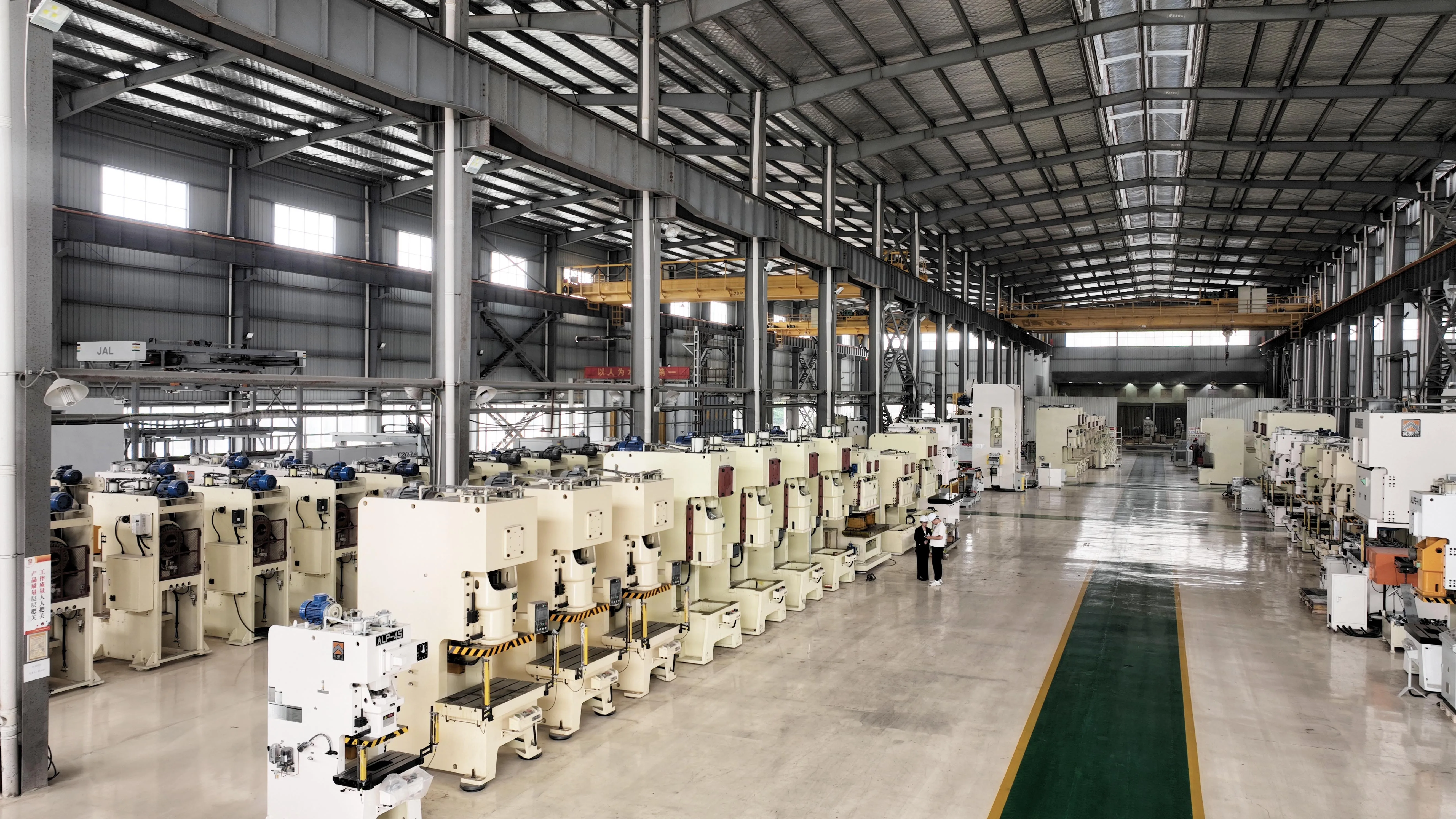
High Precision Single Press Station Power Press Machine for Metal Coin Closed Stamping and Punching
- Category: >>>
- Supplier: Zhejiang Jinaolan Machine Tool Co. Ltd.
Share on (1601200456009):
Product Overview
Description
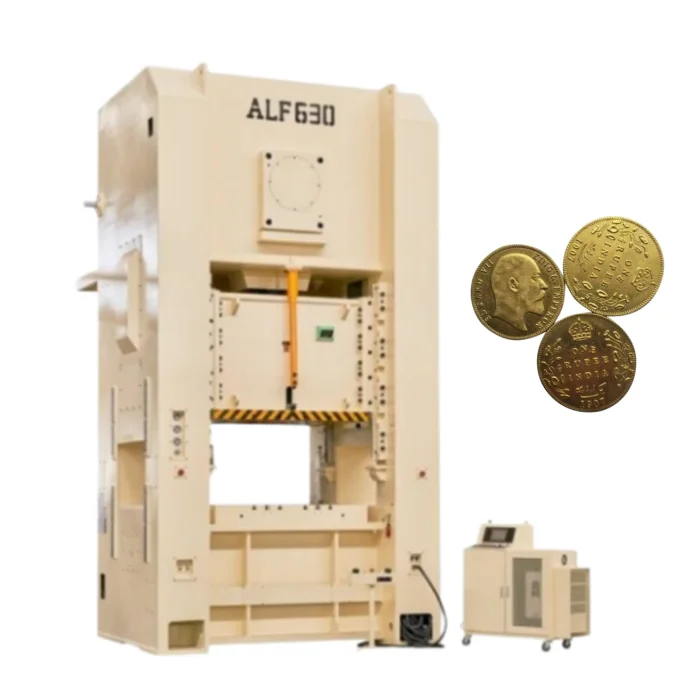
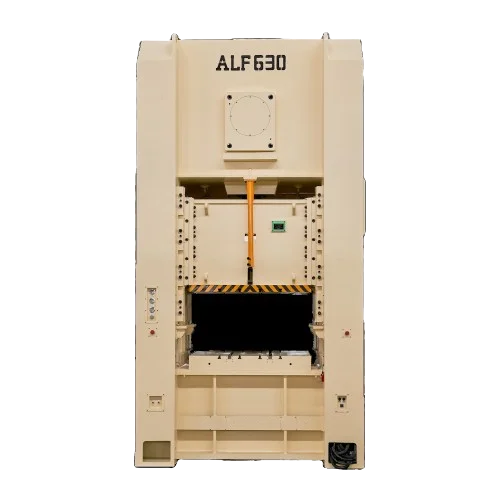
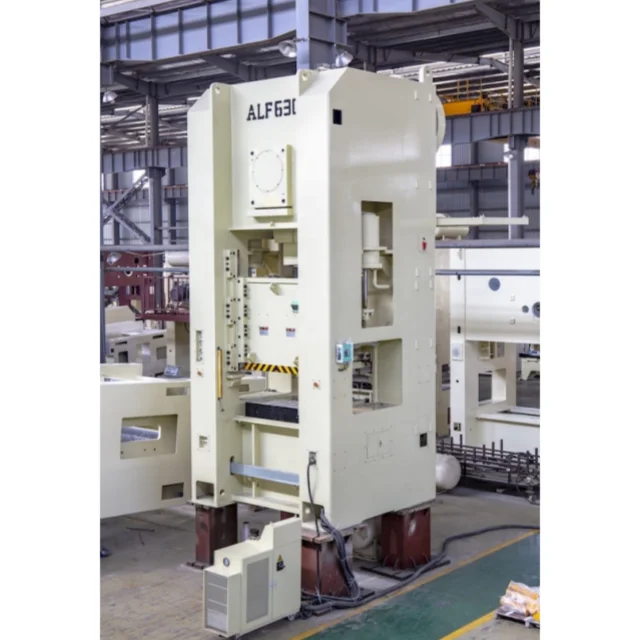
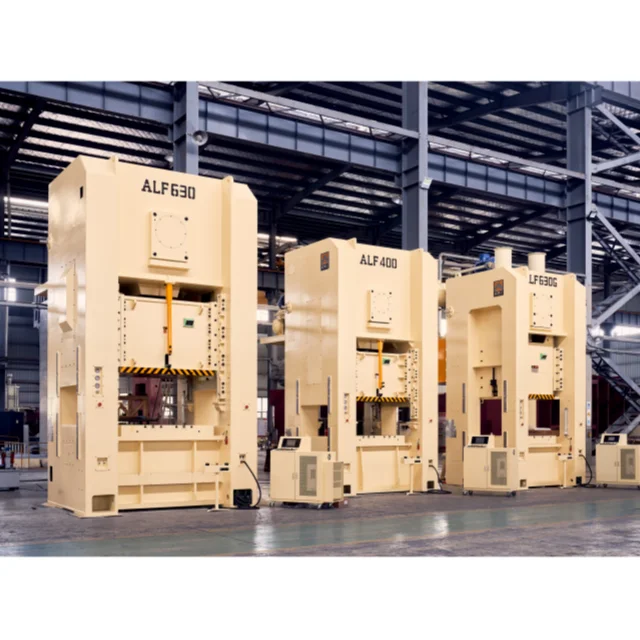
ALF-630 Single Crank H Frame Power Press
| Metalworking Turnkey Solution | Metal Stamping Press Machine
| Stamping Tool/Progressive Die | Uncoiler Straightener and Feeder
| 2D & 3D Transfer Manipulators / Stamping Robots / Automation System
| Stamping Tool/Progressive Die | Uncoiler Straightener and Feeder
| 2D & 3D Transfer Manipulators / Stamping Robots / Automation System
Product Images


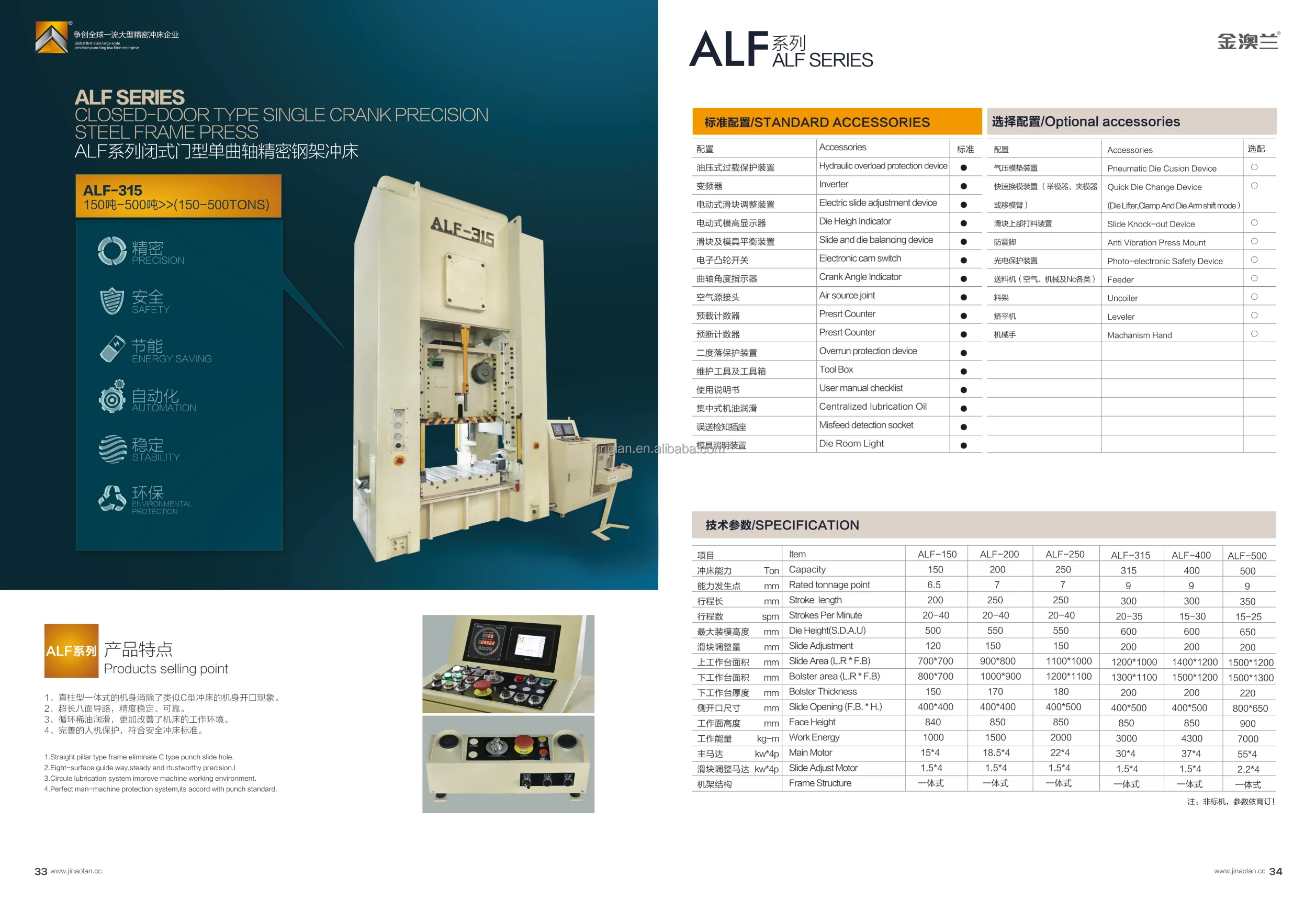
ALF Series
1.KINGLAN famous brand, the ALE(JH21) series press machine capacity can be 160 T, 200 T, 250 T, 300 T,400 T,500 T. Punching -machine Stamping Mold Save Energy 30% . ISO /CE certificate approved.
2.Pneumatic open type double crank Punching Machine /press machine/Power Press
3.ALT air source punching machine customized table size
Basic Parameter
项目 | Item | ALF-630 |
型式 (Ton) | Type | 630T |
行程长 (mm) | Stroke Length | 350 |
行程数 (spm) | Strokes Per Minute | 15-25 |
能力发生点 (mm) | Rated Tonnage Point | 9 |
最大装模高度 (mm) | Die Height(S.D.A.U) | 700 |
滑块调整量 (mm) | Slide Adjustment | 250 |
上工作台板(mm) | Slide Area (L.R* F.B) | 1800*1450 |
下工作台面积(mm) | Bolster Area (L.R* F.B) | 1800*1500 |
主马达( kw*4p) | Main Motor | 230 |
冲床精度 | Precision | CNS(JIS) Class 1 |
KINGLAN Profile

KINGLAN Press Machine
25T to 2400T
We could provide the whole line solution including power press, feeder and decoiler, mold, manipulator, Iron-hand, robot, etc.
After twenty years of dedication, KINGLAN has become a comprehensive stamping manufacturer, specializing in technology research and development, manufacturing, and sales. Our products are widely used in aerospace, automobile, shipbuilding, electronic appliances, instrumentation, medical equipment, metal products, and other manufacturing industries.
Precision assembly, enhanced value. Our state-of-the-art assembly equipment, including manipulators and punch assembly joint simulation, greatly improves assembly efficiency. Through adjustment, inspection, testing, and other assembly processes, we ensure the high precision and reliability of our products.
Throughout our years of manufacturing high-quality power presses and other press products, we have prioritized customer satisfaction. We believe in providing the right solutions to meet your needs, whether it is supplying the necessary parts for your existing machines, offering affordable presses, or providing ongoing support to maintain your machines' optimal condition.
Our goal is to deliver the highest level of quality to our customers, both in terms of our power presses and other press designs,as well as in our customer service interactions. With our 20 years of experience, we are well-equipped to meet the diverse needs of our customers. Contact us today to learn more!
After twenty years of dedication, KINGLAN has become a comprehensive stamping manufacturer, specializing in technology research and development, manufacturing, and sales. Our products are widely used in aerospace, automobile, shipbuilding, electronic appliances, instrumentation, medical equipment, metal products, and other manufacturing industries.
Precision assembly, enhanced value. Our state-of-the-art assembly equipment, including manipulators and punch assembly joint simulation, greatly improves assembly efficiency. Through adjustment, inspection, testing, and other assembly processes, we ensure the high precision and reliability of our products.
Throughout our years of manufacturing high-quality power presses and other press products, we have prioritized customer satisfaction. We believe in providing the right solutions to meet your needs, whether it is supplying the necessary parts for your existing machines, offering affordable presses, or providing ongoing support to maintain your machines' optimal condition.
Our goal is to deliver the highest level of quality to our customers, both in terms of our power presses and other press designs,as well as in our customer service interactions. With our 20 years of experience, we are well-equipped to meet the diverse needs of our customers. Contact us today to learn more!
Whole Line Solution
Feedering Material System Machines
The wide range of automatic equipment that we supply includes 3-in-1 decoiler straightener feeder, 2-in-1 decoiler straightener,decoiler, coil straightener, press feeder, coil blanking line, as well as all kinds of press transfer including 2D transfer, 3D transfer, single bar transfer, and long beam transfer between multiple presses, etc.
Dependable Quality: KINGLAN continues to control the entire supply chain and quality from raw material to machine assembly. All machines are certified with the European CE mark. Lower maintenance and procurement costs help you maximize efficiency and profits.
KINGLAN is active in global markets with permits for import and export. We have completed numerous successful projects with local manufacturers in the Czech Republic, Italy, Portugal, Ireland, Spain, Canada, the USA, Mexico, South Africa, as well as Asian markets such as South Korea, Malaysia, Indonesia, Pakistan, and India.
KINGLAN is active in global markets with permits for import and export. We have completed numerous successful projects with local manufacturers in the Czech Republic, Italy, Portugal, Ireland, Spain, Canada, the USA, Mexico, South Africa, as well as Asian markets such as South Korea, Malaysia, Indonesia, Pakistan, and India.

Manipulator
The stamping robotic arm manipulator is a device developed on the basis of automation equipment and specially developed for the unmanned production of stamping automation according to the characteristics of stamping products. It can replace the man power in terms of stamping, handling, loading and unloading of materials in various stamping stations.

Mold Design & Manufacturing
The power press stamping molds/tools are including:
1. Progressive die,
2. Stage mold (single stage mold),
3. Transfer mold (with transfer system)
What is the difference between progressive die, stage mold and transfer mold?
Continuous die (also known as progressive die, step die) refers to the press in a stroke, in turn in several different positions, at the same time to complete a number of procedures of the die. Blanking parts are gradually formed in the continuous die, continuous forming is a process method of process concentration, can make the edge cutting, incision, groove cutting, punching, plastic deformation, blanking and other processes in a mold to complete. According to the actual needs of stamping parts, according to a certain order arranged a number of stamping processes (called in the progressive die station) for continuous stamping. It can not only complete the blanking process, but also complete the forming process, and even the assembly process, many complex stamping parts that need multi-process stamping can be completely formed on a die, which provides favorable conditions for high-speed automatic stamping. It can be seen
that the continuous die is a kind of punching die with many working stations and high efficiency.
that the continuous die is a kind of punching die with many working stations and high efficiency.
An engineering mold (single working procedure mold/single-stage mold) is a mold with a single working position and a single working procedure. It is characterized by a simple mold structure and requires manual or robotic arm assistance. As a result, the production efficiency is relatively low, and it is mainly used for the production of workpieces with small batch sizes and low precision requirements. Due to the low cost of engineering molds and the low tonnage requirement for punch presses, the engineering mold approach is often preferred when designing molds. However, with the continuous increase in costs, engineering molds are gradually being replaced by continuous molds or transfer molds.
Multi-station transfer mold, generally refers to the use of special multi-station punch, by a number of engineering mold with a certain process connection according to the process sequence installation, a kind of mold delivered by the manipulator. The most important characteristics of the multi-station transfer die (1) in the use of multi-station punch;(2) Each station is a complete engineering model to complete a specific process. Each engineering mold (single station-mold)
has a certain connection, each station mold can be adjusted independently, and the adjustment is generally not restricted by the front and back mold;(3) transmission mode: mechanical hand delivery.
has a certain connection, each station mold can be adjusted independently, and the adjustment is generally not restricted by the front and back mold;(3) transmission mode: mechanical hand delivery.

Product Details
Electrical Control Box
Touch Screen
Exhausting System
Application


Partnership

Package/Delivery


Customers Visit


Certifications
We can supply
1. CE, ISO Certification.
2. We can supply KINGLAN brand or OEM for clients.
3. We can supply product line solution according to clients' requirements.
4. The pressure, stroke, and time of pressure maintaining can be regulated.
5. High quality and performance with good price.
6. Safe and stable operation.
7. Support 7*24 remote service or locate service.
8. Supply maintenance service all life.

Our Service
Guarantee period:
Our product quality guarantee period is 12 months from B/L date. During guarantee period, we will provide spare
parts without any charge in case of quality discrepancy caused by us. If the malfunctions are caused by customers’ incorrect operations, we will provide customers spare parts at cost price. We also can offer flexible extended warranties according to the actual situation.
parts without any charge in case of quality discrepancy caused by us. If the malfunctions are caused by customers’ incorrect operations, we will provide customers spare parts at cost price. We also can offer flexible extended warranties according to the actual situation.
After-sales services:
Our engineer can go to your factory for installation and showing operation details on condition of you provide the round-trip air tickets, visa formalities, food and accommodation. In turn, your engineers can come to our factory for learning the installation, operation and maintenance for free.
Why Choose Us:
1. We will run the machine for a few days, and use your materials to do the test. Only guarantee the machine shows best performance, and then we will ship out.
2. Our elite teams can provide you professional, customized, and all-round services around the clock.
How can we provide you efficient services (metal processing solution):
There are Three Steps as following:
1. Gather your requirements based on your real working situation.
2. Analyze your information and provide our feedback.
3. Offer options based on your specific needs. For instance, reg. standard products, we can offer professional recommendations; reg. non-standard products, we can offer professional designing.
Contact US

FAQ
Q: Are you a factory or trading company?
A: We are a factory which has been producing stamping machines for more than 35 years.
Q: What are your main products?
A: We specialize in manufacturing press machine, decoiler straightener and feeder, metal stamping die, transfer arms etc. i.e. we mainly help customers contract to build the whole stamping line projects.
Q: What's the delivery time?
A: The standard machine is 25 to 30 days after payment. If asked to supply whole production line by our customer, we will confirm the delivery time based on the specific project itself.
Q: What's your payment term?
A: We advise 30% T/T deposit, balance paid before shipment.
Q: Do you receive OEM?
A: Yes, we warmly welcome customers to do OEM in our factory.
A: We are a factory which has been producing stamping machines for more than 35 years.
Q: What are your main products?
A: We specialize in manufacturing press machine, decoiler straightener and feeder, metal stamping die, transfer arms etc. i.e. we mainly help customers contract to build the whole stamping line projects.
Q: What's the delivery time?
A: The standard machine is 25 to 30 days after payment. If asked to supply whole production line by our customer, we will confirm the delivery time based on the specific project itself.
Q: What's your payment term?
A: We advise 30% T/T deposit, balance paid before shipment.
Q: Do you receive OEM?
A: Yes, we warmly welcome customers to do OEM in our factory.
We Recommend
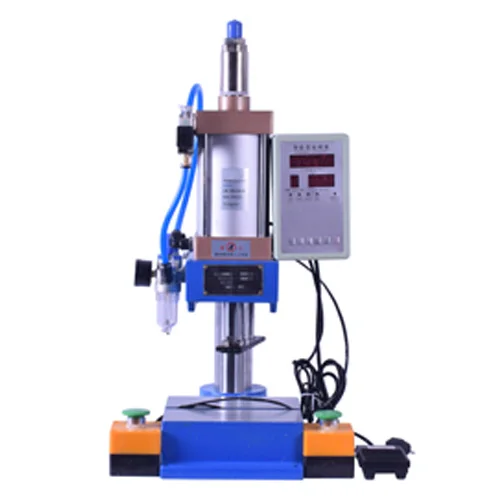
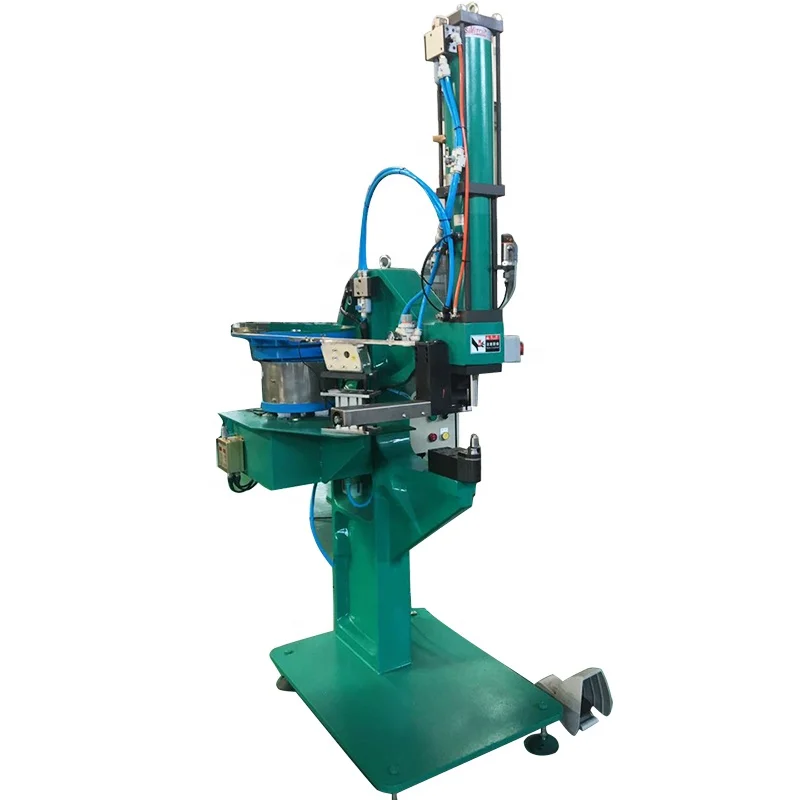
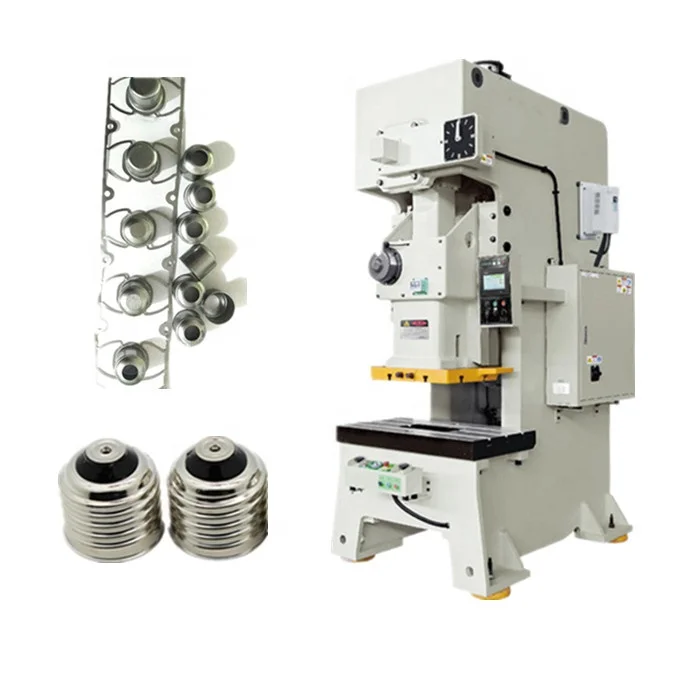
80 Ton Sheet Metal Punching Machine Price
$18,500.00-18,800.00
JH21-110L 110Ton Stroke Adjustable C Frame Metal Punching Press Machine
$27,900.00-28,600.00
JH21-45L 45Ton Stroke Adjustable Metal Punching Press Machine
$16,000.00-17,000.00
New Arrivals
New products from manufacturers at wholesale prices