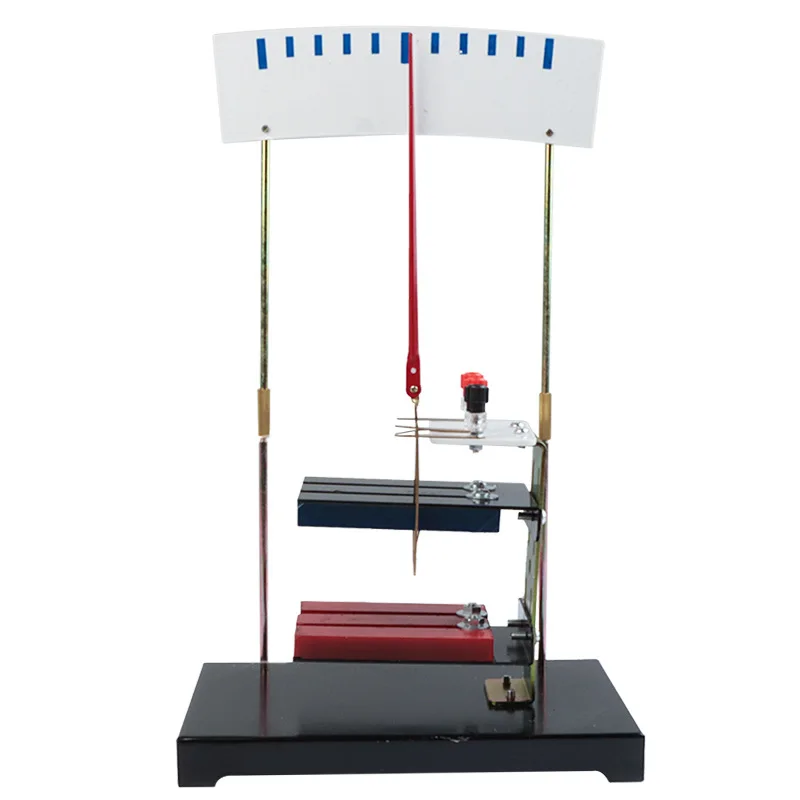
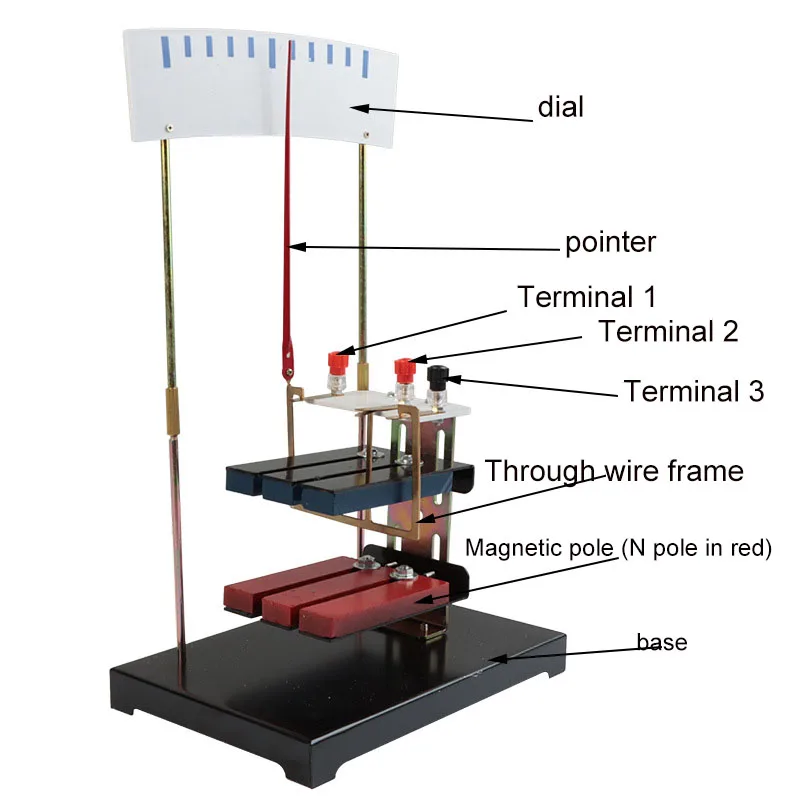
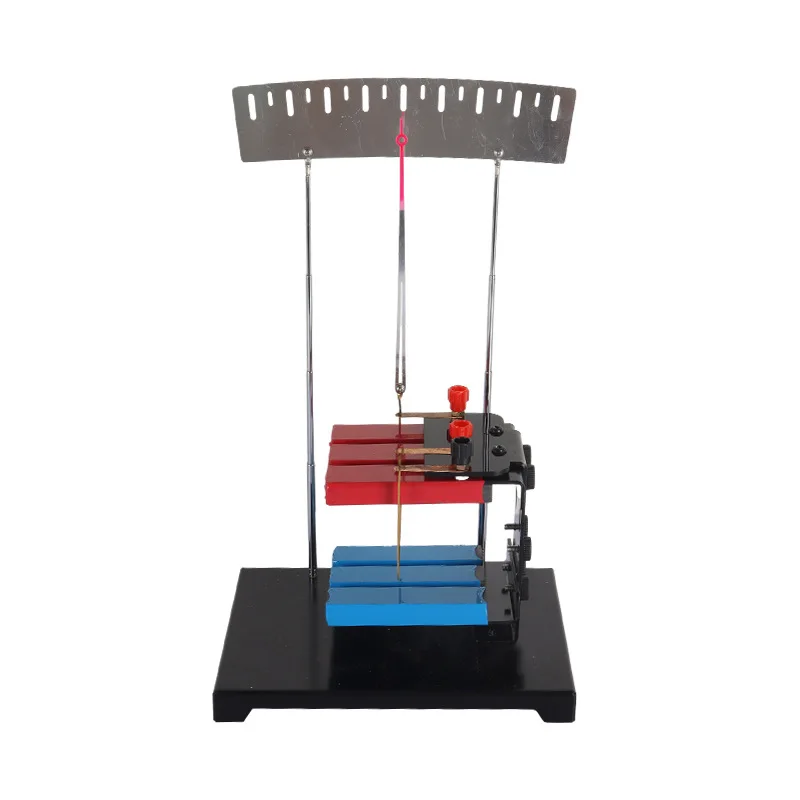
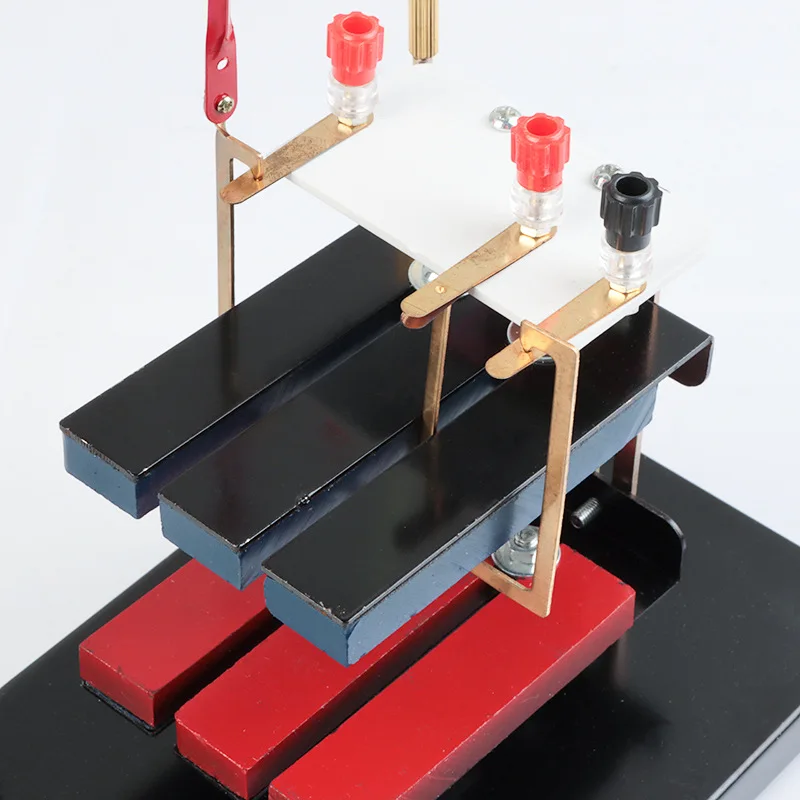
Use Method:Install the instrument according to the diagram, and prepare a student power supply (or 4 dry batteries), a single-pole switch, a 10-20 euro sliding rheostat, and several wires. The above instrument is formed into a series circuit through the terminal and the wire frame.
1. Demonstrate the effect and direction of the magnetic field on the energized conductor
A. Connect the 1 and 3 terminals of the demonstrator to the circuit, turn on the power supply (3-6V), and see that the pointer deflects, indicating that the wire frame is affected by a force in the magnetic field, which is the ampere force. When the current direction is changed, it can be found that the direction of the pointer deflection is also changed, indicating that the direction of the ampere force is related to the direction of the current.
b. In addition, the direction of the amperage force is also related to the direction of the magnetic field. Connect the 1 and 3 terminals of the demonstrator to the circuit, keep the current intensity unchanged, install the upper and lower magnetic poles on another frame to make the wire frame consistent with the direction of the magnetic field, and the pointer does not deflect at this time, that is, the amperage force received by the wire frame is zero.
2, demonstrate the relationship between the size of the ampere force and the size of the current
The 1 and 3 terminals of the demonstrator are connected to the circuit, and the sliding rheostat is adjusted to reduce its resistance value in order to increase the current intensity in the circuit (the size of the current intensity can be connected to the ammeter to show). It can be found that the Angle of pointer deflection increases with the increase of the current, which can qualitatively indicate that the size of the ampere force is proportional to the current intensity.
3. Demonstrate the relationship between the size of the ampere-force and the length of the energized conductor. Connect the 1 and 3 terminals of the demonstrator to the circuit, adjust the sliding rheostat to deflect the pointer to a certain Angle, and then keep the current in the circuit unchanged. Connect the 1, 2, 2 and 3 terminals of the demonstrator to the circuit respectively, and it can be found that the deflection Angle of the pointer decreases with the reduction of the length of the energized conductor. The experiment shows that the ampere-force is proportional to the length of the current conductor.
4, demonstrate the relationship between the size of the ampere force and the magnetic induction intensity
Connect the 1 and 3 terminals of the demonstrator to the circuit, keep the current intensity unchanged, increase the distance between the upper and lower magnetic poles to reduce the magnetic induction intensity, and find that the Angle of pointer deflection is reduced. Qualitatively, the amperage force is proportional to the magnetic induction intensity.