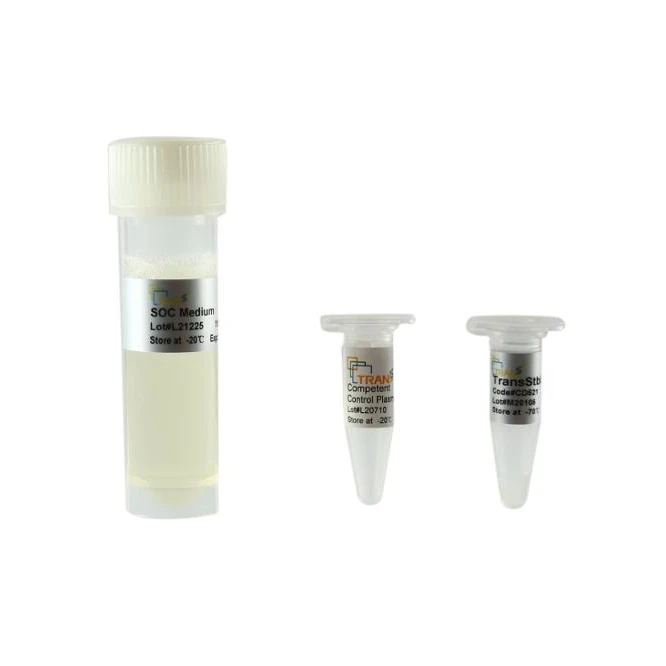
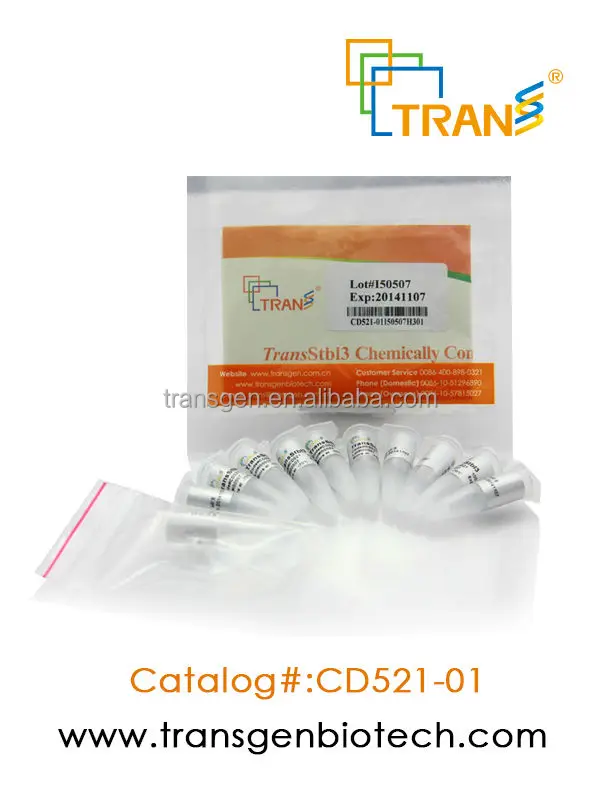
TransStbl3 Chemically Competent Cell
- Category: >>>
- Supplier: Beijing Transgen Biotech Co. Ltd.
Share on (1652163691):
Product Overview
Description
TransStbl3 Chemically Competent Cell
Trans Stbl3 Chemically Competent Cell is specifically designed for chemical transformation of DNA. It permits a transformation efficiency of over 108cfu/μg DNA (tested by pUC19 plasmid DNA).
| Cat. No. | CD521 |
| Specification | CD521-01: 10×100 μl |
| Storage: | at -70oC for six months |
| Genotype | F- mcrB mrr hsdS20(rB -, mB -) recA13 supE44 ara-14 galK2 lacY1 proA2 rpsL20 (StrR) xyl-5 λ- leu mtl-1 |
| Features | • Suitable for lentivirus and retrovirus vector replication. |
| • Minimize the error recombination. | |
| Procedures | 1. Thaw a vial of 100 μl Trans Stbl3 Chemically Competent Cell on ice, aliquot 50 μl of the cells into a prechilled 1.5 ml tube, add target DNA into the tube and mix gently. Incubate the cells on ice for 20-30 minutes. |
| 2. Heat-shock the cells for 45 seconds at 42oC, and then quickly remove the tube from the 42oC water bath and place them on ice for 2 minutes. Do not shake the tube during this procedure. | |
| 2. Add 500 μl of sterile SOC medium or LB medium (no antibiotic) into the tube, mix well and shake at 37oC for 1 hour at 200 rpm to resuscitate cells. | |
| 3. According to the experiment requirement (plasmid, transformation of recombinant ligation product), add different volumes of transformed cells into corresponding antibiotic-containing LB medium. Spread the transformed cells on selective plate. Invert the plate and incubate at 37oC overnight. | |
| Notes | • High efficiency transformation can be achieved by transforming cells immediately following thawing. |
| • Avoid repeated thawing. | |
| • Avoid pipetting cells. | |
| • Gentle handling is required for the entire procedure. |


We Recommend
New Arrivals
New products from manufacturers at wholesale prices