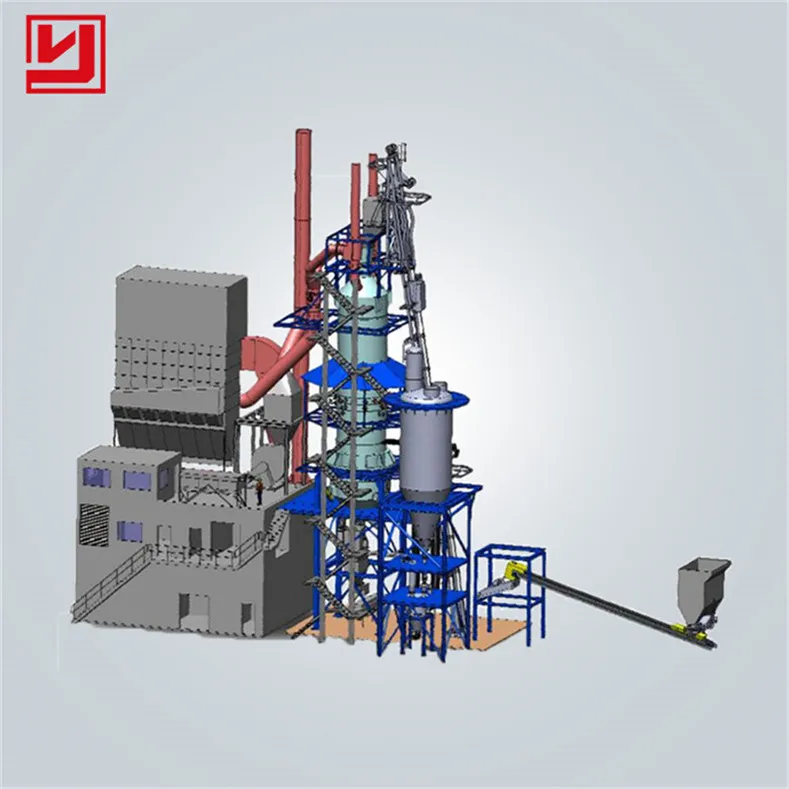
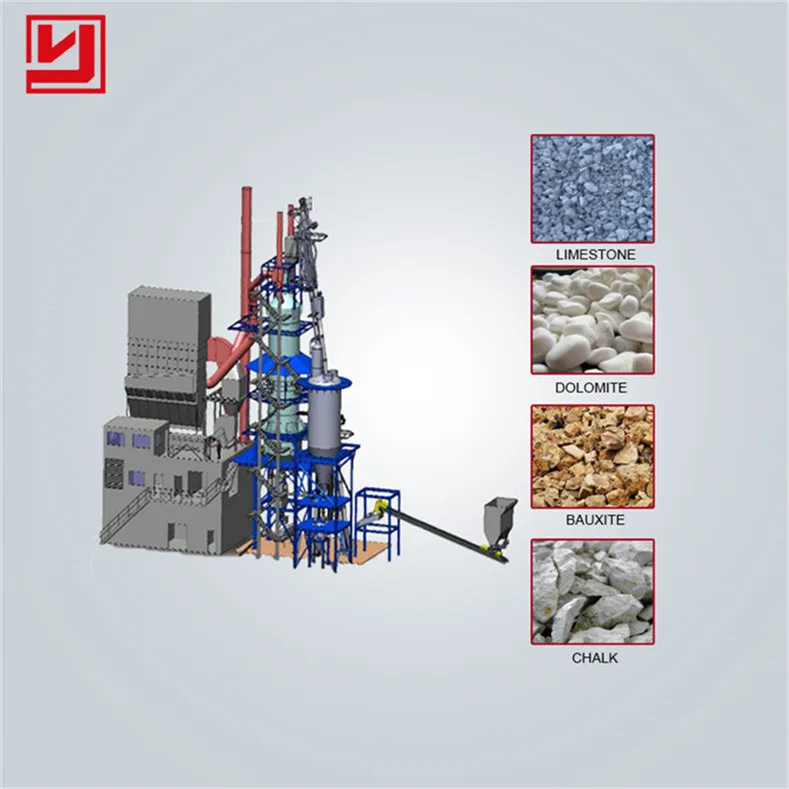
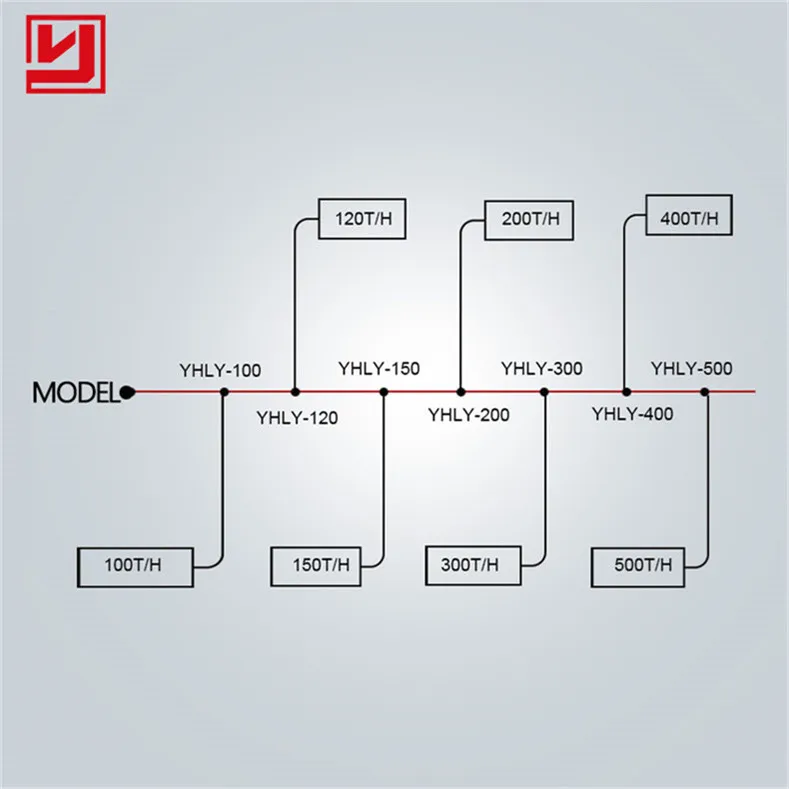
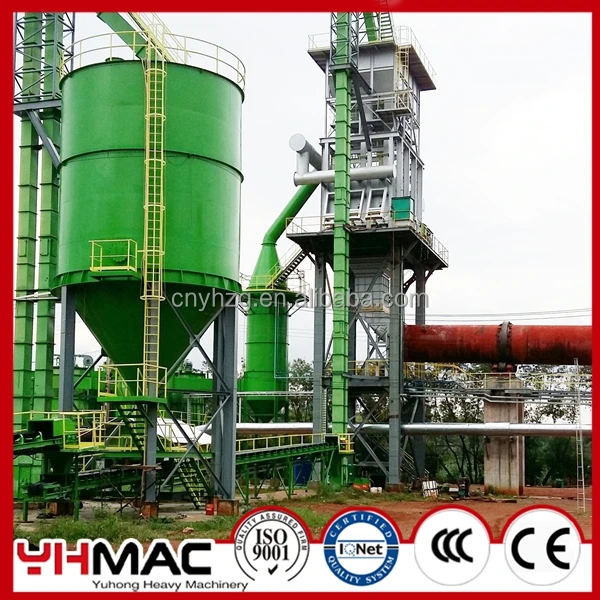
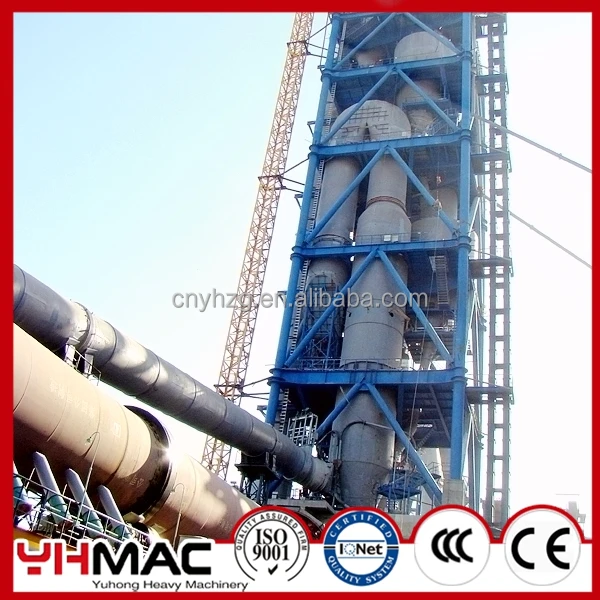
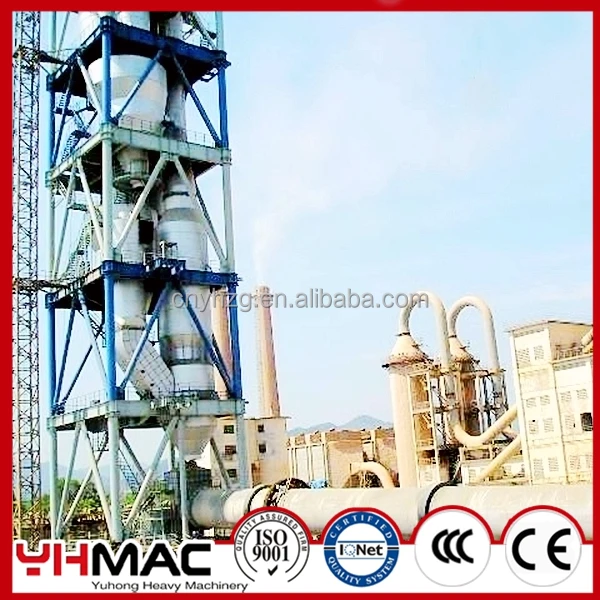
Усовершенствованная Вращающаяся печь для цемента, лайма, огнеупорных материалов, метакаолина, диоксида титана, глинозема, вермикулета, гранул железной руды
- Category: >>>
- Supplier: Henan Yuhong Heavy Machinery Co. Ltd.
Share on (1721706294):
Product Overview
Description
rotary Kiln for Cement,Lime,Refractories,Metakaolin,Titanium dioxide,Alumina,Vermiculite,Iron ore pellets
Product Description
Rotary Kiln
A Rotary kiln is a pyroprocessing device used to raise materials to a high temperature (calcination) in a continuous process. Materials produced using rotary kilns include:
Cement
Lime
Refractories
Metakaolin
Titanium dioxide
Alumina
Vermiculite
Iron ore pellets
They are also used for roasting a wide variety of sulfide ores prior to metal extraction.

General Layout of a direct fired countercurrent rotary kiln used in cement manufacture

1.Principle of Operation
The kiln is a cylindrical vessel, inclined slightly to the horizontal, which is rotated slowly about its axis. The material to be processed is fed into the upper end of the cylinder. As the kiln rotates, material gradually moves down towards the lower end, and may undergo a certain amount of stirring and mixing. Hot gases pass along the kiln, sometimes in the same direction as the process material (co-current), but usually in the opposite direction (counter-current). The hot gases may be generated in an external furnace, or may be generated by a flame inside the kiln. Such a flame is projected from a burner-pipe (or "firing pipe") which acts like a large bunsen burner. The fuel for this may be gas, oil, pulverized petroleum coke or pulverized coal.
2.Construction


The basic components of a rotary kiln are the shell, the refractory lining, support tyres and rollers, drive gear and internal heat exchangers.
3.Kiln Shell

This is made from rolled mild steel plate, usually between 15 and 30 mm thick, welded to form a cylinder which may be up to 230 m in length and up to 6 m in diameter. This will be usually situated on an east/west axis to prevent eddy currents.
Upper limits on diameter are set by the tendency of the shell to deform under its own weight to an oval cross section, with consequent flexure during rotation. Length is not necessarily limited, but it becomes difficult to cope with changes in length on heating and cooling (typically around 0.1 to 0.5% of the length) if the kiln is very long.
4.Refractory Lining
The purpose of the refractory lining is to insulate the steel shell from the high temperatures inside the kiln, and to protect it from the corrosive properties of the process material. It may consist of refractory bricks or cast refractory concrete, or may be absent in zones of the kiln that are below around 250 Degree C. The refractory selected depends upon the temperature inside the kiln and the chemical nature of the material being processed. In some processes, such as cement, the refractory life is prolonged by maintaining a coating of the processed material on the refractory surface. The thickness of the lining is generally in the range 80 to 300 mm. A typical refractory will be capable of maintaining a temperature drop of 1000 Degree C or more between its hot and cold faces. The shell temperature needs to be maintained below around 350 Degree C in order to protect the steel from damage, and continuous infrared scanners are used to give early warning of hot-spots indicative of refractory failure.
5.Tyres and Rollers

Kiln tyre closeup showing typical chair arrangement
Tyres, sometimes called riding rings, usually consist of a single annular steel casting, machined to a smooth cylindrical surface, which attach loosely to the kiln shell through a variety of "chair" arrangements. These require some ingenuity of design, since the tyre must fit the shell snugly, but also allow thermal movement. The tyre rides on pairs of steel rollers, also machined to a smooth cylindrical surface, and set about half a kiln-diameter apart. The rollers must support the kiln, and allow rotation that is as nearly frictionless as possible. A well-engineered kiln, when the power is cut off, will swing pendulum-like many times before coming to rest. The mass of a typical 6 x 60 m kiln, including refractories and feed, is around 1100 tonnes, and would be carried on three tyres and sets of rollers, spaced along the length of the kiln. The longest kilns may have 8 sets of rollers, while very short kilns may have only two. Kilns usually rotate at 0.5 to 2 rpm, but sometimes as fast as 5 rpm. The Kilns of most modern cement plants are running at 4 to 5 rpm. The bearings of the rollers must be capable of withstanding the large static and live loads involved, and must be carefully protected from the heat of the kiln and the ingress of dust. In addition to support rollers, there are usually upper and lower "retaining (or thrust) rollers" bearing against the side of tyres, that prevent the kiln from slipping off the support rollers.
6.Drive Gear
The kiln is usually turned by means of a single Girth Gear surrounding a cooler part of the kiln tube, but sometimes it is turned by driven rollers. The gear is connected through a gear train to a variable-speed electric motor. This must have high starting torque in order to start the kiln with a large eccentric load. A 6 x 60 m kiln requires around 800 kW to turn at 3 rpm. The speed of material flow through the kiln is proportional to rotation speed, and so a variable speed drive is needed in order to control this. When driving through rollers, hydraulic drives may be used. These have the advantage of developing extremely high torque. In many processes, it is dangerous to allow a hot kiln to stand still if the drive power fails. Temperature differences between the top and bottom of the kiln may cause the kiln to warp, and refractory is damaged. It is therefore normal to provide an auxiliary drive for use during power cuts. This may be a small electric motor with an independent power supply, or a diesel engine. This turns the kiln very slowly, but enough to prevent damage.
7.Internal heat exchangers
Heat exchange in a rotary kiln may be by conduction, convection and radiation, in descending order of efficiency. In low-temperature processes, and in the cooler parts of long kilns lacking preheaters, the kiln is often furnished with internal heat exchangers to encourage heat exchange between the gas and the feed. These may consist of scoops or "lifters" that cascade the feed through the gas stream, or may be metallic inserts that heat up in the upper part of the kiln, and impart the heat to the feed as they dip below the feed surface as the kiln rotates. The latter are favoured where lifters would cause excessive dust pick-up. The most common heat exchanger consists of chains hanging in curtains across the gas stream.
8.Other equipment
The kiln connects with a material exit hood at the lower end and to ducts for waste gases. This requires gas-tight seals at either end of the kiln. The exhaust gas may go to waste, or may enter a preheater which further exchanges heat with the entering feed. The gases must be drawn through the kiln, and the preheater if fitted, by a fan situated at the exhaust end. In preheater installations which may have a high pressure-drop, a lot of fan power may be needed, and the fan is often then largest drive in the kiln system. Exhaust gases contain dust and there may be undesirable constituents such as sulfur dioxide or hydrogen chloride. Equipment is installed to scrub these out before the exhaust gases pass to atmosphere.
9.Thermal efficiency
The thermal efficiency of the rotary kiln is about 50-65%.
Packaging & Shipping
Packaging: Standard export packing (Waterproof rust), Nude cargo and spare parts in wooden
cases (special fumigation-free wooden material).
Shipping: Int'l Shipping, Road / railway / air / ocean transportation
Our Services
1.Pre-sale services:
1) Selecting equipment type;
2) Designing and fabricating the products in accordance with the special requirements of the clients;
3) Training technical personnel for our clients;
4) Providing construction and technology consultations or working out proper construction schemes for those new, special or difficult projects.
2.Services provided during the sale:
Respect our clients; present the clients with ease, relaxation and a surprise; devote ourselves to improve the total value of our clients.
1) Checking products acceptance ahead of delivery;
2) Introducing the service system to our clients.
3. After-sale services:
Improve the added value of our products, and let the clients free from the using troubles:
1) Assisting the clients preparing for the first construction scheme;
2) Installing and testing the equipments;
3) Training the first-line operators on site;
4) Examining the equipment regularly;
5) Taking the initiatives to eliminate the failure(s) rapidly at site;
6) Distributing the guarantee fittings door-to-door;
7) Providing technical exchanging;
8) Providing maintenance for big item
Company Information
Company Information
Our henan YUHONG heavy machinery co., ltd. (YUHONG FROUP) have rich experiences in designing and producing the rotary dryer for more than 20 years. Our YUHONG rotary dryer sales all over the country as well as we are expanding the rotary dryer overseas market. We hope to help more rotary dryer users to get strong quality rotary dryer with the reasonable price. Our YUHONG heavy machinery co., ltd. has the whole manufacturing machine to producing the rotary dryer, the pictures below are our workshope rolling steel plate pictures then to produce the rotary kiln's shell. We mainly have lime plant client's working site, cement plant client's working site, LECA client's working site, Our YUHONG heavy machinery co., ltd has a professional rotary dryer technical team of 10 engineers. We hope we can help more persons to solve the drying system problems all the time. We are sincere to invite you to visit our company and communicate more with us.

FAQ
Why Choose Us
1. We are Manufacturer (Not Dealer):
All machineries from HENAN YUHONG HEAVY MACHINERY CO., LTD are made by ourselves,
with lower price, good quality and assured full after service.
2. Training & Service:
1.We provide you with the prophase plan, process flow design and manufacture equipment according to your special demand.
2.Send technicians to the jobsite for guiding the installation and adjustment, training operators and finishing the check and accept together with you.
3.We always keep certain inventory level of spare parts, which means the replacements can be shipped to you right away.
3. If you are new for this business:
Many thanks for your trust; we can provide you with design scheme for complete production lines, spot inspection and operator training according to your demands and the conditions of applied spot, we can help you choose the right equipments.
4. We’d like to recommend a suitable model for you and send you a best quotation. So please give us some more information about your requirement in your enquiry.
♥ What is your project are you sut up it ?
capacity
♥ what fuel are used for the rotary kiln ,for example ,the coal ,nature gas ,LPG or diesel oil and so on.
♥ Usage


case photos


We Recommend
New Arrivals
New products from manufacturers at wholesale prices