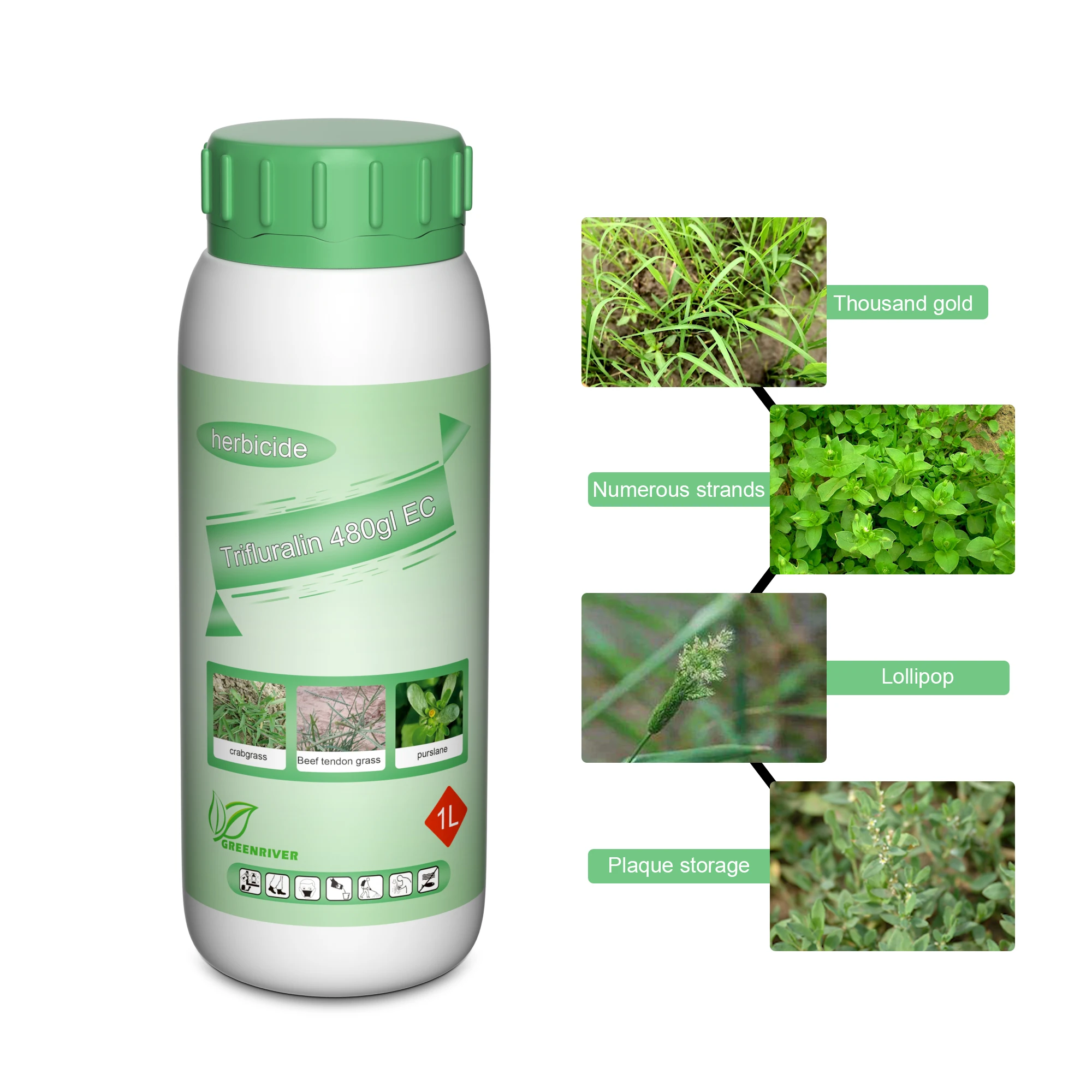
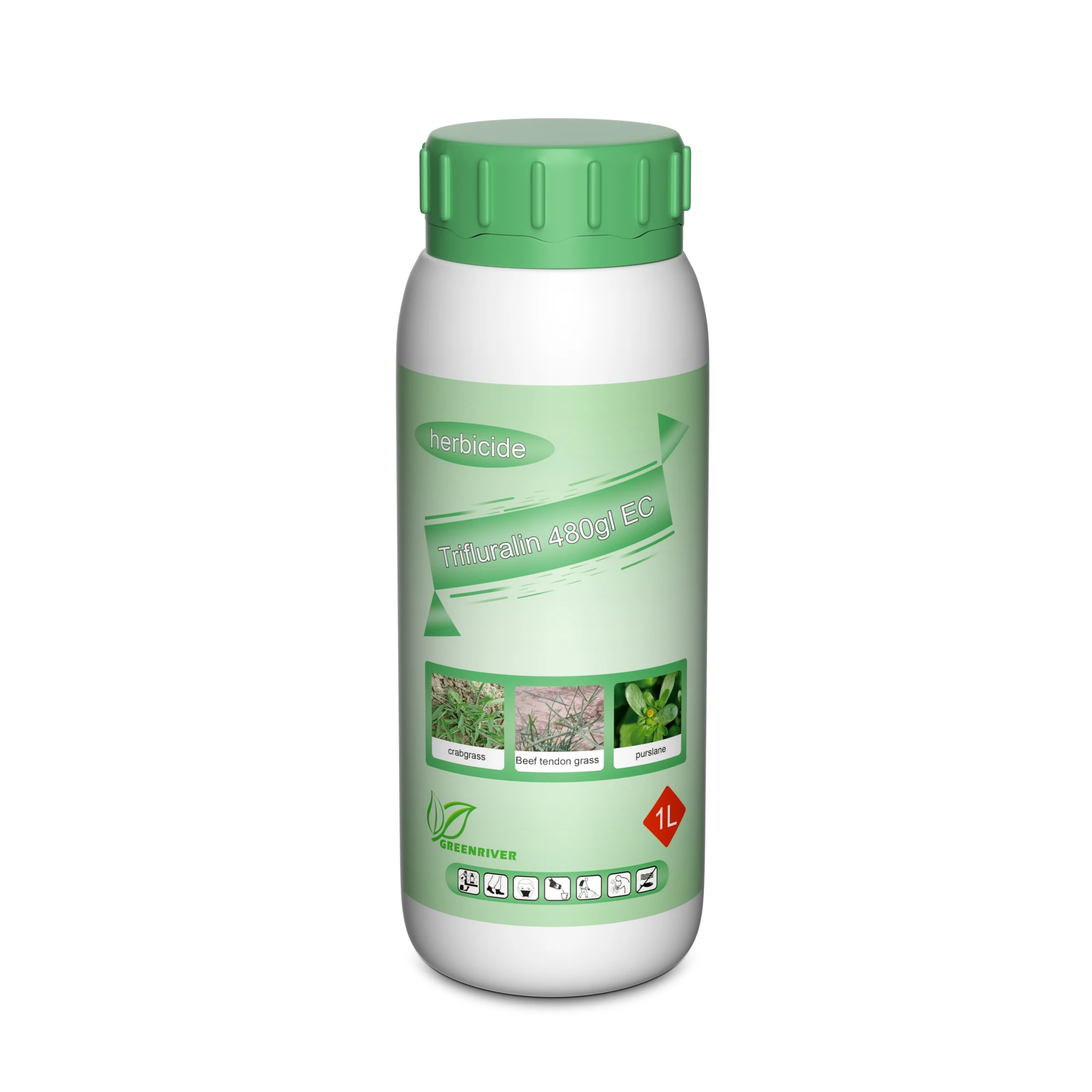
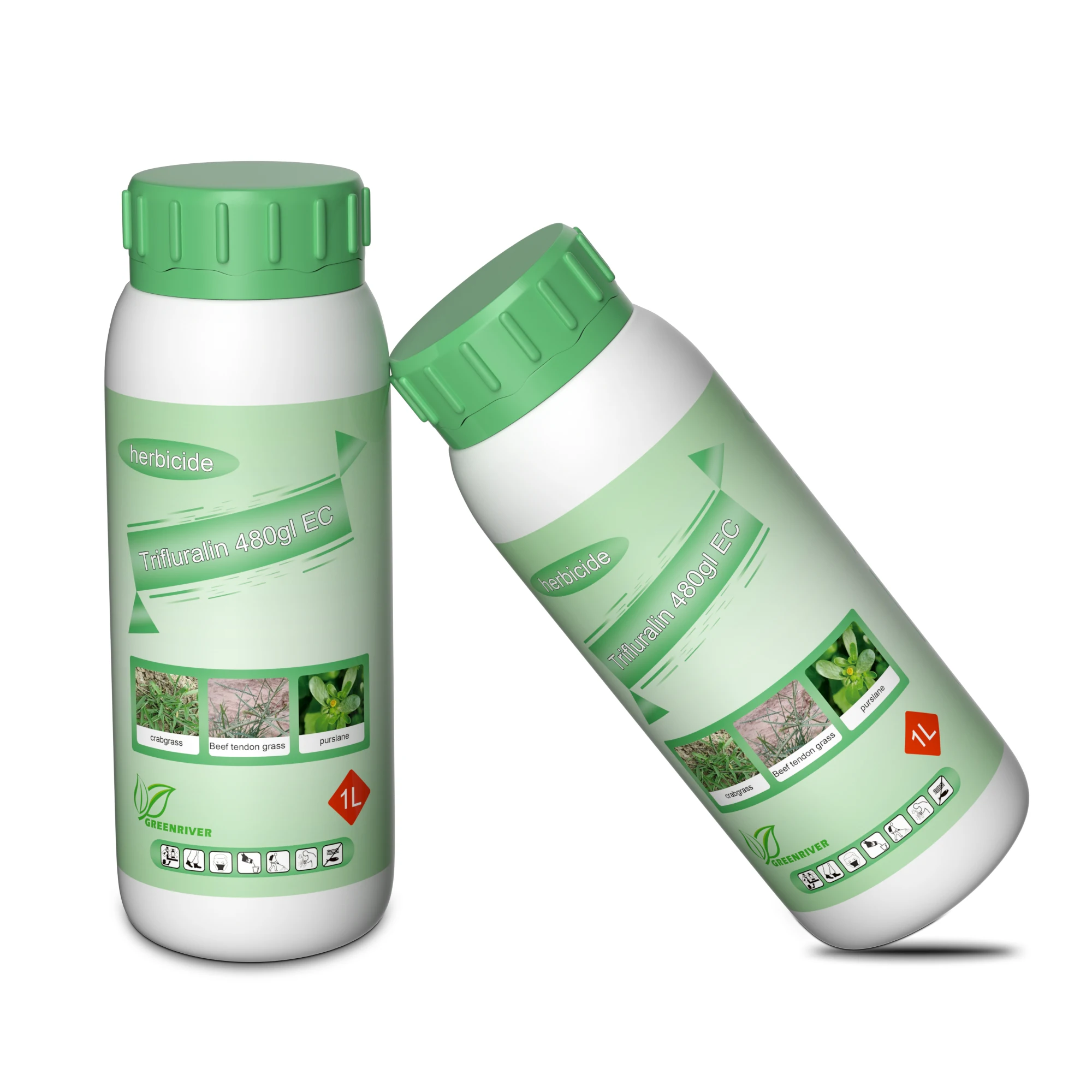
Trifluralin 48%EC, 1582 09 8, Trifluralin 480g/l EC herbicide Agrochemical
- Category: >>>
- Supplier: Greenriver Industry Co. Ltd.
Share on (1905818819):
Product Overview
Description
Product Description


Specification
Active ingredient | Trifluralin | ||||
Chemical name | 2,6-dinitro-N,N-dipropyl-4-(trifluoromethyl)benzenamine | ||||
Classification | Herbicide / Agrochemical | ||||
Biochemistry | Microtubule assembly inhibition. | ||||
Mode of action | Selective soil-herbicide, which acts by entering the seedling in the hypocotyl region. Also inhibits root development. | ||||
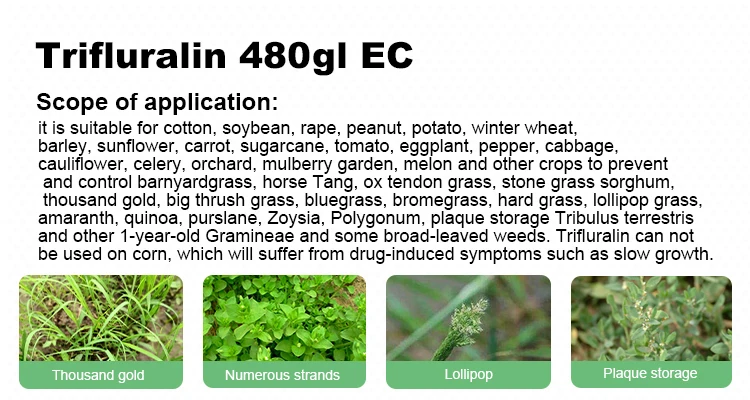
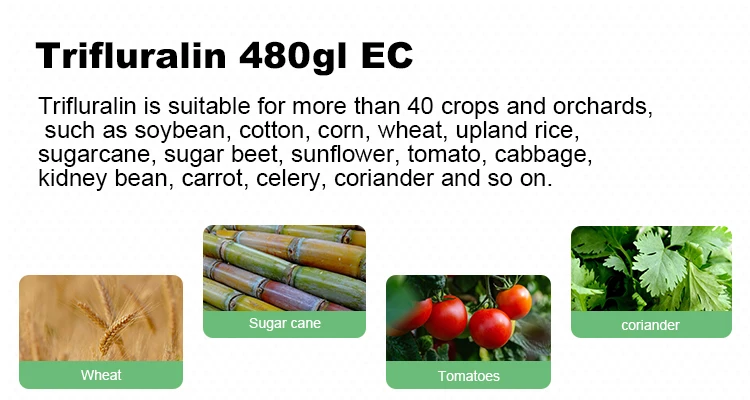
Usage | Pre-emergence control of many annual grasses and broad-leaved weeds in brassicas, beans, peas, carrots, parsnips, lettuce, capsicums, tomatoes, artichokes, onions, garlic, vines, strawberries, raspberries, citrus fruit, oilseed rape, peanuts, soya beans, sunflowers, safflowers, ornamentals, cotton, sugar beet, sugar cane, and in forestry. Used with linuron or isoproturon for control of annual grasses and broad-leaved weeds in winter cereals. Normally applied pre-planting with soil incorporation, at 0.5-1.0 kg/ha, but post-planting application is also possible for some crops. | ||||
Mammalian Toxicology | Oral: Acute oral LD50 for rats >5000 mg/kg. Skin and eye: Acute percutaneous LD50 >5000 mg/kg (rabbits). Non-irritating to skin; slightly irritating to eyes (rabbits). Inhalation: LC50 (4 h) for rats >4.8 mg/l. | ||||
Certificate of quality | Trifluralin 480g/l EC | ||||
Item Appearance A.I. Content pH value Water N-nitrosoamine | Specification Orange liquid ≥480g/l 4.0-8.0 ≤0.3% ≤1.0mg/kg | ||||
Company Profile

FAQ
Q1. I want more styles, how can I get latest catalogue for your reference?
A: You can contact us by Email, we will give you our latest catalogue according to your information.
Q2. Can you add our own logo on the product?
A: Yes. We offer the service of adding customers’ logo. There are many types of this service. If you have this need, kindly send us you own logo you are welcome.
Q2. Can you add our own logo on the product?
A: Yes. We offer the service of adding customers’ logo. There are many types of this service. If you have this need, kindly send us you own logo you are welcome.
Q3. How does your factory do regarding quality control?
A: "Quality is priority? We always attach great importance to quality controlling.
A: "Quality is priority? We always attach great importance to quality controlling.
1) Skillful workers care every details in handling the producing and packing processes;
2) Quality Control Department specially responsible for quality checking in each
process.
Q4. How can we guarantee quality?
Always a pre-production sample before mass production;
Always final Inspection before shipment;
Q5. How can I order?
A: You can directly place an order on our shop in Alibaba web. Or you can tell us the product name, packing and quantity you need, then we will send you the quotation.
Q6.what can you buy from us?
Insecticide,Herbicide,Fungicide,Rodenticide,Plant Growth Regulator
Q7. what services can we provide?
Accepted Delivery Terms: FOB,CFR,CIF,CIP,CPT,DDP,DDU,Express Delivery;
Accepted Payment Currency:USD,EUR,HKD,CNY;
Accepted Payment Type: T/T,L/C,D/P D/A,Credit Card,PayPal,Western Union,Cash;
Language Spoken:English,Chinese,Spanish,Arabic,Russian
process.
Q4. How can we guarantee quality?
Always a pre-production sample before mass production;
Always final Inspection before shipment;
Q5. How can I order?
A: You can directly place an order on our shop in Alibaba web. Or you can tell us the product name, packing and quantity you need, then we will send you the quotation.
Q6.what can you buy from us?
Insecticide,Herbicide,Fungicide,Rodenticide,Plant Growth Regulator
Q7. what services can we provide?
Accepted Delivery Terms: FOB,CFR,CIF,CIP,CPT,DDP,DDU,Express Delivery;
Accepted Payment Currency:USD,EUR,HKD,CNY;
Accepted Payment Type: T/T,L/C,D/P D/A,Credit Card,PayPal,Western Union,Cash;
Language Spoken:English,Chinese,Spanish,Arabic,Russian
We Recommend
New Arrivals
New products from manufacturers at wholesale prices