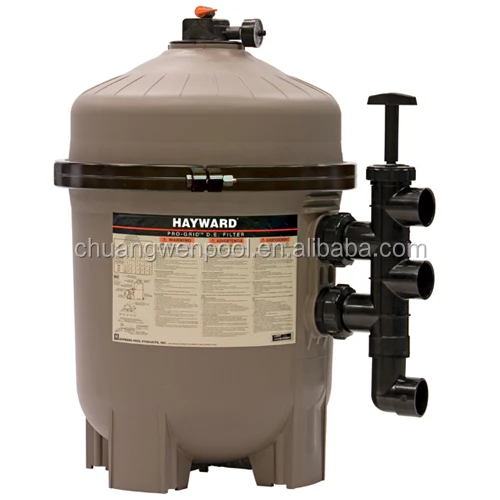
Large cleaning capacity vertical grid D.E.. filter
- Category: Water Filter >>>
- Supplier: Guangzhou Chuangwen Pool & Sports Equipment Co. Ltd.
Share on (1938863611):
Product Overview
Description
Product Description
Large cleaning capacity vertical grid D.E.. filter
Description:
Hayward Pro-Grid uses superior filter performance to achieve remarkable water clarity, efficient flow and large cleaning capacity for pools of all types and sizes. Pro-Grid filter tanks are constructed of a durable glass-reinforced copolymer, for the ultimate in strength, durability and long life.
Featuring “service ease” assembly, Pro-Grid delivers low maintenance and dependable operation. Pro-Grid filters are also available with an optional control valve. Choose quality results and maximum value with Pro-Grid filters by Hayward, the first choice of pool professionals.

Technical Data:

Remark:
- Payment: 70% T/T prepaid,Western Union.
- Terms of payment:All payment are before shipment .
- Price will be adjusted if USD:RMB rate varies by +/- 2%. Freight not included .
- Offer validity: one month
Our Services
We Provide high-quality service for:
1,Swimming pool equipment wholesalers.
2,Retailers and online shops.we have shops in Chengdu,Shanghai,Beijing and Guangzhou,We supply the high quality and low price,and best service.
3,OEM-The custom-made pumps are available.Upon customer’s idea,drawings,photos etc.more detail.The length of time depend on the procedures .
Company Information
Addr: Fl.2, No.166, Gangdong Rd., Dashi street, Panyu District, Guangzhou.China.
Tel: +86 20 34796181 Fax: +86 20 34796171
Exhibitions:
1.company shows:

2.company certificate:

3.warehouse

FAQ
1. Will backwashing thoroughly clean my DE filter?
- When a DE filter is properly backwashed you will be removing about 80-90% of the DE. Remaining DE may be clumped in the corners of the filter or caked in the middle. This is common. After backwashing, new DE must be added to the filter. Add the entire amount of DE the filter recommends. If you see DE returning to the pool, vacuum it to waste, after it settles. The next time you backwash and recoat, decrease the amount by 1 pound. This will avoid DE going back into the pool.
- The only way to remove the entire DE is to disassemble the filter. The next time the filter is disassembled and cleaned, pre-coat with the entire quantity of DE.
Remember, the filter should be taken apart and cleaned at least once a year.
2. How do I add DE and how often do I need to change my DE?
- DE is added through the skimmer with the pump running. Each filter has a different requirement of DE. At initial start up or after a thorough cleaning, the filter will need to be pre-coated with DE. The filter label will state the amount of DE required. Start the pump and once the pump is fully primed, measure the DE using a DE scoop, part # EC10SC. Slowly add the DE into the skimmer. The pump will draw in the DE and send it into the filter, where it coats the grids or Flex tubes. Once all the DE is added, take a reading of the filter’s pressure gauge. This is the clean starting pressure of the filter.
- When the pressure rises 8-10 PSI above the starting pressure, it is time to backwash or clean the filter. After the filter is backwashed or thoroughly cleaned, by taking it apart and hosing it out, you will need to pre-coat the filter again with the entire amount of DE stated on the filter label.
3. Why is DE leaking into the pool?
- There are only a handful of reasons DE is leaking into the pool. They vary depending on which DE filter you have.
(a) Vertical Grid:
(1) Too much DE was added.
(2) Tear in the fabric of the Grid
(3) Crack in the top manifold
(4) Bad o-ring on the standpipe (the pipe the DE cluster sits on)
(b) Perflex “Bump” Filter.
(1) Too much DE
(2)Tear in the fabric of the fingers
(3) Bad diaphragm gasket
(4) Cracked tube sheet(s)
(5) Loose or missing tube sheet bolts
(6)Bad o-rings on the bump shaft
We Recommend


New Arrivals
New products from manufacturers at wholesale prices