Rare Earth Fluorescent Powder Tri color Green phosphor for Lamps
- Category: >>>
- Supplier: Fujian Changting Golden Dragon Rare-Earth Co. Ltd. [Fujian China]Fujian
Share on (1965045943):
Product Overview
Description
Fluorescent powder description
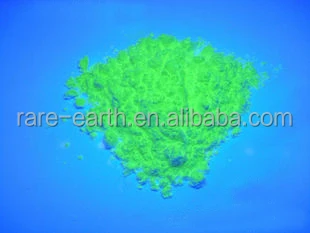
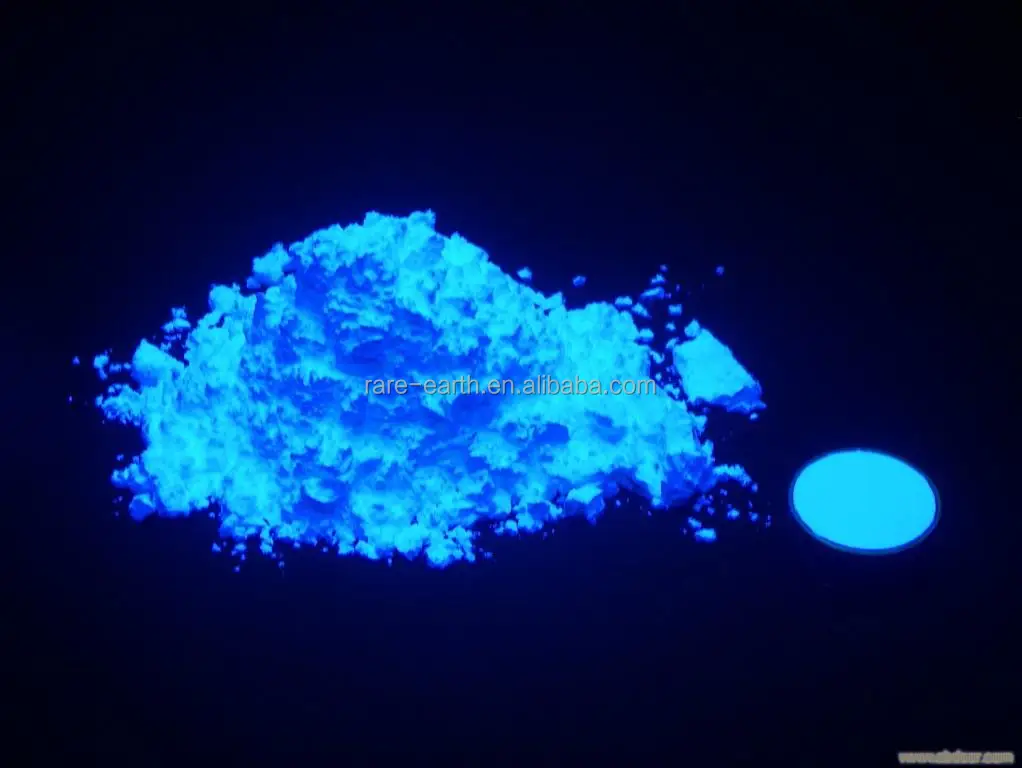
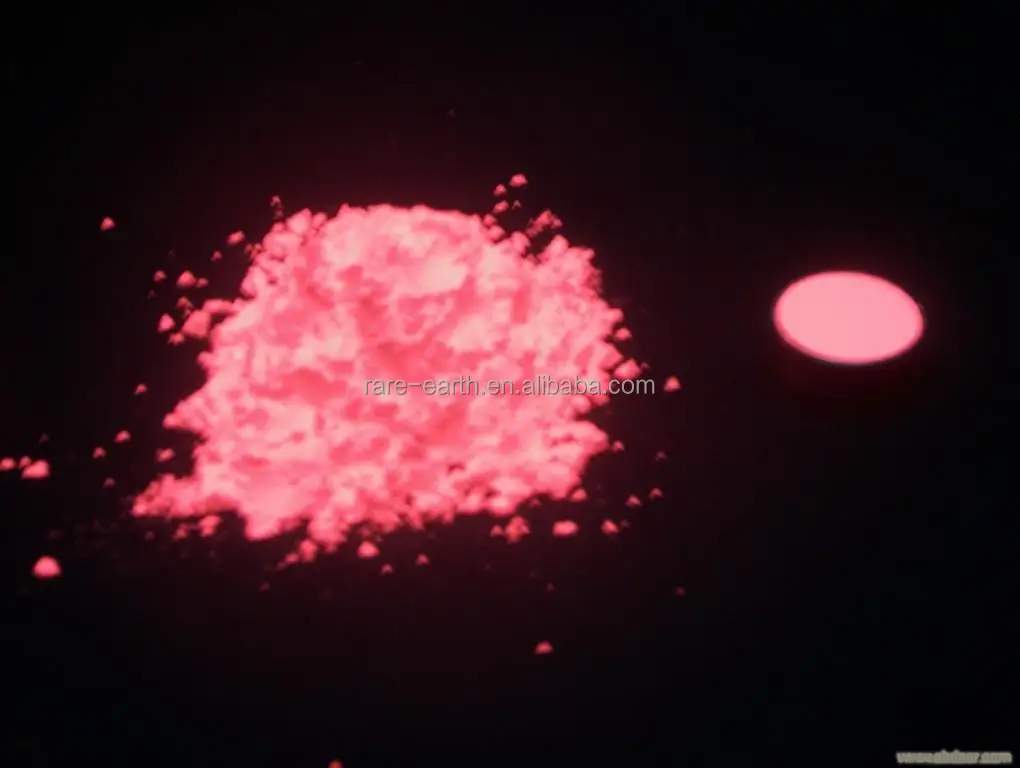
Fluorescent powder, also called phosphor, most generally, is a substance that exhibits the phenomenon of luminescence. Somewhat confusingly, this includes both phosphorescent materials, which show a slow decay in brightness (> 1 ms), and fluorescent materials, where the emission decay takes place over tens of nanoseconds. Phosphorescent materials are known for their use in radar screens and glow-in-the-dark toys, whereas fluorescent materials are common in cathode ray tube (CRT) and plasma video display screens, sensors, and white LEDs.
Fluorescent powder or Phosphors are often transition metal compounds or rare earth compounds of various types. The most common uses of phosphors are in CRT(cathode ray tube) displays and fluorescent lights. CRT phosphors were standardized beginning around World War II and designated by the letter "P" followed by a number.Phosphorus, the chemical element named for its light-emitting behavior, emits light due tochemiluminescence, not phosphorescence.
Fluorescent Powder (Phosphor) degradation
Many phosphors(Florescent Powder) tend to lose efficiency gradually by several mechanisms. The activators can undergo change of valence (usually oxidation), thecrystal lattice degrades, atoms – often the activators – diffuse through the material, the surface undergoes chemical reactions with the environment with consequent loss of efficiency or buildup of a layer absorbing either the exciting or the radiated energy, etc.
The degradation of electroluminescent devices depends on frequency of driving current, the luminance level, and temperature; moisture impairs phosphor(Fluorescent Powder) lifetime very noticeably as well.
Materials for Fluorescent powder(phosphor)
Fluorescent powder (Phosphors) are usually made from a suitable host material with an added activator. The best known type is a copper-activated zinc sulfide and the silver-activated zinc sulfide (zinc sulfide silver).
The host materials are typically oxides, nitrides and oxynitrides,sulfides, selenides, halides or silicates of zinc, cadmium, manganese,aluminium, silicon, or various rare earth metals. The activators prolong the emission time (afterglow). In turn, other materials (such asnickel) can be used to quench the afterglow and shorten the decay part of the phosphor emission characteristics.
Many phosphor powders (fluorescent powders)are produced in low-temperature processes, such as sol-gel and usually require post-annealing at temperatures of ~1000 °C, which is undesirable for many applications. However, proper optimization of the growth process allows to avoid the annealing.
Phosphors(Fluorescent powder) used for fluorescent lamps require a multi-step production process, with details that vary depending on the particular phosphor(Fluorescent Powder). Bulk material must be milled to obtain a desired particle size range, since large particles produce a poor quality lamp coating and small particles produce less light and degrade more quickly. During the firing of the phosphor(fluorescent powder), process conditions must be controlled to prevent oxidation of the phosphor activators or contamination from the process vessels. After milling the phosphor may be washed to remove minor excess of activator elements. Volatile elements must not be allowed to escape during processing. Lamp manufacturers have changed composition of phosphors(Fluorescent Powder) to eliminate some toxic elements, such as beryllium, cadmium, or thallium, formerly used.
The commonly quoted parameters for phosphors are the wavelength of emission maximum (in nanometers, or alternatively color temperature in kelvins for white blends), the peak width (in nanometers at 50% of intensity), and decay time (in seconds).
Fluorescent Powder (Phosphor) Applications
Fluorescent powder for lighting or fluorescentlamps
Phosphor layers provide most of the light produced by fluorescent lamps, and are also used to improve the balance of light produced by metal halide lamps. Various neon signs use phosphor layers to produce different colors of light. Electroluminescent displays found, for example, in aircraft instrument panels, use a phosphor layer to produce glare-free illumination or as numeric and graphic display devices. White LED lamps consist of a blue or ultra-violet emitter with a phosphor coating that emits at longer wavelengths, giving a full spectrum of visible light.
Fluorescent powder for phosphor thermometry
Fluorescent powder for glow-in-the-dark toys
In these applications, the phosphor is directly added to the plastic used to mold the toys, or mixed with a binder for use as paints.
ZnS:Cu phosphor is used in glow-in-the-dark cosmetic creams frequently used for Halloween make-ups. Generally, the persistence of the phosphor increases as the wavelength increases.
Fluorescent powder for cathode ray tubes
Cathode ray tubes produce signal-generated light patterns in a (typically) round or rectangular format. Bulky CRTs were used in the black-and-white household television ("TV") sets that became popular in the 1950s, as well as first-generation, tube-based color TVs, and most earlier computer monitors. CRTs have also been widely used in scientific and engineering instrumentation, such asoscilloscopes, usually with a single phosphor color, typically green.
Diagram:Spectra of constituent blue, green and red phosphors in a common cathode ray tube.
Fluorescent powder (phosphor)spectra
Uses & applications of GDRE fluorescent powder or phosphor

Corporate Certificates

Corporate honors

We Recommend

New Arrivals
New products from manufacturers at wholesale prices