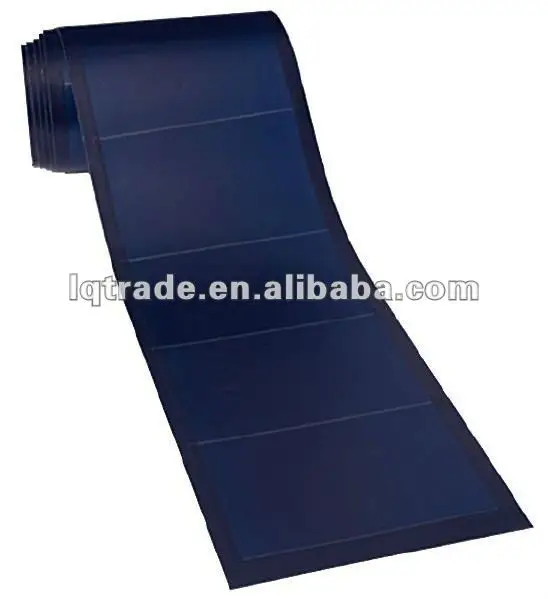
144W Thin Film Flexible Solar Amorphous Silicon Solar Panel
- Category: >>>
- Supplier: Jinan Lin Quan Import And Export Co. Ltd.
Share on (520557710):
Product Overview
Description
144W Thin Film Flexible Solar Amorphous Silicon Solar Panel
| Type | PVL144 22L | ||
| Maximum Power | Pmax | (W) | 144 |
| Voltage at Pmax | Vmp | (V) | 33 |
| Current at Pmax | Imp | (A) | 4.36 |
| Short-circuit Current | Isc | (A) | 5.3 |
| Open-circuit Voltage | Voc | (V) | 46.2 |
| Maximum Power | Pmax | (W) | 111 |
| Voltage at Pmax | Vmp | (V) | 30.8 |
| Current at Pmax | Imp | (A) | 3.6 |
| Short-circuit Current | Isc | (A) | 4.3 |
| Open-circuit Voltage | Voc | (V) | 42.2 |
| Length | mm | 5486 | |
| Width | mm | 394 | |
| Area | A | m² | 2.16 |
| Power density unit area | ρp-A | W/m² | 66.62 |
| Weight | W | Kg | 7.7 |
| Power density unit weight | ρp-w | W/Kg | 18.70 |
| Cell Area (356×239) | Acell | m² | 1.8718 |
| Available Area (336×239) | AAA | m² | 1.7667 |
| Available Area Efficiency | ηAAE | % | 8.15% |
| Module Efficiency | ηmodul | % | 6.7% |
Thin-Film Photovoltaic Technology Compared to Crystalline Technology
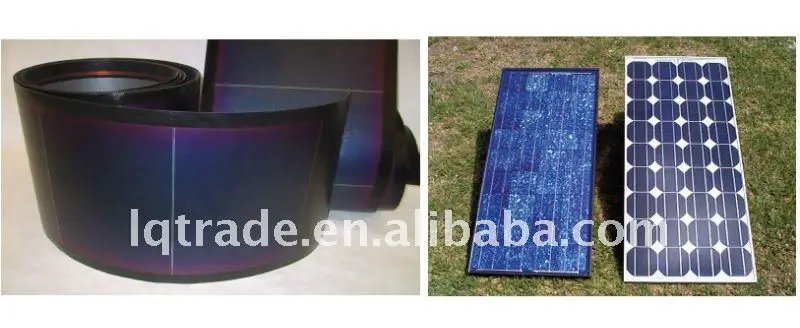
The Triple-Junction PV products have significant advantages when compared to crystalline technology PV products. They are flexible, lightweight, and have better performance at actual
operating temperatures, under lower light intensities, and even when damaged (unlikely due to the durability of the PV Laminate).
CATEGORY | THIN FILM SOLAR | CRYSTALLINE SILICON |
Weight | .7 lbs/Sq Ft. | 2.64 lbs/Sq Ft |
Flexibility | Very Flexible | Rigid |
Performance –Temperature | -4% @ 60 deg C | - 16% @ 60 deg C |
Performance- Low Light Intensity | 20% More W-hours/day | 20% Less W-hours/day |
Performance –Shaded | Slight Reduction(4%-5%) | Loss of at least 30% |
Performance – Damaged | Slight Reduction | Degrades to Zero |
Based on data from independent studies(ECN, NREL. TISO)
LIGHTWEIGHT & FLEXIBLE
The Thin-Film PV panels achieve their lightweight and flexibility advantages over the glass-based crystalline PV panels through the following:
1. Thin-Film Amorphous Silicon thickness = Less than 1 Micron
2. Stainless Steel substrate = 5 mil
3. Protective Coating = ETFE Film
4. Average Weight = .7 lbs/sq ft
Glass-Based PV Panels are rigid and relatively fragile. They are almost four times heavier per square foot due to the use of glass as a laminating/protecting material. The required metal framing adds additional weight.
THIN FILM SOLAR PANEL IS LESS SENSITIVE TO HIGHER AMBIENT TEMPERATURE
What the following chart shows:
• Rated PV module output is measured at a cell temperature of 25° Centigrade (77° Fahrenheit).
• Normal operating cell temperatures range from 50° C to 70° C (122° F to 158° F).
• At normal operating temperatures (60°C), actual output for crystalline is 16% lower than rated power.
• At normal operating temperatures (60°C), actual output for UNI-SOLAR is 4% lower than rated power.
THIN FILM SOLAR PANEL IS LESS SENSITIVE TO HIGHER AMBIENT TEMPERATURE
We Recommend
New Arrivals
New products from manufacturers at wholesale prices