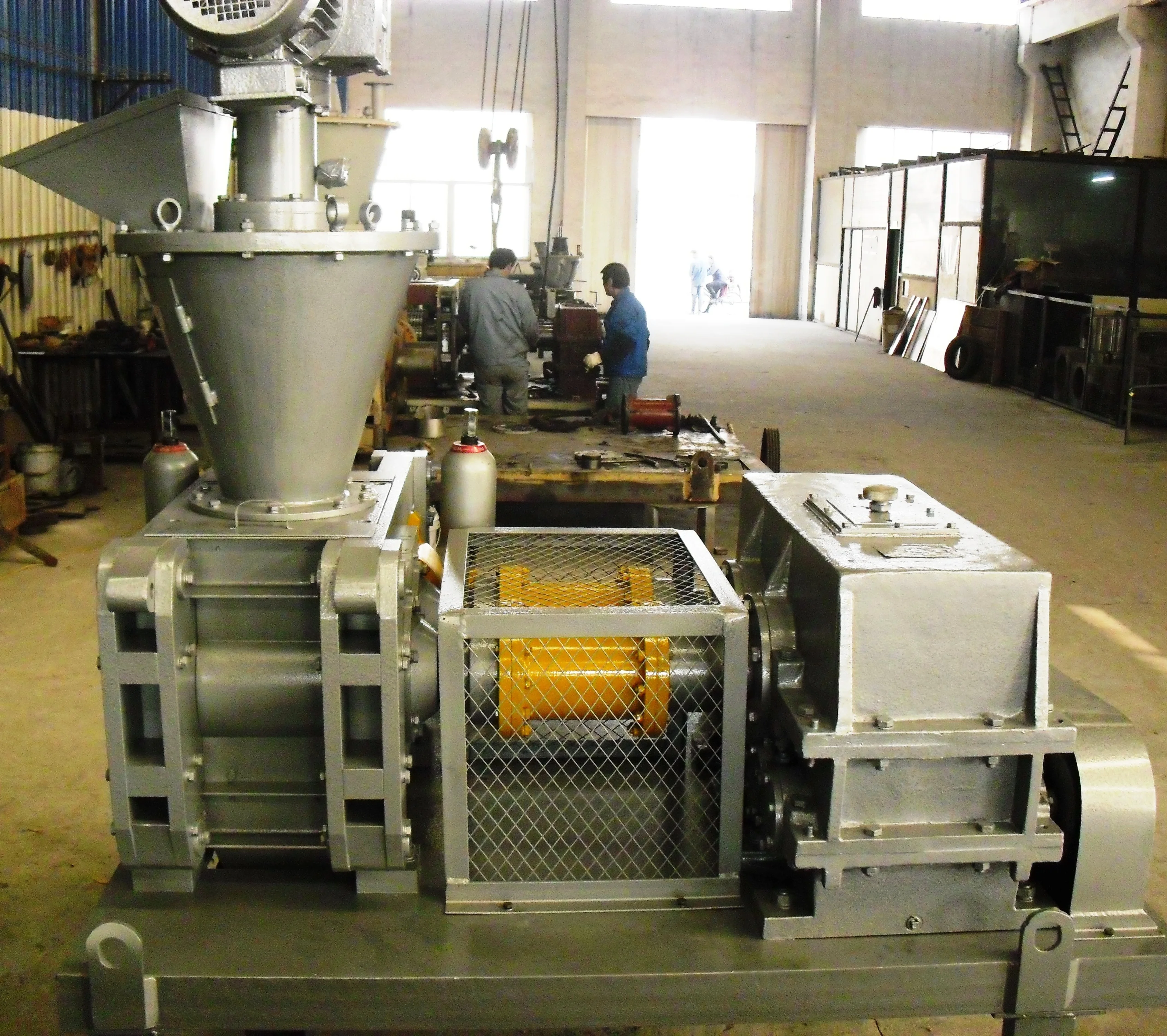
Chemical / mining / fertilizer roll compaction granulating machine
- Category: >>>
- Supplier: Changzhou Shengong Granulation Equipment Co. Ltd.
Share on (526428655):
Product Overview
Description
We are small factory but dedicated in roller compactor for granulating & briquetting powders.


The dry granulation process is used to form granules without using a liquid solution because the product granulated may be sensitive to moisture and heat. Forming granules without moisture requires compacting and densifying the powders. In this process the primary powder particles are aggregated under high pressure.
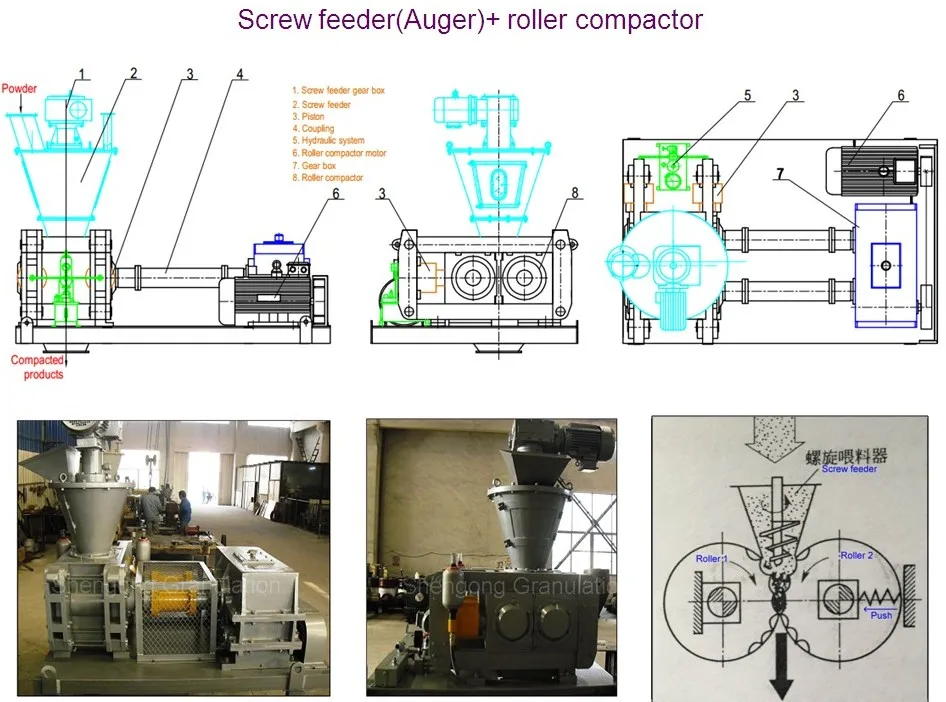
Dry granulation can be conducted under this process: the powder is squeezed between two counter-rotating rollers to produce a continuous sheet or ribbon of materials.
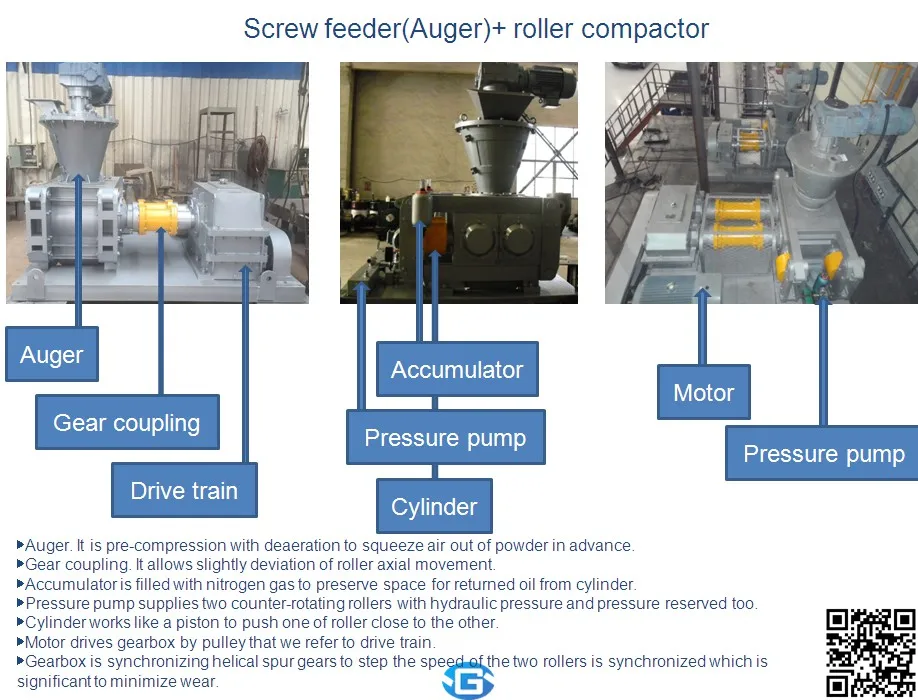
When a roller compactor is used for dry granulation, the powders may not possess enough natural flow to feed the product uniformly into the die cavity, resulting in varying degrees of densification. The roller compactor (granulator-compactor) uses an auger-feed system that will consistently deliver powder
uniformly between two pressure rollers. The powders are compacted into a ribbon or a sheet between these rollers and milled through a low-shear mill.
Typical roller compaction processes consist of the following steps: convey powdered material to the compaction area, normally with a screw feeder, compact powder between two counter-rotating rolls with applied forces, mill resulting compact to desired particle size distribution. Roller compacted particle are
typical dense, with sharp-edged profiles.
Roller/roll compaction granulating machine application

Specification of different models (takes SOP for instance, final products are irregular/angular)
Type Item | SG-240A | SG-360A | SG-500A | SG-600A | SG-650A |
Roller dia. (mm) | Φ240 | Φ360 | Φ504 | Φ600 | 650 |
Effective width (mm) | 80/120/160 | 180 | 300 | 310 | 330 |
Roller rotating speed (r/min) | 5-35 | 3-26 | 14-20 | 12-18 | 10-16 |
Power of feeder (kw) | 4 | 7.5 | 11 | 11 | 15 |
Pre-pressure of accumulator (Mpa) | 5 | 6 | 8-10 | 8-10 | 10-14 |
Max. flaking pressure rate (kN/cm) | 65 | 65 | 70(75) | 70(75) | 70(75) |
Thickness of flakes (mm) | 2-6 | 6-8 | 10-12 | 12-14 | 14-16 |
Flaking productivity (t/h) | 0.8-2 | 2.5-3 | 6-8 | 8-10 | 10-12 |
Pellet output (kg/h) | 200-600 | 1000-1200 | 2500-3000 | 3000-3600 | 3500-4500 |
Pellet size (mm) | 1-5 | 1-5 | 1-5 | 1-5 | 1-5 |
Power of flaking machine (kw) | 11 | 30 | 75 | 90 | 110 |
Installed capacity (kw) | 35 | 50 | 109 | 125 | 165 |
Dimension (l*w*h) (mm) | 1850*1500*1650 | 2350*2000*2400 | 3650*2250*2500 | 3660*2450*2700 | 4000*2600*3300 |
Total weight (t) | 7-8 | 10 | 20-21 | 25-26 | 32-33 |
Delivery time(d) | 15 | 25 | 30 | 60 | 60 |
Roller/roll compaction principle


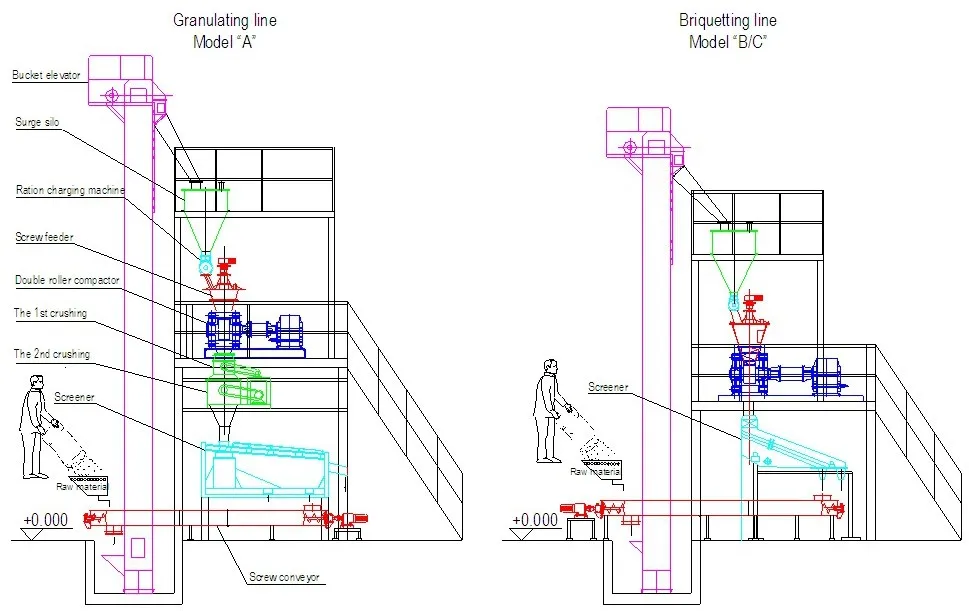
Difference between Roller/roll compaction type A and type B

Roller/roll compaction consists of screw feeder and double counter-rotating rollers.

Roller/roll compaction line peripheral equipments

Rollers and final products' shapes


Roller/roll compaction products variable shapes


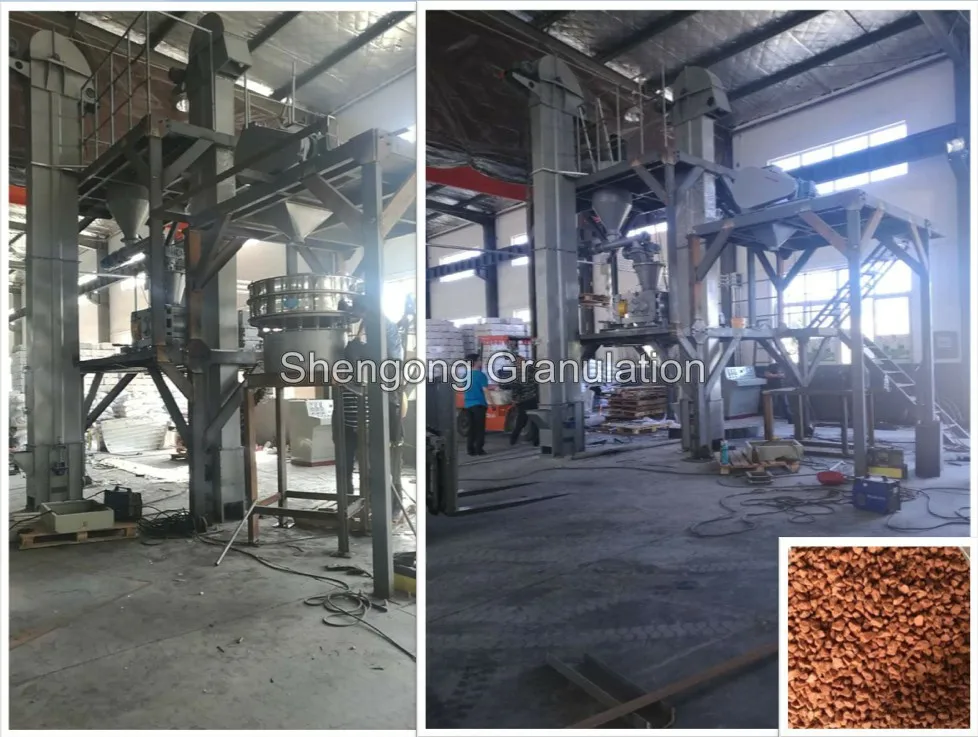
Roller/roll compaction line being loaded in one 40ft. container

We Recommend
New Arrivals
New products from manufacturers at wholesale prices