Alpha amylase from Bacillus subtilis var, textile enzyme
Product Description
Application
An Alpha-Amylase reduces processing costs without any damage to the fibers in textile processing.
Description
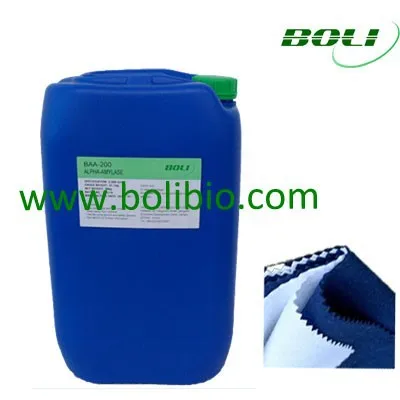
Alpha-Amylase BAA-200 contains a hydrolyzing alpha-amylase made from submerged culture of Bacillus subtilis var. Through extraction and refining processes. It is a kind of endoamylase, which rapidly decreases the viscosity of the gelatinous starch solution by randomly hydrolyzing starch, glycogen and its degradation products within the alpha-1, 4 glycosidic bonds and produces soluble dextrins and oligosaccharides.
The powerful amylase activity of BAA-200 breaks down starch to soluble polysaccharide in the textile which can easily be washed out. It enables the following benefits for textile industry: Mild, non-hazardous operating conditions, no damage to the fiber, considerably reduced water consumption, workload and processing costs.
Product Characteristics
Activity
2, 000 U/ml (minimum)
Systematic Name
EC 3.2.1.1, 1, 4-alpha-D-glucan glucanohydrolase
Product pH
5.5 to 7.0
Specific gravity
1.15 to 1.25 g/ml
Optimum pH
6.0~6.5
Effect of pH Optimum pH 6.0~6.5, stable pH range 6.0~7.0, inactivated dramatically with pH below 5.0.
Effect of Temperature Optimum temperature ranges from 60 to 90º C. At a temperature ranges from 70 to 90º C, the reaction speeds up when the temperature rises while the enzyme inactivation also speeds up.
Effect of Calcium Calcium ion plays a protective role for the stability of enzyme activity. The enzyme activity may disappear completely without the presence of calcium ion. The pH range of enzyme activity is broadened with the presence of calcium and narrowed without it.
Dosage Protection salts should be added (0.025% calcium chloride, 0.4% sodium chloride) befor adding BA-200. Typical dosage rate is 0.5 to 3 ml per liter of water. Exact dosage level should be determined after test according to the actual situation.