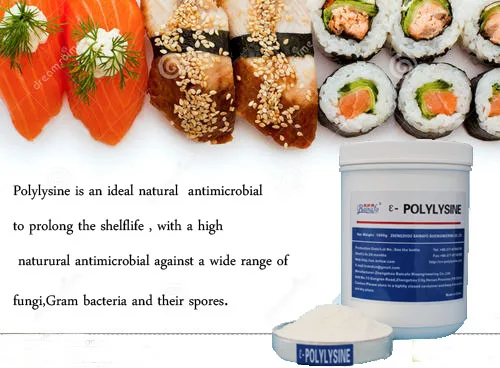
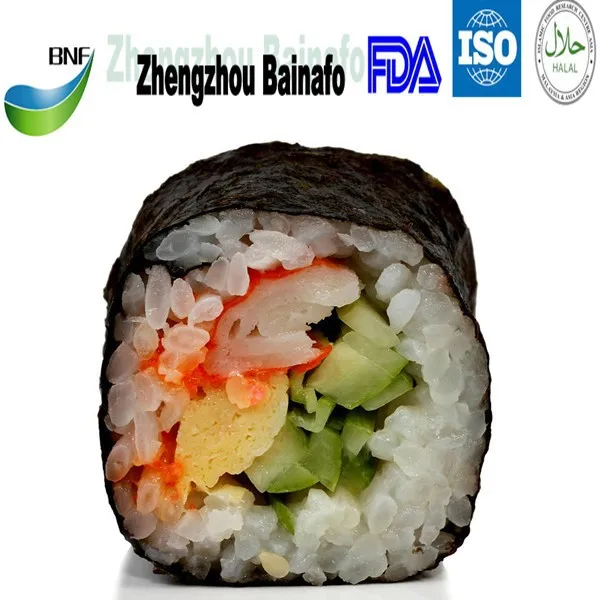
Polylysine natural preservative for Sushi and japanese food
Product Description
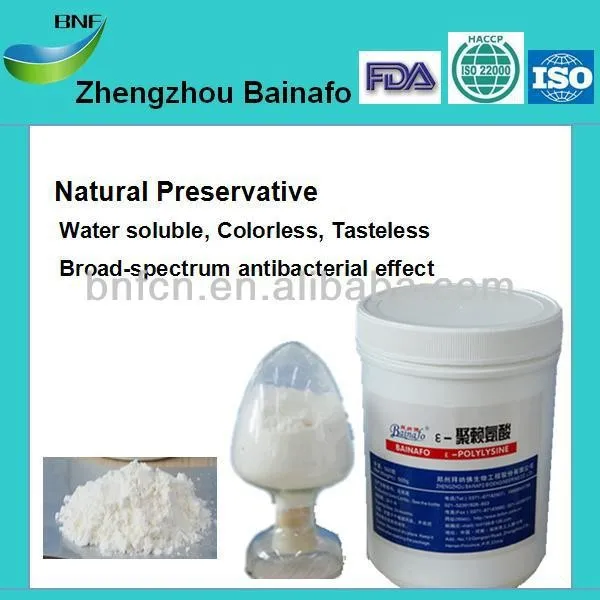
Polylysine(ε-poly-L-lysine or EPL) is a natural homo-polymer of the essential amino acid L-lysine which is produced by bacterial fermentation.
The strong cationic charge of Polylysine is what gives it it’s antimicrobial properties.
BNF has commercialized the manufacture of Polylysine in the the year of 2007 in China for using as a natural preservative.
Dosage
0.06g/kg
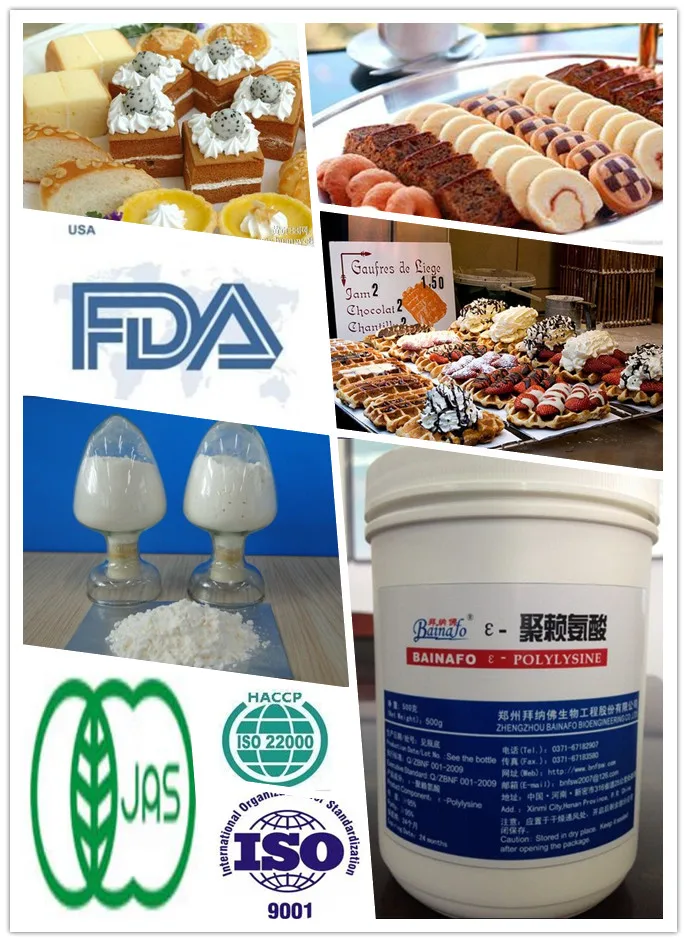
Application in food: Beverage,cake,pastry,snack,foods,butter,sauce,wine,meat,cans.cake,bread,pastry,fruit,vegetable,chocolate,chocolate milk,soy milk,ice cream ,tea, coffee,herbal drink,pure water,fresh aquatic products,cookies and so on.
ITEM
STANDARD
Description
Pale yellow powder
ε-Polylysine Purity
≥95%
Loss on drying
≤8%
Residue on ignition
≤1%
Heavy metals
≤20ppm
Arsenic
≤4ppm
ε-polylysine Effect
1.Natural preservative, product of bacterial fermentation
2.Powerful, broad spectrum antimicrobial, works against gram positive and gram negative bacteria, yeast & molds
3.Minimal effect on taste and odor
4.Excellent Synergistic effect with other preservatives such as cultured sugars, vinegar, organic acids, ethanol, EDTA, monoglycerides, etc. (opportunities for cost averaging)
5.Excellent Heat/Cold Stability
6.Works well in wide range of pH (weak acidic – weak alkaline)
7.Long track record of product use and safety (more than 20 years in Japan and Korea)
8.High Safety, Acute toxicity(LD50), more than 5.0g/kg
9.Available in powder and liquid
10.GRAS for most food applications
Table 1 ε-PL MIC (minimum inhibition concentration) Test
Different Types of Microorganisms
Bacteric
MIC
μg/ml
pH
Fungi
Aspergillus niger IFO4416
250
5.6
Trichophyton mentagrophytes IFO7522
60
5.6
Yeast
Candida acutus IFO1912
6
5.0
Phaffia rhodozyma IFO10129
12
5.0
Pichia anomala IFO0146
150
5.0
Pichia membranaefaciens IFO0577
< 3
5.0
Rhodotorula lactase IFO1423
25
5.6
Sporobolomyces roseus IFO1037
< 3
5.0
Saccharomyces cerevisiae
50
5.0
Zygosaccharomyces rouxii IFO1130
150
5.6
Gram+ bacteria
Geobacillus stearothermophilus IFO12550
5
7.0
Bacillus coagulans IFO12583
10
7.0
Bacillus subtilis IAM1069
< 3
7.3
Clostridium acetobutylicum IFO13948
32
7.1
Leuconostoc mesenteroides
50
6.0
Lactobacillus brevis IFO3960
10
6.0
L1 plantarum IFO12519
5
6.0
Micrococcus luteus IFO12708
16
7.0
Staphylococcus aureus IFO13276
12
7.0
Streptococcus lactis IFO12546
100
6.0
Gram- bacteria
Raoultella planticola IFO3317
8
7.0
Campylobacter jejuni
100
7.0
Escherichia coli IFO13500
50
7.0
Pseudomonas aeruginosa IFO3923
3
7.0
Salmonella typhymurium
16
7.0
Packaging & Shipping
Packages: Strong damp-proof, water-proof packing
1kg,2kg, 25kg or packed to customer's requirements.
Company Information
Biological, Natural, Favorable ——BNF ——Essence of BaiNaFo Products
FAQ
Q. What is polylysine and how does it work?
A. Polylysine is simply a chain of lysine molecules produced by fermentation. This chain of lysine has a strong charge that attracts it to mold, yeasts & bacteria, attacking these microbes and knocking them out.
Q. Is Polylysine safe?
A. Polylysine is 100% natural and extremely safe – safer than the salt on your dinner table (LD50 for Polylysine is more than 5g/kg vs. 4g/kg for NaCl). It’s GRAS by the US FDA for a wide variety of applications and approved for use in food in Japan in Korea, where it’s been used for over 20 years.
Q. How much Polylysine do I need in my application?
A. It varies based on your application, condition, and your expectations, but generally 20-250ppm is recommended. In some applications, Polylysine works best in combination with other preservatives. Our sales staff can give you information specific to your application.
Q. Why Polylysine?
A. Polylysine is unique in that it’s natural and works where others don’t – on pathogens, mold and yeast. All this and it’s virtually flavorless and odorless – providing the extra “bump” you need to your existing preservative system or replacing it altogether.
Q. Where does Polylysine work best?
A. Polylysine works best with moist foods of neutral to higher pH and higher temperature (that’s right, HIGHER pH and temperature are NO PROBLEM for Polylysine). Polylysine can be refrigerated, frozen, boiled, baked and gets right to work when it needs to.
Application of ε-PL in Different Countries
Japan 1989, Japanese food additive list classified ε-PL as natural food preservative and allowed to use. ε-PL has been applied for decads till now, No. 418.
U.S. In July2003, FDA has approved ε-PL as natural food preservative-GRAS Notice No1 GRN0001351. And has extended food application range in April 2010-FDA-GARS GRN000336.
South Korea 2008, KFDA has approved ε-PL as natural food preservative, No. 152.