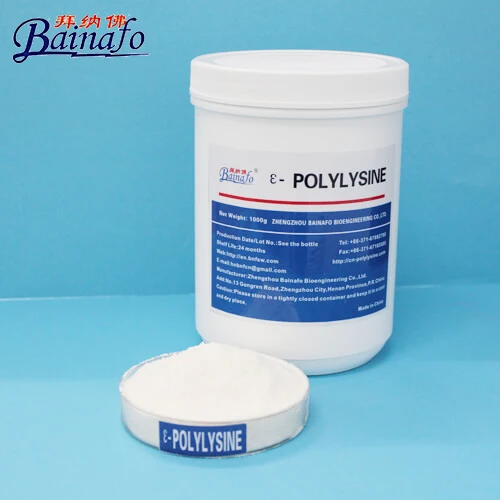
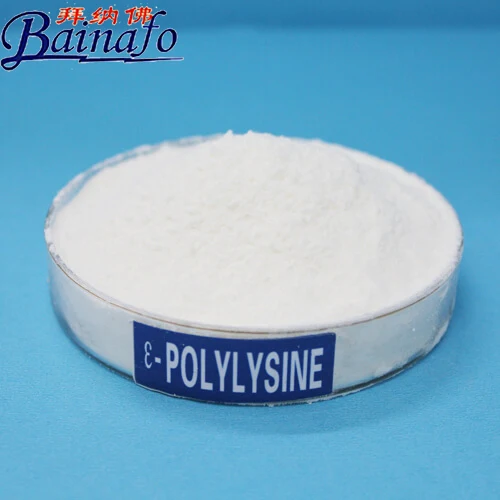
Natural food grade preservative Epsilon Polylysine
- Category: Preservatives >>>
- Supplier: Zhengzhou Bainafo Bioengineering Co. Ltd.
Share on (60200866530):
Product Overview
Description
Epsilon Polylysine
CAS No.: 28211-04-3
ε-polylysine is a naturally produced, cationic homopolymer of 25-30 L-lysine(due to Streptomyces albulus fermentation.), which was connected by ε-amido bond compounded by a e-amido of l-lysine and a e-carboxyl of another l-lysine.
|
ITEM |
STANDARD |
|
|
Description |
Off-white powder |
|
|
ε-Polylysine Purity |
≥99% |
|
|
Loss on drying |
≤10% |
|
|
Residue on ignition |
≤1% |
|
|
Heavy metals |
≤20ppm |
|
|
Arsenic |
≤4ppm |
|
ε-polylysine Effects
1> ε-polylysine can greatly inhibit the growth of bacteria, yeasts and moulds bacteria, especially to the Gram+ bacteria which can’t easily inhibit by others.
2> As a good preservative, ε-PL is characterized as being high safety, water-soluble, stable at high temperatures, widely usage, non prejudice to the taste, antibacterial in neutral or subacidity conditions.
3> Because of the stability at high temperatures, it can inhibit some heat-resistant bacillus after heat treatment and some tadpole-form noncontractile siphovirus as well.
4> ε - PL can stop small intestine fat absorption through inhibiting pancreatic lipase activities, so it can be the diet therapy for obese patients.
5> Besides, ε - PL also can be used in cosmetics, disinfectant or cleaner for food machinery or hutch, etc..
Physical and Chemical Properties
Appearance and Physical State: highly hygroscopic pale yellow powder
Melting Point: 172.8 °C
PH: 5
Solubility in Water: soluble
Molecular Weight: 4700 g/mol (degree of polymerization = 35)
Packages: Strong damp-proof, water-proof packing
1kg,2kg, 10kg or packed to customer's requirements.
Shelf life: Two years in cool (0-20°C), dry conditions, away from direct sunlight in original unopened packs.
|
Different Types of Microorganisms |
Bacteric |
MIC mg/Ltr |
pH |
|
Fungi |
Aspergillus niger IFO4416 |
250 |
5.6 |
|
Trichophyton mentagrophytes IFO7522 |
60 |
5.6 |
|
|
Yeast |
Candida acutus IFO1912 |
6 |
5.0 |
|
Phaffia rhodozyma IFO10129 |
12 |
5.0 |
|
|
Pichia anomala IFO0146 |
150 |
5.0 |
|
|
Pichia membranaefaciens IFO0577 |
< 3 |
5.0 |
|
|
Rhodotorula lactase IFO1423 |
25 |
5.6 |
|
|
Sporobolomyces roseus IFO1037 |
< 3 |
5.0 |
|
|
Saccharomyces cerevisiae |
50 |
5.0 |
|
|
Zygosaccharomyces rouxii IFO1130 |
150 |
5.6 |
|
|
Gram+ bacteria |
Geobacillus stearothermophilus IFO12550 |
5 |
7.0 |
|
Bacillus coagulans IFO12583 |
10 |
7.0 |
|
|
Bacillus subtilis IAM1069 |
< 3 |
7.3 |
|
|
Clostridium acetobutylicum IFO13948 |
32 |
7.1 |
|
|
Leuconostoc mesenteroides |
50 |
6.0 |
|
|
Lactobacillus brevis IFO3960 |
10 |
6.0 |
|
|
L1 plantarum IFO12519 |
5 |
6.0 |
|
|
Micrococcus luteus IFO12708 |
16 |
7.0 |
|
|
Staphylococcus aureus IFO13276 |
12 |
7.0 |
|
|
Streptococcus lactis IFO12546 |
100 |
6.0 |
|
|
Gram- bacteria |
Raoultella planticola IFO3317 |
8 |
7.0 |
|
Campylobacter jejuni |
100 |
7.0 |
|
|
Escherichia coli IFO13500 |
50 |
7.0 |
|
|
Pseudomonas aeruginosa IFO3923 |
3 |
7.0 |
|
|
Salmonella typhymurium |
16 |
7.0 |
Application:
| Food Type Food Name | Dosage | |
| cooked meat | Sausage | 100-250 mg/kg |
| Western-style ham | 100-250 mg/kg | |
Fresh livestock meat |
Cold Fresh meat | 200-400 mg/kg (Surface treatment |
| Frozen meat | 200-400 mg/kg (Surface treatment) | |
| Juices and drinks | Drinking pure water, | 50-100 mg/kg |
| Fruit drinks | 100-200 mg/kg | |
| Protein kind drink | 100-200 mg/kg | |
| Water-based seasonings drinks | 100-200 mg/kg | |
| Tea, coffee, plant drinks | 100-200 mg/kg | |
| aquatic products | Fresh seafood | 200-400 mg/kg (Surface treatment) |
| Frozen seafood and its products | 200-400 mg/kg (Surface treatment) | |
| Precast aquatic products | 150-300 mg/kg | |
| Cooked aquatic products | 150-300 mg/kg | |
| bakery products | Bread | 100-200 mg/kg |
| Chinese style pastry | 150-250 mg/kg | |
| Western pastry | 150-250 mg/kg | |
| dairy products | Pure milk | 100-200 mg/kg |
| Dilute cream | 150-250 mg/kg | |
| Dilute cream cheese | 150-250 mg/kg | |
Packaging:

We Recommend

Food Grade Preservative Polylysine 99% natural polylysine Hcl
US $200.00-$300.00


Food Grade Preservative Nisin Powder Pure Nisin
US $50.00-$80.00
Casein industrial grade casein acid casein
US $670.00-$740.00

beef gelatin powder 160 bloom
US $2.00-$6.00
New Arrivals
New products from manufacturers at wholesale prices