T7 High Efficiency Transcription Kit RNA polymerase by TransGen Biotech
- Category: Other Chemicals >>>
- Supplier: Beijing Transgen Biotech Co. Ltd.
Share on (60222917416):
Product Overview
Description
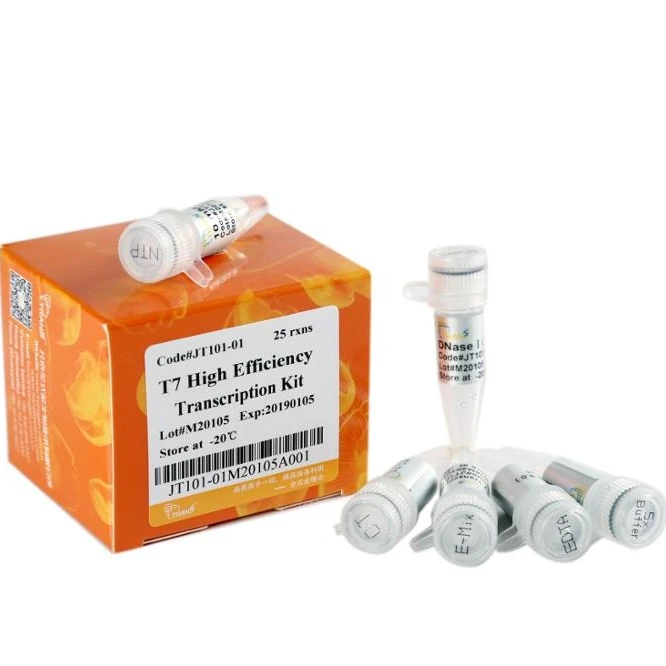
T7 High Efficiency Transcription Kit
T7 High Efficiency Transcription Kit is designed for RNA synthesis by T7 RNA Polymerase with supercoiled or linearized DNA templates. This kit is suitable for production of large amount of RNA (up to 150 μg/per reaction) form DNA template size of 0.1-5 kb. Synthesized RNA can be used for in vitro translation, RNase protection assays, RNA splicing and hybridization based blots.
| Cat. No. | JT101 | |
| Specification | JT101 -01 | 20ul (25rxns) |
| Storage: | at -20°C for two years | |
| Application | In vitro site-directed mutagenesis, digestion of methylated plasmid template. | |
| Notes | RNase contamination should be avoided. | |
| Transcript produced from the control template is 2 kb. Please refer to corresponding section above for transcription, purification, quantification and analysis. | ||
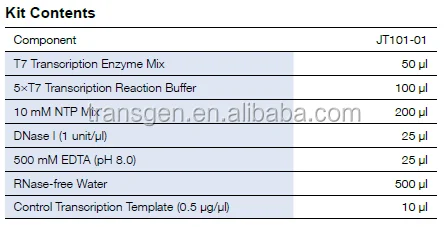
Kit Contents
| Component | JT111-01 |
| T7 Transcription Enzyme Mix | 50 μl |
| 5×T7 Transcription Reaction Buffer | 100 μl |
| 10 mM NTP Mix | 100 μl |
| DNase I (1 unit/μl) | 25 μl |
| 500 mM EDTA (pH 8.0) | 25 μl |
| RNase-free Water | 500 μl |
| Control Transcription Template (0.5 μg/μl) | 10 μl |
Protocol
RNA Synthesis
Principle of Transcription T7 RNA Polymerase

Template Preparation
• Supercoiled plasmid DNA
Supercoiled plasmid DNA should contain a T7 promoter and an effective terminator. Termination efficiency terminator varies with teminator. The following sequence has strong termination efficiency.

• Linearized DNA
Linearized DNA can be generated by restriction enzyme digested plasmid or use PCR product as template. When use linearized templates avoided 3’-overhangs, we recommend to use restriction enzymes that
produce 5’-overhangs or blunt ends. If 3’-overhangs cannot be avoided, template should be treated with T4 DNA polymerase to generate blunt ends. After digestion, template DNA should be purified.
Transcription
• Add following components
| Components | Volume |
| Template | 1 μg |
| 5×Transcription Reaction Buffer | 4 μl |
| 10 mM NTP Mix | 4 μl |
| Transcription Enzyme Mix | 2 μl |
| RNase-free water | to 20 μl |
• Mix thoroughly and incubate at 37 o C for 2 hours.
• Add 1 μl DNase I, incubate at 37 o C for 15 minutes. Then add 1 μl of 500 mM EDTA (pH 8.0) to terminate reaction (immediately proceed with following purification step after termination).
Purification of Synthesized RNA
Please refer to EasyPure ® RNA Purification Kit.
Quantification and Analysis of synthesized RNA
• RNA concentration can be determined by ultraviolet light spectrophotometer.
• Transcripts at 0.1-1 kb can be run on denaturing gel (6% acrylamide, 7 M urea). Electrophoretic buffer is
1×TBE Buffer. 10×TBE Buffer: 0.9 M Tris Base, 0.9 M Boric Acid, 20 mM EDTA. Gel Formula: for each
10 ml gel, add 4.2 g urea, 4.4 ml water, 1.5 ml of 40% ( acrylamide: methylene bis acrylamide =19:1
(w/w) acrylamide, 1 ml 10×TBE, 100 ul of 10% AP, 10 μl TEMED. AP and TEMED should be added
after urea completely dissolves.
• Transcripts at 0.5-5 kb can also be run on 1% formaldehyde denaturing gel. Electrophoretic buffer is
1×MOPS Buffer. 10×MOPS Buffer: 0.4 M MOPS (pH 7.0), 0.1 M Sodium Acetate, 10 mM EDTA. Gel
Formula: for each 100 ml gel, add 1 g agarose into 72 ml RNase-free water, dissolve it by heating, then
add 10 ml of 10×MOPS Buffer. Cool the solution until 50-60oC, add 18 ml formaldehyde (37%), mix
thoroughly and pool the gel.
• To do electrophoresis analysis, dilute 0.2-1 μg RNA with RNase-free water into 5 μl, add same volume of
2×RNA Loading Buffer and mix thoroughly, incubate at 70 o C for 10 minutes and followed by incubation
on ice for 2 minutes, load samples on the gel. After electrophoresis, stain by EB or other nucleic acid dye
for observation. RNA Marker is processed with the same method as RNA sample in this step for
electrophoresis analysis (or referring to supplier’s manual).
CITATIONS
Li M, et al. 2013. Stability and iron oxidation properties of a novel homopolymeric plant ferritin from adzuki bean seeds: A comparative analysis with recombinant soybean seed H-1 chain ferritin. 1830(4):2946-53. Biochim Biophys Acta. IF=3.848. PMID: 23313843.
We Recommend

Cheap and best Caluanie Muelear Oxidize Parteurized
US $8.90-$9.30

CAS 143-18-0 Catalyst Emulsifier Potassium Oleate
US $70.00-$88.00

Good price Boron Nitride Nanosheets BN Nanosheets
US $0.58-$0.72

China Factory of Trinexapac-ethyl CAS: 95266-40-3 with high-quality
US $460.00-$560.00
New Arrivals
New products from manufacturers at wholesale prices