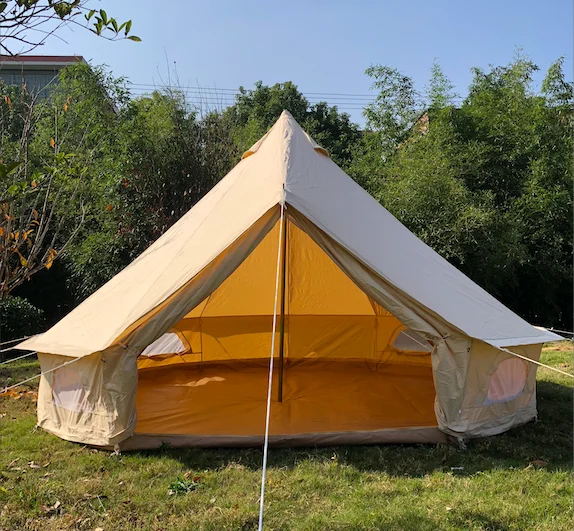
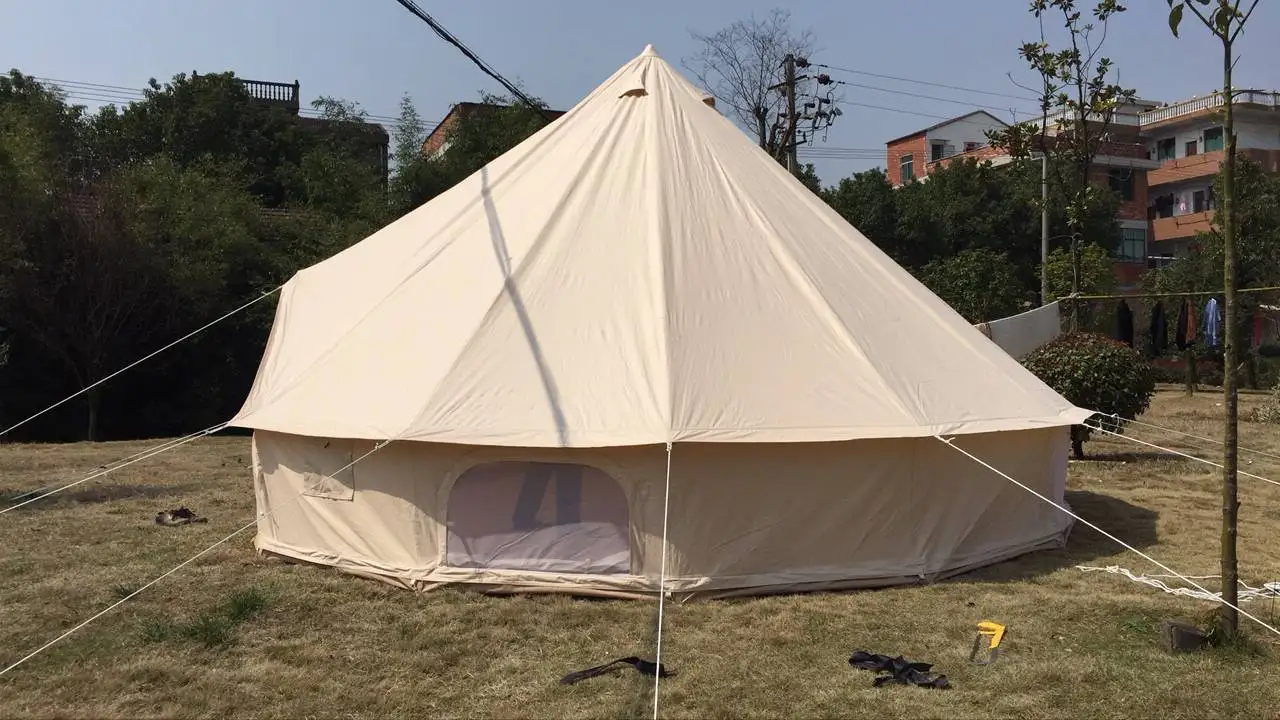
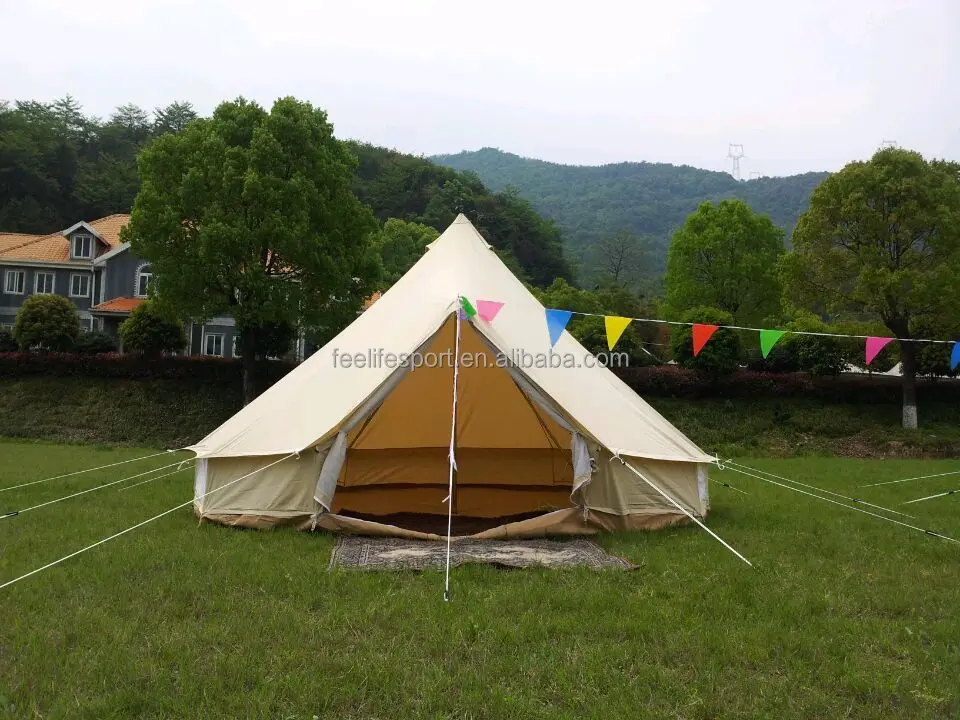

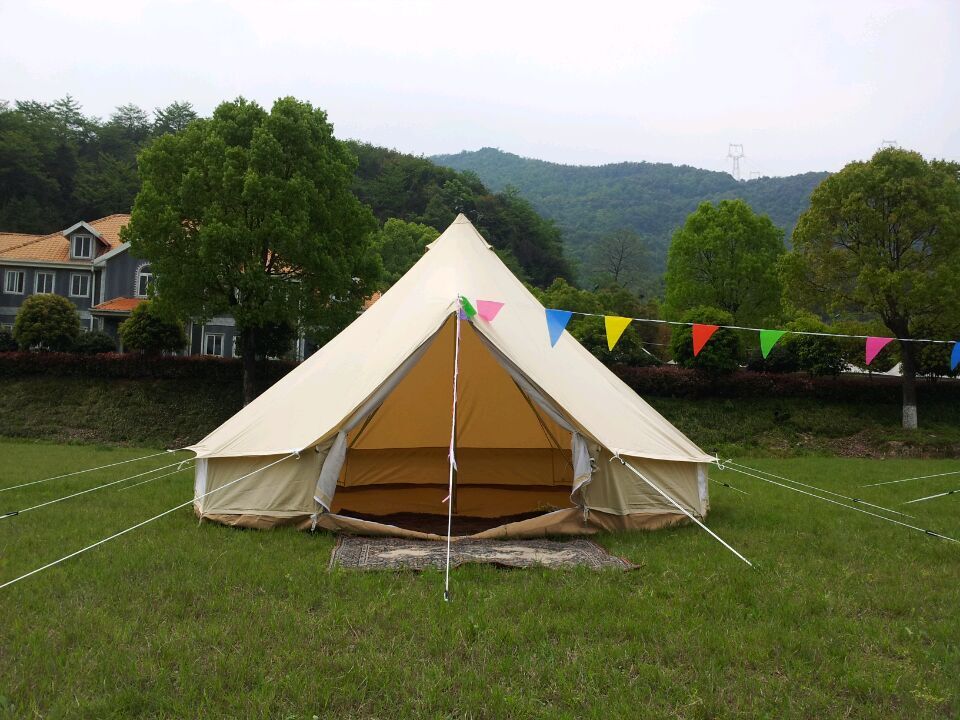
cotton canvas tipi tents for sale /medieval canvas tents/round canvas tent
- Category: >>>
- Supplier: Hangzhou Flew Leisure Products Co. Ltd.
Share on (60401086816):
Product Overview
Description
Product Description
Size: 400L/250H
door hight :150m
sidewall hight :60cm
Fabric :100% cotton canvas, 280gsm,water proof,fire resistant
Ground sheet :540gsm ripstop PVC, waterproof , fire resistant,detached with the teny by a zipper,can be taken up from unzipped ground sheet
Net :40gsm white,both on door and windows
Central pole :Dia.39mm galvanized steel tube,1.0mm thickness,copper-zinc coated
A frame pole : Dia.19mm galvanized steel tube,1.2mm thickness, copper-zinc coated
Windows 4 side windows & 4 vents on the apex, with mesh
Door 1 zipper door, with mesh, with flap
Pegs Φ5mm steel,26cm on length
Ropes Φ6mm Nylon ropes, 3m on length

Bell Tents History
The origin and style of the bell tent was a little different from the bell tents for sale today.
The first patented bell tent predecessor was the Sibley tent. Invented by military officer Henry Hopkins Sibley and patented in 1856.
Although conical in shape it differed greatly from modern day bell tents resembling and having many features of the Native American tipi with a smoke hole at the top and fire pit in the centre. It also required no guide ropes as was secured to the ground with the use of pebble ties and 24 wooden pegs at the base of the canvas.
Where it differed greatly from the tipi was in its practicality. A traditional Sioux tipi of a similar size (18 ft) would require 12 wooden poles (larch spruce, fir, cedar…) to form a tripod on which the canvas sits. The Sibley bell tent however was designed to use only one central metal pole, vastly reducing weight, set up time and immeasurably increasing maneuverability.
The tent was put to the test when 44 thousand Sibley tents were used during the Utah expedition (a confrontation between the Nauvoo legion and the United states army, otherwise known as the Mormon war or Mormon rebellion)
As holder of the patent, Sibley was due to receive $5 for every tent made ($220 thousand dollars for this one campaign!)
However, following the outbreak of civil war, Sibley’s decision to resign from the United States Army in May 1861 (in order to join the Confederate States Army) cost him dearly.
Despite a long legal battle, Sibley did not receive a dime for his invention and patent of the Sibley tent.
Although Sibley was the first to patent a conical tent in 1856, it is not the first time a conical tent was used to house troops in warfare. For the first appearance of what has now become the bell tent you have to go way back to the Byzantine army to the reign of Emperor Maurice, 582 – 602 A.D.
Packaging & Shipping

We Recommend



New Arrivals
New products from manufacturers at wholesale prices