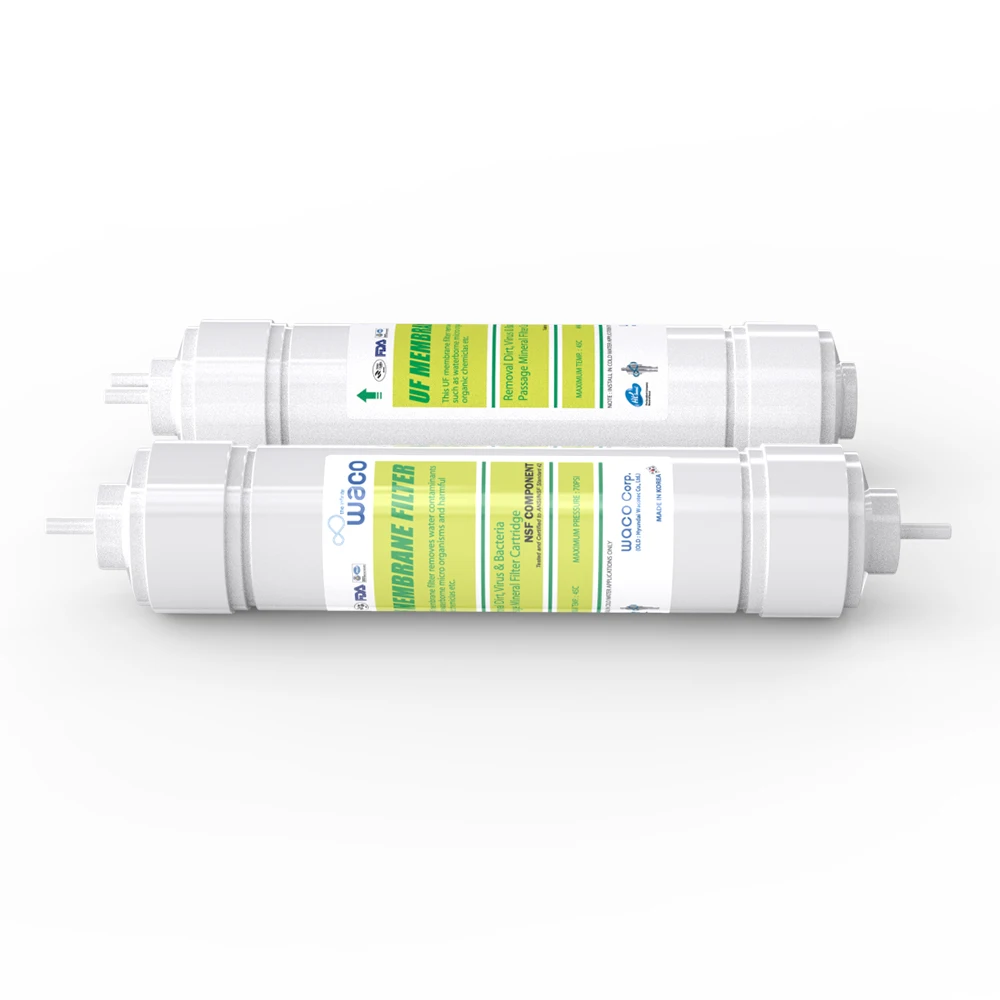
UF Membrane Filter Characteristics of Ultrafiltration Membrane
- Category: >>>
- Supplier: WACO Corp.
Share on (60437575832):
Product Overview
Description
Product Description

Characteristics of Ultrafiltration Membrane
UF membrane with pore sizes in the range of 0.03 to 0.05 micron typically remove high molecular-weight substances, colloidal materials, and organic and inorganic polymeric molecules, bacteria except minerals. Low applied pressures are sufficient to achieve high flow rates from an ultrafiltration membrane. Flow rate of a membrane is defined as the amount of permeate produced per unit. Our UF filter shows excellent water permeability. The flow rate varies between 50 and 200 GPD at operating pressure of about 50psig in contrast, Reverse osmosis membranes only produce between 10 to 30GPD at 200 to 400psig. Quality properties of resistance to acid and alkali, high flow-rate, non-toxicity, no-taste and stable performance.
Advantages:
1. High through put of product
2. Low process cost
3. Ease of scale-up
Application
1. Fraction nation of protein sand nucleic acids
2. Concentration of macro molecules
3. Desalting, i.e.removal or salts and other low molecular
weight compounds from solution of macromolecules
4. Removal of cells and cell debris from fermentation broth
5. Virus removal from therapeutic products
Ultrafiltration Membranes
Basically UF membrane modules come in plate and frame, spiral wound, and tubular configurations.
All configurations have been used successfully in different process applications. Each configuration is specially suited for some specific applications and there are many applications where more than one configuration is appropriate. For high purity water, spiral wound and capillary configurations are generally used. The configuration selected depends on the type and concerntration of colloidal material or emulsion.
Factors Affecting the Performance of Ultrafiltration.
Flow Across the Membrane surface.
The permeate rate increases with the flow velocity of the liquid across the membrane surface. Higher flow also means higher energy consumption and larger pumps. Increasing the flow velocity also reduces the fouling of the membrane surface. Generally, an optimum flow velocity is arrived at by a compromise between the pump horsepower and increase in permeate rate.
Operating Pressure.
Permeate rate is directly proportional to the applied pressure across the membrane surface. However, due to increased fouling and compaction, the operating pressures rarely exceed 100psig and are generally around 50psig. In some of the capillary-type ultrafiltration membrane modules the operating pressures are even lower due to the physical strength limitation imposed by the membrane module.
Flow Across the Membrane Surface.
Permeate rates increase with increasing temperature. However, temperature generally is not a controlled variable. It is important to know the effect of temperature on membrane flux in order to distinguish between a drop in permeate due to a drop in temperature and the effect of other parameters.
Membrane Materials
A variety of materials have used for commercial ultrafiltration membranes, but polysulfone and cellulose acetate are the most common. For high purity water applications the membrane module Materials must be compatible with chemicals such as hydrogen peroxide used in sanitizing the membranes on a periodic basis.
Packaging & Shipping
Delivery Detail: 4 Weeks After the Payment
Our Services
We're the most specialized manufacturer and exporter of hot and cold water dispenser, water purifier and reverse osmosis system, bidets and others wellness products located in Seoul, Korea. We have a distributor organization in over 40 countries in worldwide. And we share high reputation in both of home and abroad due to the superior quality, innovative design, advanced technology and convenience. Our motto-Accuracy, Technical innovation, Superiority in quality and perfect service-represents that we'll do our best to give pure, fresh, clean water and air and also to keep our customers healthy with our well-being products. For more details of us, you can check it here. (www.waco-corp.com)
Company Information
With priority to our clients’ good health in our mind, we, WACO Corp.(old hyundai wacortec co., ltd.) as the world leader and specialist in Water Purifiers, Dispensers, Air Purifiers as well other well-being products have enjoyed a great reputation of the various selections, highest quality, and advanced technology as well our commitment since established.
With the good design of our products and their durability at a reasonable price, We are dedicated to giving you a better life and benefits.
Our motto-Accuracy, Technical Innovation, Superiority in quality and Perfect Service-represents that we’ll do our best to give pure, fresh, clean water and air and also to keep our customers healthy with our well-being products.
We appreciate your continuing support and interest and in return we do our best for you.
Thank you.
With the good design of our products and their durability at a reasonable price, We are dedicated to giving you a better life and benefits.
Our motto-Accuracy, Technical Innovation, Superiority in quality and Perfect Service-represents that we’ll do our best to give pure, fresh, clean water and air and also to keep our customers healthy with our well-being products.
We appreciate your continuing support and interest and in return we do our best for you.
Thank you.
certificate

FAQ
Telephone:82-2-9482258
Mobile Phone:82-11-787-1029
Fax:82-2-9482342
Address:A-301, Hagye Technotown, 10, Nowon-ro 15-gil, Nowon-gu, Seoul, Korea
Zip:01788
Country/Region:South Korea
Province/State:Seoul
City:Seoul
We Recommend
New Arrivals
New products from manufacturers at wholesale prices