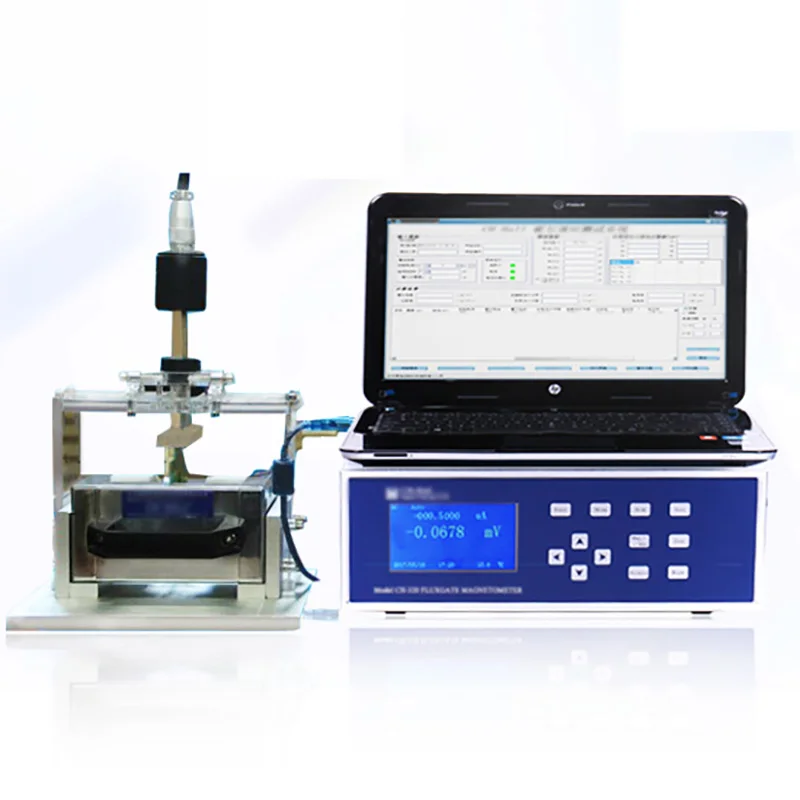
DX 3000 hall effect measurement system/measuring instrument for Laboratory
- Category: >>>
- Supplier: Xiamen Dexing Magnet Tech. Co. Ltd.
Share on (60440240879):
Product Overview
Description
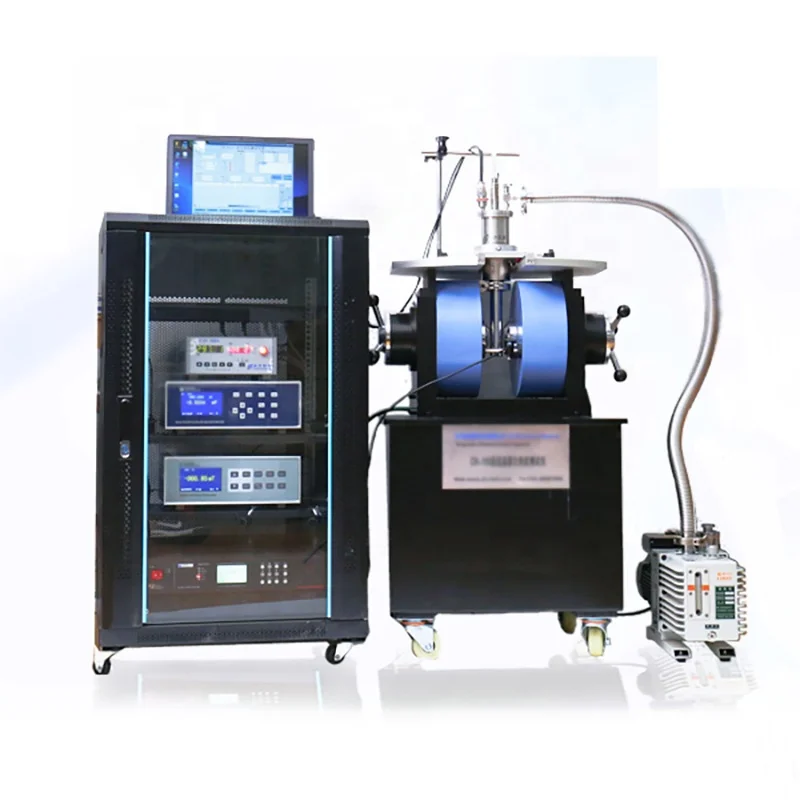
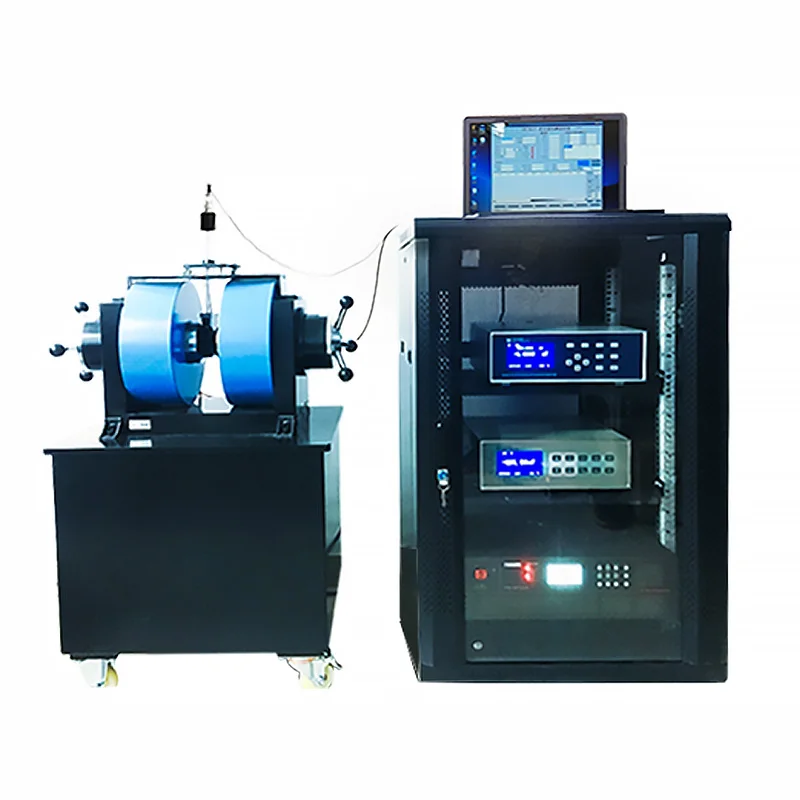
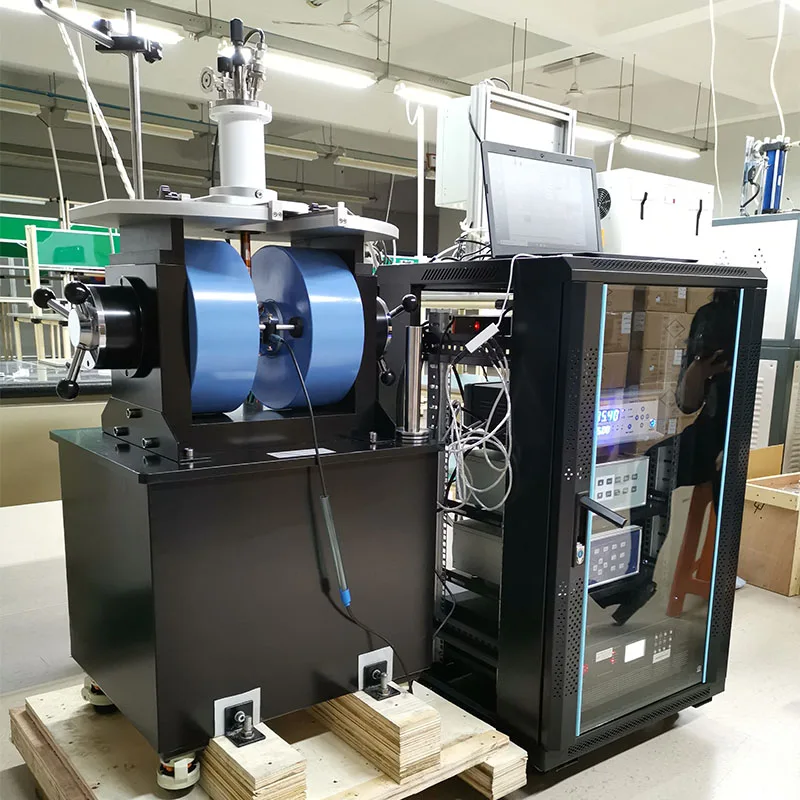
DX-3000 hall measurement effect system

Introduction
DX-3000 hall effect system is one fully automated test system, which intergrates Hall effect, magnetoresistance, IV characteristics test in one machine. This system takes some problems which users often ignore, such as instrument configuration, circuit wiring (including room temperature and low-temperature wiring) into consideration, selects the Keithley electrical measuring instruments. The magnetic field can adopt electromagnet or liquid helium superconducting magnet based on user’s requirement, equipped the smart measurement sample rod, plus a special fully automated test software, allowing users to quickly and easily measure sample and obtain accurate and reliable data. Addition, there are a variety of low-temperature options, and can transform according to the user's existing instrumentation and the special requirements of the software. DX3000 series hall effect measurement system is a powerful tool for the resaearch of materials’ electrical transport properties.
Hall effect measurement system basic configuration
U.S. Keithley instrumentation
System (resistance range) | Source meter | Voltmeter | Ammeter | Host computer | Matrix card | Electrometer | Commu nication Interface | ||||
2400 | 6220 | 2700 | 2182A | 6485 | 7001 | 7709 | 7012 | 7152 | 6514 | 488B | |
Standard (10mΩ-10MΩ) | 1 | 1 | 1 | 1 | |||||||
High sensitivity (0.1mΩ-10MΩ) | 1 | 1 | 1 | 1 | 1 | ||||||
High voltage and impedance (0.1mΩ-100GΩ) | 1 | 1 | 1 | 1 | 2 | 2 | 1 | ||||
Hall effect system main part
Magnetic field range | Magnetic body | Cooling device | Magnetic field measurement | Power | Software |
0~1T@10mm | DX-100 electromagnet | Without | DX-160 gauss meter Precision: 0.2% | DX-2030, 1KW | Full automatic data processing and drawing |
0~2.4T@10mm | DX-130 electromagnet | Without | DX-180 gauss meter Precision: 0.05% | DX-10030, 3KW | Full automatic data processing and drawing |
0~2.6T@10mm | DX-180 electromagnet | 8KW water chiller | DX-180 gauss meter Precision: 0.05% | DX-10050, 5KW | Full automatic data processing and drawing |
Low temperature portion (optional)
Temperature Range | Cooling body | Temperature control device |
80~450K | Liquid nitrogen thermostat | TC202 |
4~500K | Cycle refrigerator | TC202 |
1.6~325K | Cryogenic low temperature system | TC202 |
45~325K | CTI small refrigerator | TC202 |
Hall effect system main features:
- Using plug-sample cards, easy to install;
- One standard configuration can simultaneously measure two samples, 4 samples can be measured simultaneously by adding optional devices;
- Resistance measurement range: 0.1mΩ~100GΩ(High voltage and impedance system);
- Different Hall effect and resistance measurements under different current and magnetic field;
- Testing and calculation process performed automatically by the software, which gives the intermediate data and the curve at the same time.It will save you a lot of time;
- System provides high stability of the magnetic field for a long time,zero magnetic field can be smoothed;
- Electromagnet power supplybuilt in precision Gauss Meter, high field control speed;
- Choosing low-temperature device,Hall effect and resistance measurements can be performed at different temperatures.
Hall effect system testable material:
- Semiconductor materials: SiGe, SiC, InAs, InGaAs, InP, AlGaAs, HgCdTe and Ferrite materials, etc.
- Low impedance material: metal, transparent oxide, weak magnetic semiconductor materials, TMR materials, etc.
- High impedance material: semi-insulating GaAs, GaN, CdTe,etc.
Hall effect system basic function:
- Measurement of Hall Effect, magnetic resistance, curves of I-V and R-T .
- Parameters to be measured: Hall Effect- sheet resistance, resistivity, Hall coefficient, conductivity type, Hall mobility, carrier concentration;
- I-V curve: I-V curves at different temperature and magnetic field.
- R-T curve: Under fixed magnetic field, the curves for resistance changes at different temperature.
- R-H curve: Under fixed temperature, the curves for resistance changes at different magnetic field.
Hall effect system main technical indexes:
- Sample size
- Small size sample card: 12*12 mm2
- Large size sample card: 50*50 mm2
- Probe sample card: 1×1mm2~30×30mm2
- Sample measurement method
- Hall effect samples: Si, GaAs, ect.
- Resistance and I-V samples: 4 wire or 6 wire method
- Magnetic field environment
Model Index | DX-100 | DX-130 | DX-180 | ||||||
Pole diameter | 60mm(optional) | 100mm(optional) | 120mm(optional) | ||||||
Air gap | Room temp. 10mm | Liquid nitrogen thermostat 24mm optional | ARS refrigerator 40mm optional | Room temp. 10mm | Liquid nitrogen thermostat 24mm optional | ARS refrigerator 40mm optional | Room temp. 10mm | Liquid nitrogen thermostat 24mm optional | ARS refrigerator 40mm optional |
Max. magnetic field | 1.5T | 0.9T | 0.6T | 2.5T | 1.5T | 1.0T | 2.7T | 2.0T | 1.4T |
Uniformity | ±1% | ±1% | ±1% | ||||||
- Temperature environment (optional)
- No liquid helium superconducting magnet system, 1.6K~325K;
- Liquid nitrogen thermostat options:
Standard liquid nitrogen thermostat, 80K~325K;
High temperature liquid nitregen thermostat, 80K~500K; - Cycle refrigerator options:
Standard 4K refrigerator system, 4K~325K;
High temperature 4K refrigerator, 4K~700K;
Standard 10K refrigerator system, 10K~325K;
High temperature 10K refrigerator, 10K~800K;
Minisize refrigerator system, 45K~325K;
- Electrical properties
Under the following typical test conditions:
- Sample power consumption less than 1mV, under this condition, let excitation reach the maximum recommended current and voltage in system configuration;
- Sample temperature 295K;
- Sample seat without leak current;
- The reistance of each test lead 25Ω;
- Voltage usage effectiveness of measurement electrical resistivity (V_out/V_in) should be 0.1 approx. for Vanderbit sample and should be 0.5 approx. for hall sample;
- Sample shape correction factor 1;
- Magnetic field and sample thickness measurement uncertainty should be within 1%;
- Magnetic field/sample thickness should be 1T/mm, note the measured maximum carrier concentration is approximately proportional to this value, so stronger magnetic field and thicker sample could improve the measurement range.
System | Standard |
Current source | ±100pA~±0.1A |
Voltage source | ±0.1uV~±30V |
Current | ±100pA~±100mA (min. resolution 100pA) |
Voltage | ±0.1uV~±30V (min. resolution 0.1uV) |
Max. resistance | 10MΩ |
Min. resistance (VDP) | 40mΩ |
Min. resistance(HB) | 10mΩ |
Max. carrier concentration | 1.0E+18 |
Certification

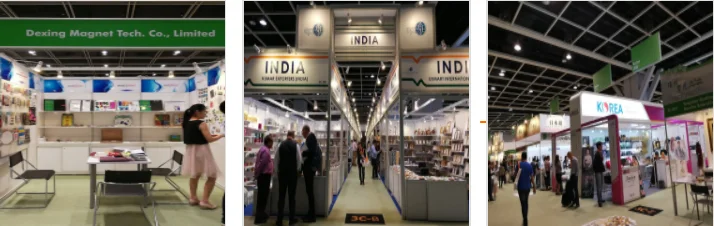
International Show
Hongkong Exhibition
Packaging & Shipping

Company Information

We Recommend
New Arrivals
New products from manufacturers at wholesale prices