Fungicide Tricyclazole 95%Tc 75%WP Used to Treat Rice Blast
US $1.00-$100.00
Share on (60470254520):
Azoxystrobin is a systemic fungicide with protectant, curative, eradicant, translaminar properties.
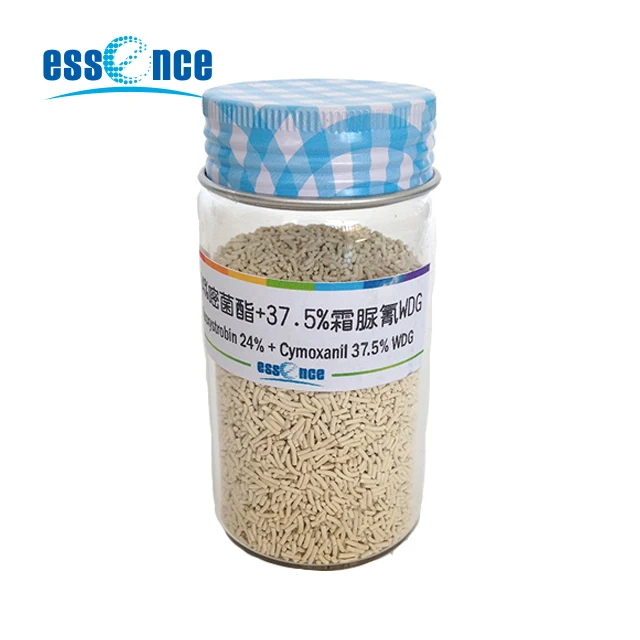
Nanjing Essence supplys Azoxystrobin 24% + Cymoxanil 37.5%WDG(WG).
Design of packaging and label can be customized from 1g to 25Kg for solid.
| Pesticide Product | Azoxystrobin + Cymoxanil |
| Uses | Fungicide with protectant, curative, eradicant, translaminar and systemic properties |
| Formulation Details | 61.5%WDG (615 g/Kg WG) |
| packaging and label | Customized 1g to 25Kg |
Azoxystrobin Biochemistry
Quinone outside inhibitor. Inhibits mitochondrial respiration by blocking electron transfer between cytochrome b and cytochrome c1, at the ubiquinol oxidising site. Controls pathogenic strains resistant to the 14-demethylase inhibitors, phenylamides, dicarboxamides or benzimidazoles.
Azoxystrobin Mode of action
Fungicide with protectant, curative, eradicant, translaminar and systemic properties. Inhibits spore germination and mycelial growth, and also shows antisporulant activity.
Azoxystrobin Applications
Controls the following pathogens, at application rates between 100 to 375 g/ha: Erysiphe graminis, Puccinia spp., Leptosphaeria nodorum, Septoria tritici and Pyrenophora teres on temperate cereals; Pyricularia oryzae and Rhizoctonia solani on rice; Plasmopara viticola and Uncinula necator on vines; Sphaerotheca fuliginea and Pseudoperonospora cubensis on cucurbitaceae; Phytophthora infestans and Alternaria solani on potato and tomato; Mycosphaerella arachidis, Rhizoctonia solani and Sclerotium rolfsii on peanut; Monilinia spp. and Cladosporium carpophilum on peach; Pythium spp. and Rhizoctonia solani on turf; Mycosphaerella spp. on banana; Cladosporium caryigenum on pecan; Elsino? fawcettii, Colletotrichum spp. and Guignardia citricarpa on citrus; Colletotrichum spp. and Hemileia vastatrix on coffee.
Azoxystrobin Phytotoxicity
Good crop safety, except on some varieties of apple (e.g. McIntosh, Cox).
Azoxystrobin Formulations
Azoxystrobin 50%WDG(WG).
Cymoxanil Mode of action
Foliar fungicide with protective and curative action. Has contact and local systemic activity, and also inhibits sporulation.
Cymoxanil Uses
Control of Peronosporales, especially Peronospora, Phytophthora, and Plasmopara spp. Normally used in combination with protectant fungicides (to improve residual activity) on a range of crops, including vines, hops, potatoes, tomatoes, cucurbits and lettuce, at 2–3 oz/a.
Cymoxanil Formulation types
WG; WP.
Cymoxanil Compatibility
Incompatible with alkaline materials.




New products from manufacturers at wholesale prices