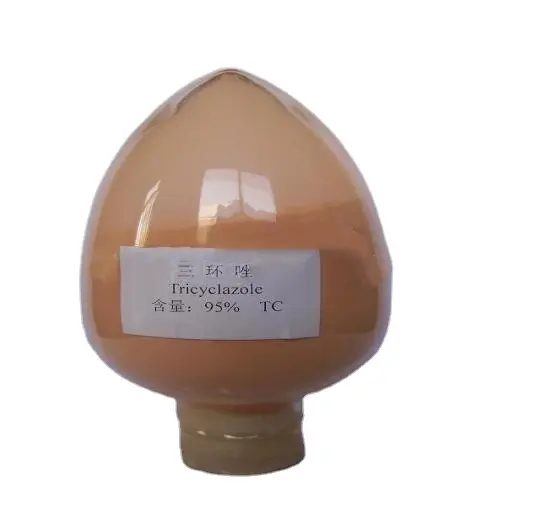
Fungicide Tricyclazole 95%Tc 75%WP Used to Treat Rice Blast
US $1.00-$100.00
Share on (60496728082):
Metiram (CAS No.9006-42-2) is non-systemic foliar fungicide with protective action..
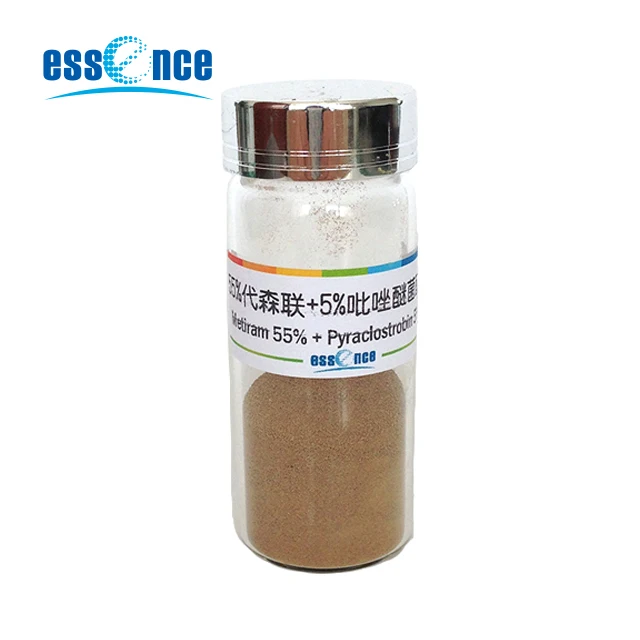
Nanjing Essence supplys Metiram 55% + Pyraclostrobin 5% DF.
Design of packaging and label can be customized from 10mL to 200L for liquids, 1g to 25Kg for solid.
| Pesticide Product | Metiram + Pyraclostrobin |
| Uses | Non-systemic foliar fungicide with protective action. |
| Formulation Details | 60%DF |
| packaging and label | Customized 1g to 25Kg |
Metiram Biochemistry
Non-specific thiol reactant, inhibiting respiration.
Metiram Mode of action
Non-systemic foliar fungicide with protective action.
Metiram Uses
Control of a wide range of diseases on many crops, e.g. scab on pome fruit; shot-hole on stone fruit; rust on currants and plums; downy mildew, red fire disease and black rot on vines; Phytophthora late blight on potatoes and tomatoes; Septoria leaf spot on celery and celeriac; downy mildew on head lettuce; rust on asparagus; anthracnose on beans; downy mildews on hops and tobacco; downy mildews and rusts on ornamentals; diseases of cotton, peanuts, pecans, etc. Application rates in the range 1.5–4.0 kg/ha. Used in forestry to combat needle cast in conifers. Also used as a seed treatment for control of emergence diseases of vegetables and ornamentals.
Metiram Formulation types
Metiram WG.
Metiram Compatibility
Incompatible with highly alkaline materials.
Pyraclostrobin Biochemistry
Quinone outside Inhibitor. Inhibits mitochondrial respiration by blocking electron transfer at the cytochrome bc1 complex.
Pyraclostrobin Mode of action
Fungicide with protectant, curative and translaminar properties.
Pyraclostrobin Uses
Control of major plant pathogens, such as Septoria tritici, Puccinia spp., Drechslera tritici-repentis and Pyrenophora teres in cereals, Mycosphaerella spp. in peanuts, Septoria glycines, Cercospora kikuchii and Phakopsora pachyrhizi in soya beans, Plasmopara viticola and Uncinula necator in grapes, Phytophthora infestans and Alternaria solani in potatoes and tomatoes, Mycosphaerella fijiensis in bananas, Elsinoë fawcettii and Guignardia citricarpa in citrus, and Rhizoctonia solani and Pythium aphanidermatum in turf. Application rates c. 50–250 g/ha for food crops and 280–560 g/ha for turf.
Pyraclostrobin Formulation types
Pyraclostrobin EC;
Pyraclostrobin SE;
Pyraclostrobin WG.




New products from manufacturers at wholesale prices