

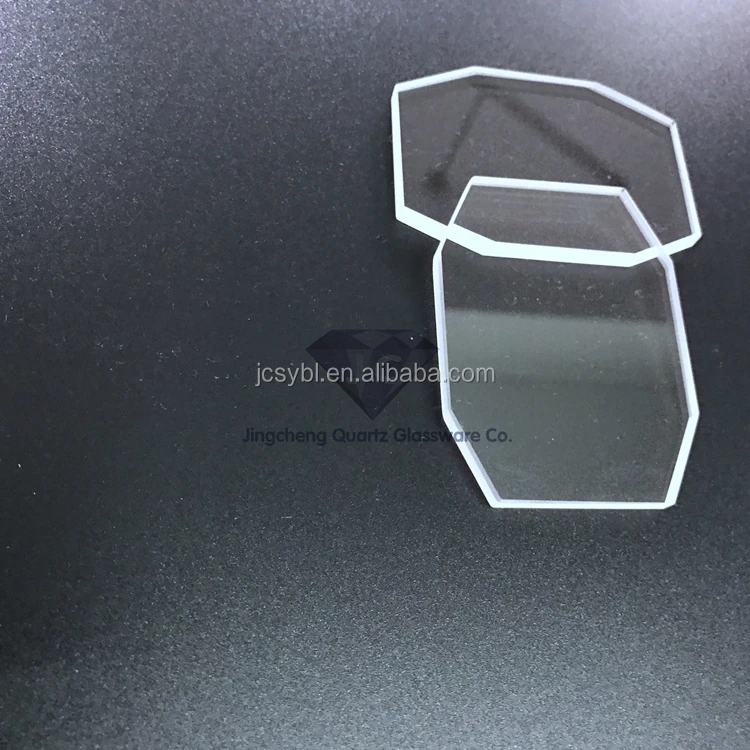
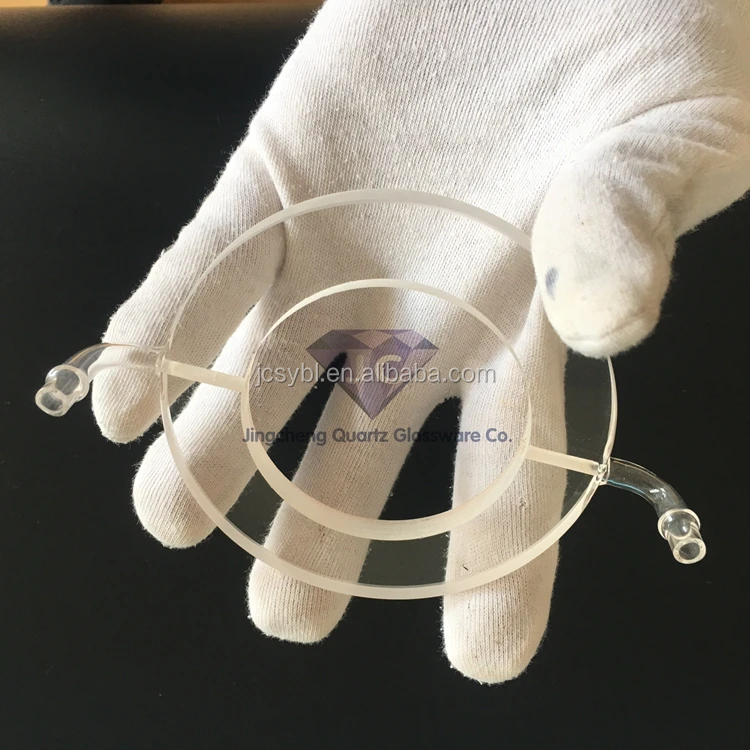
Direct supply customized crystal quartz product
- Category: >>>
- Supplier: Jinzhou Jingcheng Quartz Glassware Factory [Liaoning China]Jinzhou
Share on (60710555013):
Product Overview
Description
Applications
Most of the applications of fused silica exploit its wide transparency range, which extends from the UV to the near IR. Fused silica is the key starting material for optical fiber, used for telecommunications.
Because of its strength and high melting point (compared to ordinary glass), fused silica is used as an envelope for halogen lamps and high-intensity discharge lamps, which must operate at a high envelope temperature to achieve their combination of high brightness and long life. Vacuum tubes with silica envelopes allowed for radiation cooling by incandescent anodes.
Because of its strength fused silica was used in deep diving vessels such as the Bathysphere and Benthoscope.
The combination of strength, thermal stability, and UV transparency makes it an excellent substrate for projection masks for photolithography.
An EPROM with fused quartz window in the top of the packageIts UV transparency also finds uses in the semiconductor industry; an EPROM, or erasable programmable read only memory, is a type of memory chip that retains its data when its power supply is switched off, but which can be erased by exposure to strong ultraviolet light. EPROMs are recognizable by the transparent fused quartz window which sits on top of the package, through which the silicon chip is visible, and which permits exposure to UV light during erasing.
Due to the thermal stability and composition it is used in semiconductor fabrication furnaces.Fused quartz has nearly ideal properties for fabricating first surface mirrors such as those used in telescopes. The material behaves in a predictable way and allows the optical fabricator to put a very smooth polish onto the surface and produce the desired figure with fewer testing iterations. In some instances, a high-purity UV grade of fused quartz has been used to make several of the individual uncoated lens elements of special purpose lenses including the Zeiss 105mm f/4.3 UV Sonnar, a lens formerly made for the Hasselblad camera, and the Nikon UV-Nikkor 105mm f/4.5 (presently sold[clarification needed] as the Nikon PF10545MF-UV) lens. These lenses are used for UV photography, as the quartz glass has a lower extinction rate than lens made with more common flint or crown glass formulas.
Fused quartz can be metallised and etched for use as a substrate for high precision microwave circuits, the thermal stability making it a good choice for narrowband filters and similar demanding applications. The lower dielectric constant than alumina allows higher impedance tracks or thinner substrates.
Fused quartz is also the material used for modern glass instruments such as the glass harp and the verrophone, and is also used for new builds of the historicalglass harmonica. Here, the superior strength and structure of fused quartz gives it a greater dynamic range than the historically used lead crystal, and a clearer sound.
Product Details Show