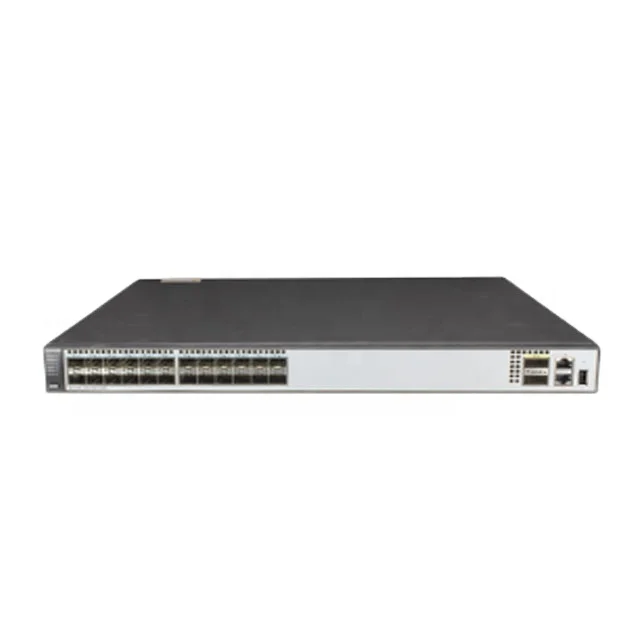
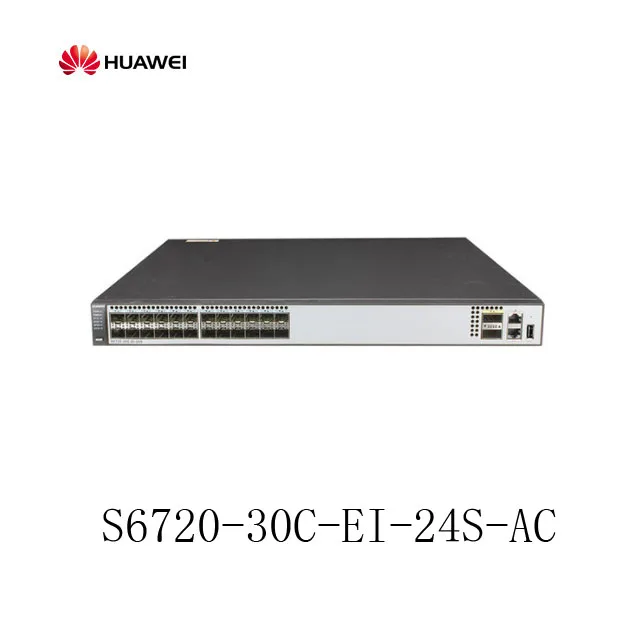
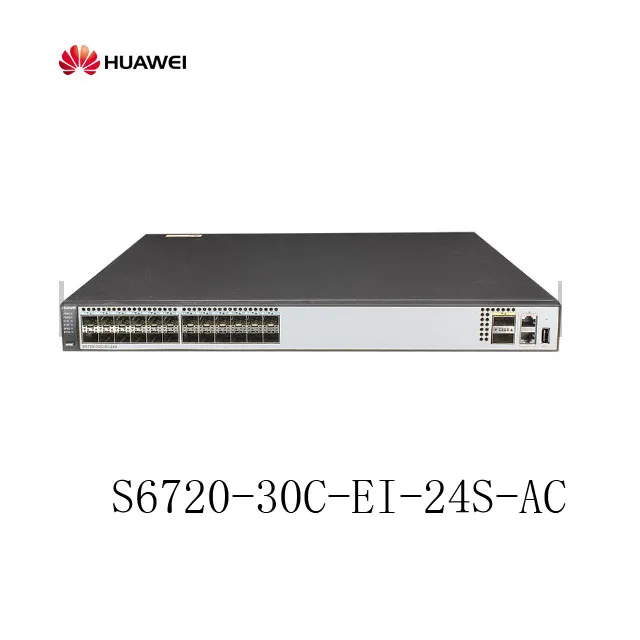
Huawei S6720 EI Series Next Generation Enhanced 10 GE Switches S6720 30C EI 24S AC
- Category: >>>
- Supplier: Combasst Industry Development (shanghai) Co. Limited
Share on (60764008396):
Product Overview
Description
Huawei S6720-EI Series Next-Generation Enhanced 10 GE Switches S6720-30C-EI-24S-AC
Product Description
The S6720-EI series switches are next-generation 10G box switches. The S6720-EI can function as an access switch in an Internet Data Center (IDC) or a core/aggregation switch on a campus network. The S6720-EI has industry-leading performance, provides line-speed 10 GE access ports, and line-speed 40 GE uplink ports. It can be used in a data center to provide 10 Gbit/s access to servers or function as a core switch on a campus network to provide 10 Gbit/s traffic aggregation. In addition, the S6720-EI provides a wide variety of services, comprehensive security policies, and various QoS features to help customers build scalable, manageable, reliable, and secure data centers.
S6720S-26Q-EI-24S is a compact switch with 220 mm depth, perfectly suitable in a 300 mm deep cabinet, saving installation space for customers.
Pictures

Highlight Features
Large-capacity, high-density, 10 Gbit/s access and 40 Gbit/s uplink
- To provide sufficient bandwidth for users, many servers, particularly those in data centers, use 10G network adapters. The S6720-EI can be used in data centers to provide high forwarding performance and 10 GE ports. The S6720-EI has the high density of 10 GE ports and the largest switching capacity in the industry. Each S6720-EI provides a maximum of 6 line-speed QSFP+ ports and 48 line-speed 10 GE ports.
- S6720-EI ports support 1 GE and 10 GE access and can identify optical module types, maximizing the return on investment and allowing users to flexibly deploy services.
- The S6720-EI has a large buffering capacity and uses an advanced buffer scheduling mechanism to ensure non-block transmission when data center traffic volume is high.
Higher reliability mechanism
- The S6720-EI supports redundant power supplies. You can choose a single power supply or use two power supplies to ensure device reliability. With two fans, the S6720-EI has a longer MTBF time than its counterpart switches.
- The S6720-EI supports MSTP multi-process that enhances the existing STP, RSTP, and MSTP implementation. This function increases the number of MSTPs supported on a network. It also supports enhanced Ethernet reliability technologies such as Smart Link and RRPP, which implement millisecond-level protection switchover and ensure network reliability. Smart Link and RRPP both support multi-instance to implement load balancing among links, optimizing bandwidth usage.
- The S6720-EI supports the Enhanced Trunk (E-Trunk) feature. When a CE is dual-homed to two S6720s (PEs), E-Trunk protects the links between the CE and PEs and implements backup between the PEs. E-trunk enhances link reliability between devices.
- The S6720-EI supports the Smart Ethernet Protection (SEP) protocol, a ring network protocol applied to the link layer on an Ethernet network. SEP can be used on open ring networks and can be deployed on upper-layer aggregation devices to provide fast switchover (within 50 ms), ensuring the non-stop transmission of services. SEP features simplicity, high reliability, fast switchover, easy maintenance, and flexible topology, facilitating network planning and management.
- The S6720-EI supports Ethernet Ring Protection Switching (ERPS), also referred to as G.8032. As the latest ring network protocol, ERPS was developed based on traditional Ethernet MAC and bridging functions and uses mature Ethernet OAM function and a Ring Automatic Protection Switching (R-APS) mechanism to implement millisecond-level protection switching. ERPS supports various services and allows flexible networking, helping customers build a network with lower OPEX and CAPEX.
- The S6720-EI supports VRRP. Two S6720s can form a VRRP group to ensure non-stop reliable communication. Multiple equal-cost routes to upstream devices can be configured on the S6720-EI to provide route redundancy. When an active route is unreachable, traffic is switched to a backup route.
Enhanced QoS control mechanism
- The S6720-EI implements complex traffic classification based on packet information, such as the 5-tuple, IP preference, ToS, DSCP, IP protocol type, ICMP type, TCP source port, VLAN ID, Ethernet protocol type, and CoS. ACLs can be applied to inbound or outbound directions on an interface. The S6720-EI supports a flow-based two-rate three-color CAR. Each port supports eight priority queues, multiple queue scheduling algorithms, such as WRR, DRR, SP, WRR + SP, and DRR + SP, and WRED, a congestion avoidance algorithm. All of these features ensure high-quality voice, video, and data services.
High scalability
- The S6720-EI supports the iStack function, which allows switches that are far apart to form a stack. A port on the S6720-EI can be configured as a stack port using a command for flexible stack deployment. The distance between stacked switches is further increased when the switches are connected with optical fibers. A stack is easier to expand, is more reliable, and has a higher performance rate than a single switch. New member switches can be added to a stack without interrupting services when the system capacity needs to be increased or a member switch fails. Compared with the stacking of chassis-shaped switches, the iStack function can increase system capacity and port density without being restricted by hardware. Multiple devices in a stack can function as one logical device, which simplifies network management and configuration.
Convenient management
- The S6720-EI supports automatic configuration, plug-and-play, deployment using a USB flash drive, and batch remote upgrades. These capabilities simplify device management and maintenance and reduce maintenance costs.
- The S6720-EI supports SNMP v1/v2c/v3 and provides flexible methods for managing devices. Users can manage the S6720-EI using the CLI, Web NMS and Telnet. The NQA function assists users with network planning and upgrades. In addition, the S6720-EI supports NTP, SSH v2, HWTACACS, RMON, log hosts, and port-based traffic statistics.
- The S6720-EI supports GARP VLAN Registration Protocol (GVRP), which dynamically distributes, registers, and propagates VLAN attributes to reduce network administrator workloads and ensure correct VLAN configuration. In a complex network topology, GVRP simplifies VLAN configuration and reduces network communication faults caused by incorrect VLAN configuration.
- The S6720-EI supports Multiplex VLAN (MUX VLAN). MUX VLAN isolates Layer 2 traffic between interfaces in a VLAN. Interfaces in a subordinate separate VLAN can communicate with ports in the principal VLAN, but cannot communicate with each other. MUX VLAN is typically used on an enterprise intranet to isolate user interfaces from each other while still allowing them to communicate with server interfaces. This function prevents communication between network devices connected to certain interfaces or interface groups, but allows these devices to communicate with the default gateway.
- The S6720-EI supports BFD, which provides millisecond-level fault detection for protocols, such as OSPF, IS-IS, VRRP, and PIM, to improve network reliability. Complying with IEEE 802.3ah and 802.1ag, the S6720-EI supports point-to-point Ethernet fault management and can detect faults in the last mile of an Ethernet link to users. Ethernet OAM improves Ethernet network management and maintenance capabilities and ensures a stable network.
Various IPv6 features
- The S6720-EI supports IPv4/IPv6 dual stack and can migrate from an IPv4 network to an IPv6 network. S6720-EI hardware supports IPv4/IPv6 dual stack, IPv6 over IPv4 tunnels (including manual tunnels, 6to4 tunnels, and ISATAP tunnels), and Layer 3 line-speed forwarding. The S6720-EI can be deployed on IPv4 networks, IPv6 networks, or networks that run both IPv4 and IPv6. This makes networking flexible and enables a network to migrate from IPv4 to IPv6.
- The S6720-EI supports various IPv6 routing protocols, including RIPng and OSPFv3. The S6720-EI uses the IPv6 Neighbor Discovery Protocol (NDP) to manage packets exchanged between neighbors. It also provides a Path MTU (PMTU) discovery mechanism to select a proper MTU on the path from the source to the destination, optimizing network resource utilization and obtaining the maximum throughput.
Specification
Specifications | S6720-30C-EI-24S-AC | S6720-54C-EI-48S-AC | S6720S-26Q-EI-24S-AC |
Switching Capacity | 2.56 Tbit/s | 2.56 Tbit/s | 2.56 Tbit/s |
Forwarding Performance | 720 Mpps | 1,080 Mpps | 480 Mpps |
Fixed Ports | 24 x 10 GE SFP+, 2 x 40 GE QSFP+ ports | 48 x 10 GE SFP+, 2 x 40 GE QSFP+ ports | 24 x 10 GE SFP+, 2 x 40 GE QSFP+ ports |
Extended Slot | One extended slot for 4 x 40 GE QSFP+ interface card | One extended slot for 4 x 40 GE QSFP+ interface card | Not supported |
MAC Address Table | 288k MAC address entries MAC address learning and aging Static, dynamic, and black hole MAC address entries Packet filtering based on source MAC addresses | ||
IPv4 Routing | Static routing, RIPv1, RIPv2, ECMP, and URPF OSPF, IS-IS, and BGP VRRP Policy-based routing | ||
IPv6 Routing | Static route RIPng OSPFv3 BGP4+ ISISv6 | ||
Multicast | Static Layer 2 multicast MAC address MAC-based multicast forwarding IGMP snooping and IGMP fast leave Multicast VLAN MLD snooping IGMP proxy Controllable multicast Port-based multicast traffic statistics IGMP v1/v2/v3 PIM-SM, PIM-DM, and PIM-SSM MSDP MVPN | ||
QoS/ACL | Rate limiting on packets sent and received by an interface Packet re-direction Port-based traffic policing and two-rate three-color CAR Eight queues on each port WRR, DRR, SP, WRR + SP, and DRR + SP queue scheduling algorithms Re-marking of the 802.1p priority and DSCP priority Packet filtering at Layer 2 to Layer 4, filtering out invalid frames based on the source MAC address, destination MAC address, source IP address, destination IP address, port number, protocol type, and VLAN ID Rate limiting in each queue and traffic shaping on ports | ||
Security | User privilege management and password protection DoS attack defense, ARP attack defense, and ICMP attack defense Binding of the IP address, MAC address, interface, and VLAN Port isolation, port security, and sticky MAC Blackhole MAC address entries Limit on the number of learned MAC addresses 802.1x authentication and limit on the number of users on an interface AAA, RADIUS, and TACACS authentications SSH v2.0 Hypertext Transfer Protocol Secure (HTTPS) CPU defense Blacklist and whitelist | ||
Packaging & Shipping
Packaging
1.Trade terms: FOB,CIF,CFR,etc
2.Price Terms: T/T,Western Union,PAYPAL
3.Payment Terms: T/T in advance
4.MOQ: 1 pcs
5.FOB Price:US $100-300/ Piece
6.Port: Shanghai
7.Lead time: Within 3-5 working days after receiving the full payment.
8.Shipment: Express, Air, Sea
9.Supply capability: 200 Piece/Pieces per Week
10.Sample availability: Yes( not free)
11.Package information: carton package with Grandstream original package or as customers' requests.

Our Services

Company Information
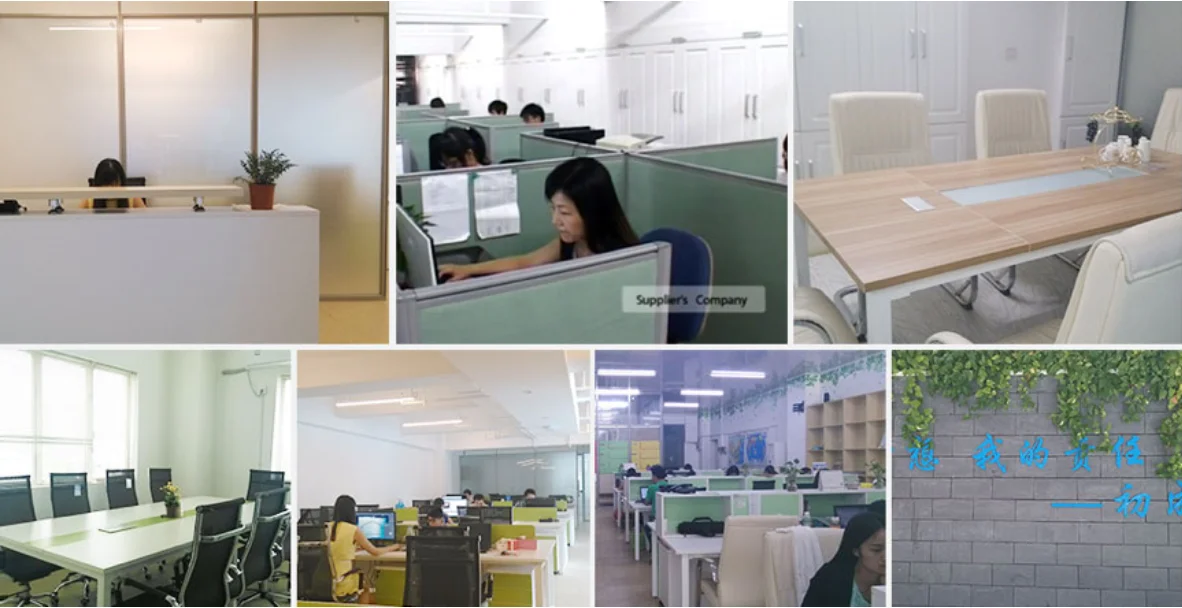
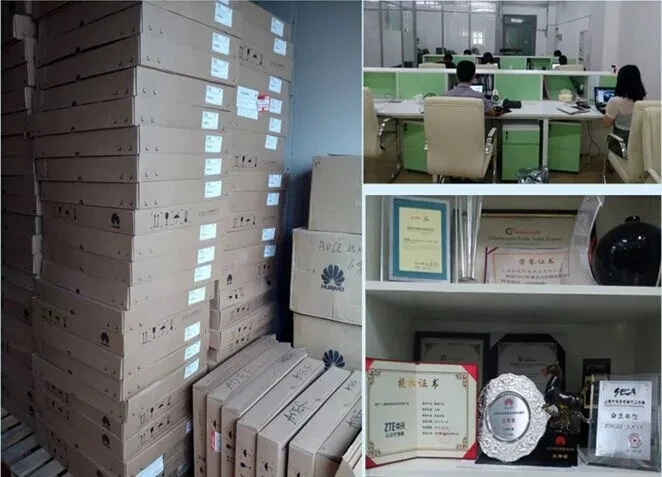
Combasst Industry Development (Shanghai) Co,.Ltd, which provides main services in terms of broadband communications and information technology industries, is a high-tech enterprise integrating research and development, production, sales, and service. Our products mainly cover the optical signal transmission and access, signal transmission and access, photoelectric signal conversion and photoelectric signal.
We will constantly improve ourselves and feed back with our superior-quality products and meticulous care to all walks of partners, creating a win-win situation.
We Recommend

New Arrivals
New products from manufacturers at wholesale prices