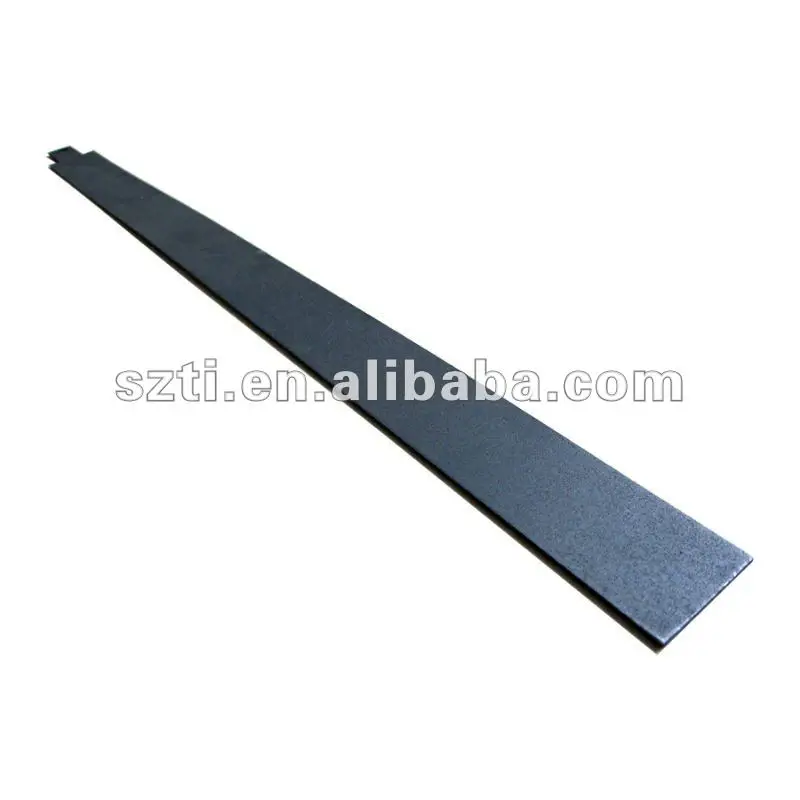
MMO Oxidation Plated Titanium anodized titanium
- Category: >>>
- Supplier: Suzhou Fenggang Titanium Products And Equipment Manufacturing Co. Ltd. [Jiangsu China]Suzhou
Share on (608761895):
Product Overview
Description
| Name: | MMO Oxidation Plated Titanium Sheet Anode |
| Item No. | MD-011 |
| Specifications: | Floor Metal: Gr1, Gr2, TA1, TA2 Coating Thickness: 0.5-1.5mm Fluotine Ion Concetration: <50mg/L Vitriol Concentration: <30% |
| Features: | 1. High erosion-resisting 2. High current efficiency 3. High durability 4. Floor can circle after electrodes lose activity 5. Heavy current density, high productivity 6. Light weight |
| Application: | Electrolytic synthesis of of organic Regeneration and cycle of oxidant Plating industry Electrolytic synthesis of perchlorate Electrodialysis L-threonine |
| Introduction: | Anode: In electrochemistry, the anode is where oxidation occurs and is the positive polarity contact in an electrolytic cell. At the anode, anions (negative ions) are forced by the electrical potential to react chemically and give off electrons (oxidation) which then flow up and into the driving circuit. Mnemonics: LEO Red Cat (Loss of Electrons is Oxidation, Reduction occurs at the Cathode), or AnOx Red Cat (Anode Oxidation, Reduction Cathode), or OIL RIG (Oxidation is Loss, Reduction is Gain of electrons), or Roman Catholic and Orthodox (Reduction - Cathode, anode - Oxidation), or LEO the lion says GER (Losing electrons is Oxidation, Gaining electrons is Reduction) This process is widely used in metals refining. For example, in copper refining, copper anodes, an intermediate product from the furnaces, are electrolysed in an appropriate solution (such as sulfuric acid) to yield high purity (99.99%) cathodes. Copper cathodes produced using this method are also described as electrolytic copper. |
We Recommend
New Arrivals
New products from manufacturers at wholesale prices