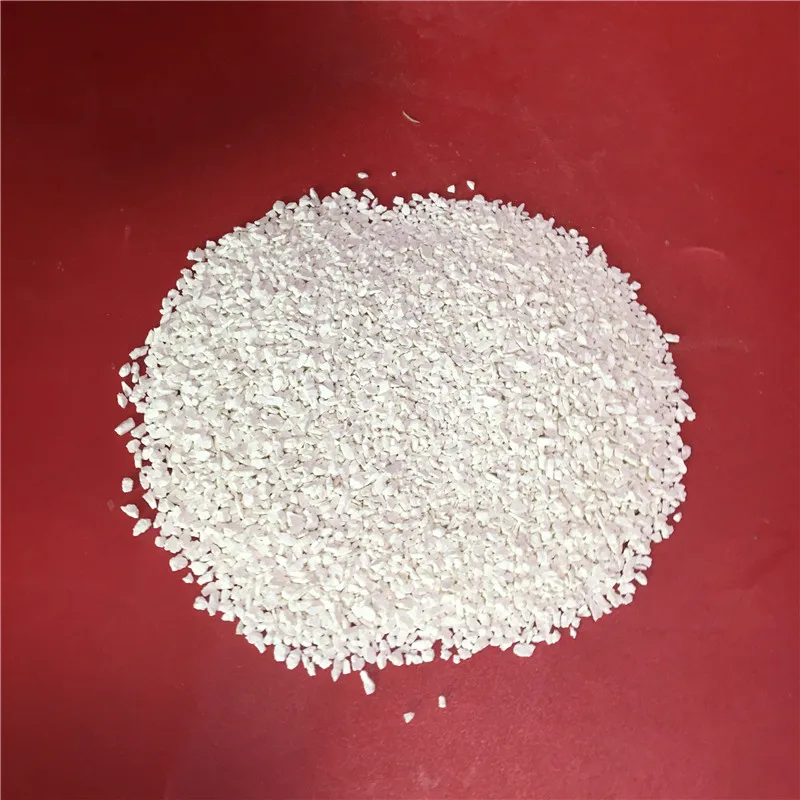
manufacture water treatment Calcium hypochlorite 75% cas no. 7778 54 3
- Category: Chlorate >>>
- Supplier: HWATSI CHEMICAL PRIVATE LIMITED [India]HWATSI
Share on (62016111707):
Product Overview
Description
Product Description
Calcium hypochlorite
Calcium hypochlorite is an inorganic compound with formula Ca(ClO)2. It is the main active ingredient of commercial products called bleaching powder, chlorine powder, or chlorinated lime, used for water treatment and as a bleaching agent. This compound is relatively stable and has greater available chlorine than sodium hypochlorite (liquid bleach). It is a white solid, although commercial samples appear yellow. It strongly smells of chlorine, owing to its slow decomposition in moist air. It is not highly soluble in hard water, and is more preferably used in soft to medium-hard water. It has two forms: dry (anhydrous); and hydrated (hydrous).
Uses
Sanitation
Calcium hypochlorite is commonly used to sanitize public swimming pools and disinfect drinking water. Generally the commercial substances are sold with a purity of 65% to 73% with other chemicals present, such as calcium chloride and calcium carbonate, resulting from the manufacturing process. As a swimming pool chemical, it is blended with other chemicals less on than other forms of chlorine, due to dangerous reactions with some common pool chemicals. In solution, calcium hypochlorite could be used as a general purpose sanitizer, but due to calcium residue, sodium hypochlorite (bleach) is usually preferred.
Organic chemistry
Calcium hypochlorite is a general oxidizing agent and therefore finds some use in organic chemistry. For instance the compound is used to cleave glycols, α-hydroxy carboxylic acids and keto acids to yield fragmented aldehydes or carboxylic acids. Calcium hypochlorite can also be used in the haloform reaction to manufacture chloroform.
Production
Calcium hypochlorite is produced industrially by treating lime (Ca(OH)2) with chlorine gas. The reaction can be conducted in stages to give various compositions, each with different concentration of calcium hypochlorite, together with unconverted lime and calcium chloride.
Bleaching powder is made with slightly moist slaked lime. It is not a simple mixture of calcium hypochlorite, calcium chloride, and calcium hydroxide. Instead, it is a mixture consisting principally of calcium hypochlorite Ca(ClO)2, dibasic calcium hypochlorite, Ca3(ClO)2(OH)4 (also written as Ca(ClO)2 · 2 Ca(OH)2), and dibasic calcium chloride, Ca3Cl2(OH)4 (calcium hydroxychloride also written as CaCl2 · 2 Ca(OH)2).
Chemical properties
Calcium hypochlorite exhibits both acido-basic and oxydo-reduction properties: it is a strong base (as it accepts proton) and a strong oxidizing species (as it accepts electron).
A calcium hypochlorite solution is basic as the hypochlorite anion can easily accept a proton from a water molecule leaving an hydroxyl anion in solution. This basicity is due to the hydrolysis undergone by the hypochlorite anion, as the hypochlorous acid is a weak acid. As a result, the hypochlorite anion is a strong conjugate base:
ClO−+ H2O → HClO + OH−
The hypochlorite anion is also a strong oxidizing agent containing a chlorine atom at the valence I (redox state: Cl+1) which reacts under acidic conditions with the reduced chloride species (Cl–, here the reducing agent) present in hydrochloric acid to form calcium chloride, water and gaseous chlorine. The global redox reaction involving an electron transfer from the chloride anion (e– donor) towards the hypochlorite anion (e– acceptor) is the following:
Ca(ClO)2 + 4 HCl → CaCl2 + 2 H2O + 2 Cl2
Detailed Images