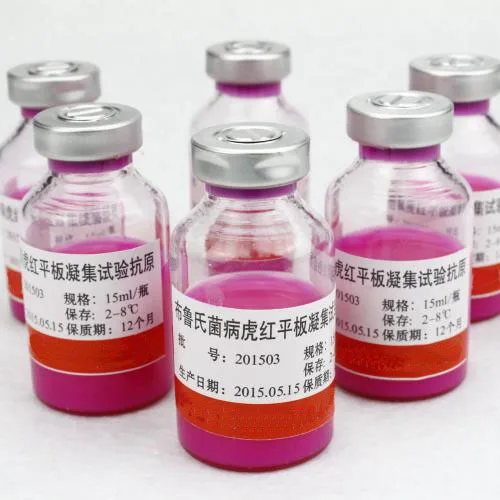
Brucellosis Bengal Rose plate agglutination Antigen
- Category: Other Veterinary Instrument >>>
- Supplier: Shenzhen Zhenrui Biotech Co. Ltd.
Share on (62079753827):
Product Overview
Description
veterinary Bovine and Goat brucella Ag rapid test kit



Brucellosis Bengal Rose plate agglutination Antigen Instruction
This strain is prepared by inoculating of Brucella with good antigenicity, inoculated in a suitable medium, harvesting the cells, inactivation by heating, centrifugation, dyeing with rose Bengal dyeing solution, and suspending in a buffer solution of lactic acid. Use to diagnosis of animal brucellosis.
[Properties] This product is a red uniform suspension. Static placement long time, the upper part is clarified, and a small amount of red bacteria can be precipitated at the bottom.
[Aseptic inspection] According to the law, it should be grown aseptically.
[Titer test] Take the antigen and the Brucella disease agglutination test positive serum with national standard 25IU, 50IU, 100IU, 200IU for the agglutination test, and use the reference antigen as a control, the reaction should be consistent.
[Specificity test] Take the new antigen and the reference antigen for 5 to 10 negative serum for plate agglutination test, and there should be no agglutination.
[pH measurement] The pH should be 3.65 to 3.70.
[Capacity Measurement]The fresh antigen was mixed with an equal amount of negative serum. Determination by pH meter, the pH should be 3.9 ~ 4.0.
[Function and use]For the test of Bengal rose plate agglutination test for livestock brucellosis.
[Usage and Judgment]
(1) Take 0.03ml of the tested serum and 0.03ml of the antigen, and observe the results within 4 minutes. All the reactions above "+" are positive.
(2) Animals that have a positive response are required to undergo a complement fixation test or other complementary diagnostic test.
[Precautions]
(1) Shake well before use. Do not use if there is pollution or clot.
(2) The cryopreserved antigen and serum should be allowed to stand at room temperature for 30 to 60 minutes before testing.
[Specifications] 15ml / bottle
[Storage]2 to 8 ° C preservation, valid for 1 year.
Note: Judging criteria for reaction intensity
“-” has no agglutination and is evenly pink.
"+" can be slightly agglomerated, with a slight curling, and the liquid between the agglomerates is red.
"++" forms a clear curl, and the liquid between the agglomerates is slightly clear.
The "+++" agglutination reaction is stronger.
The "++++" agglutination block is cluster-like, and the liquid between the agglutination blocks is clear.








We Recommend


New Arrivals
New products from manufacturers at wholesale prices