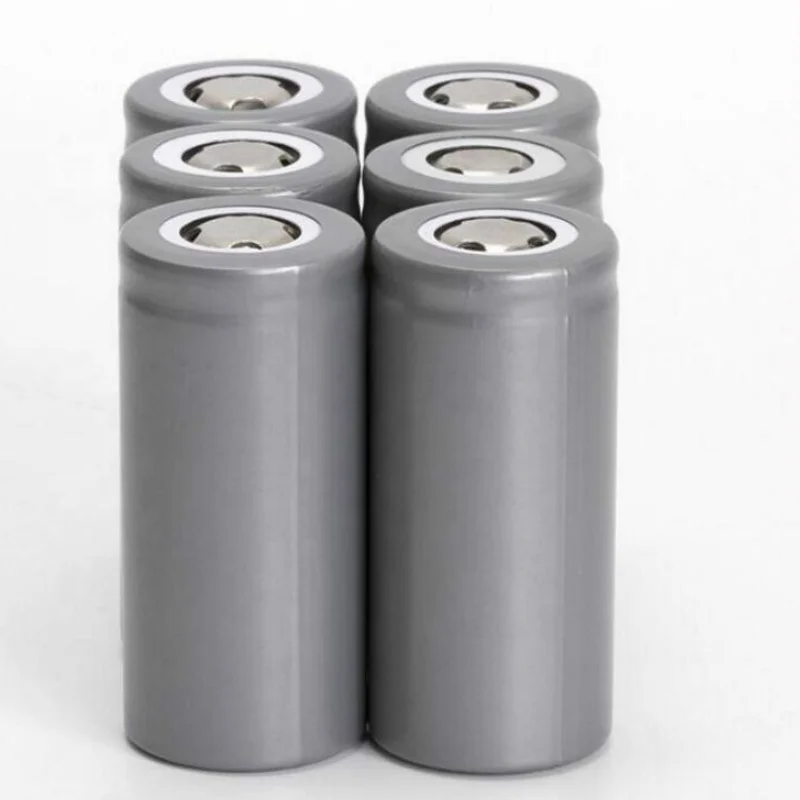
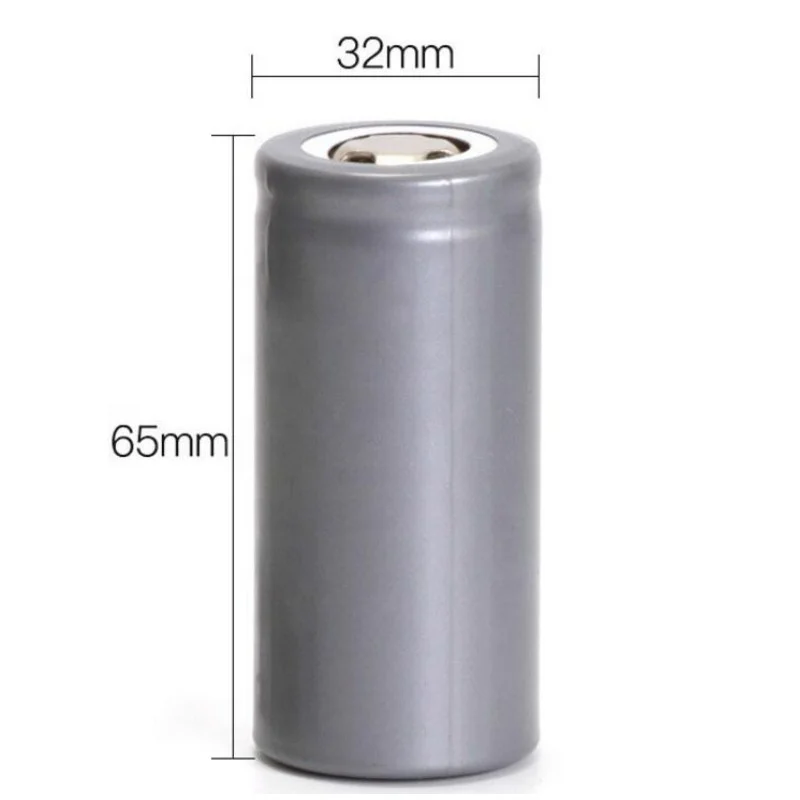
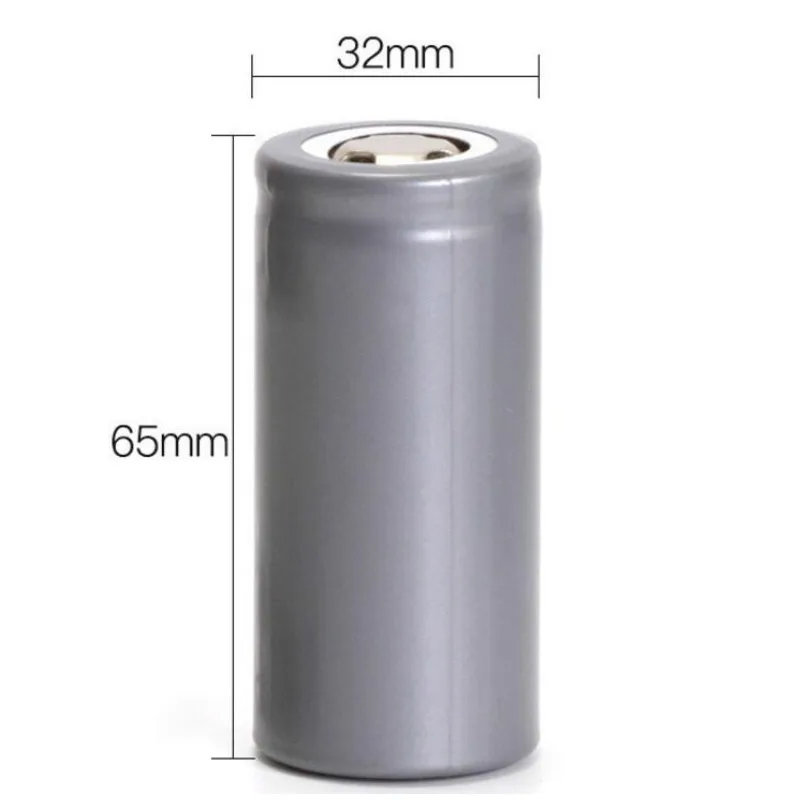
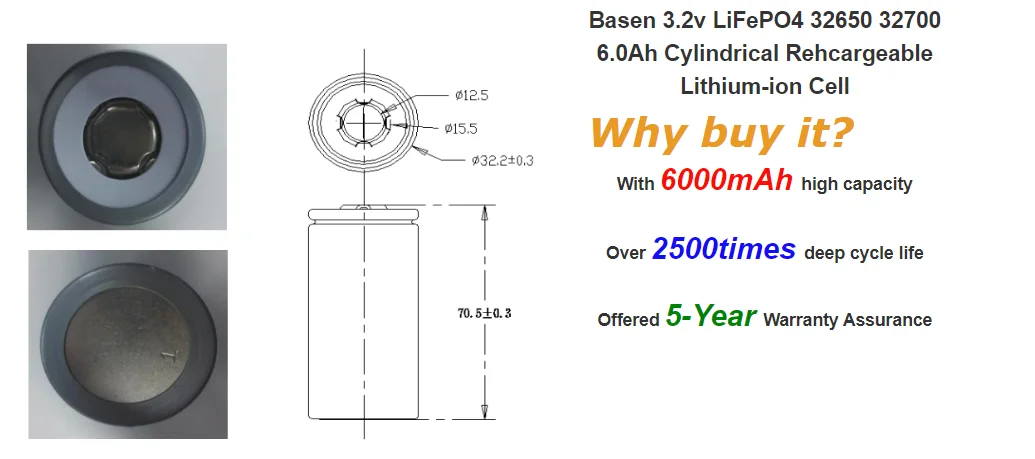
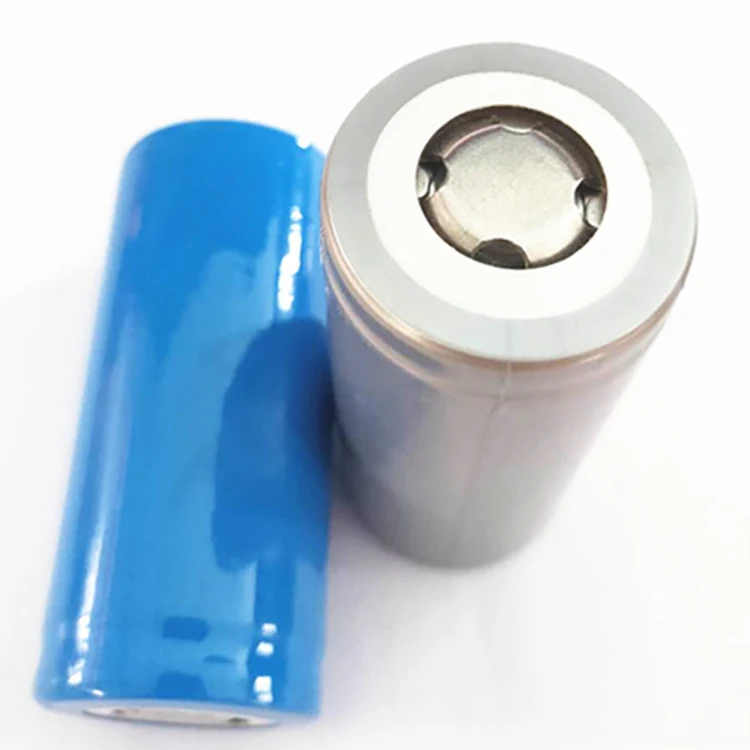
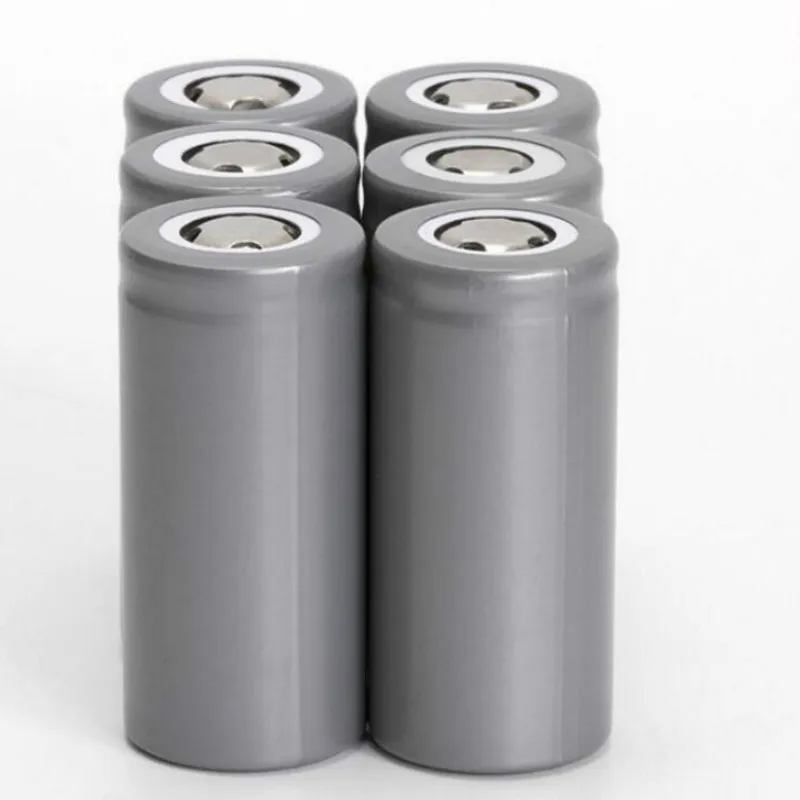
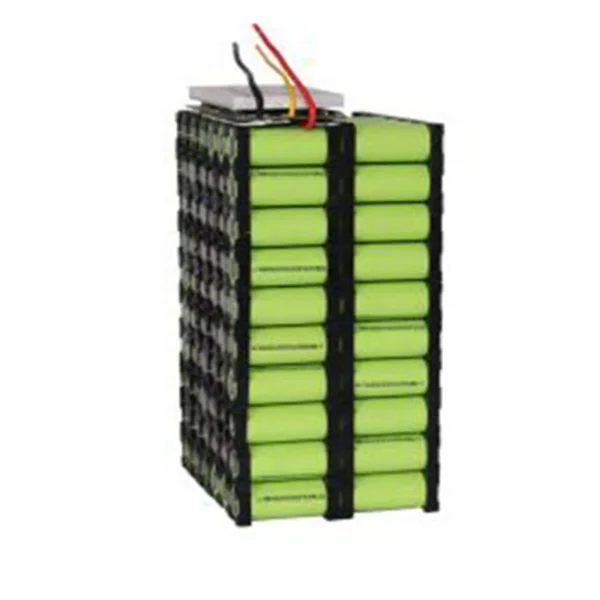
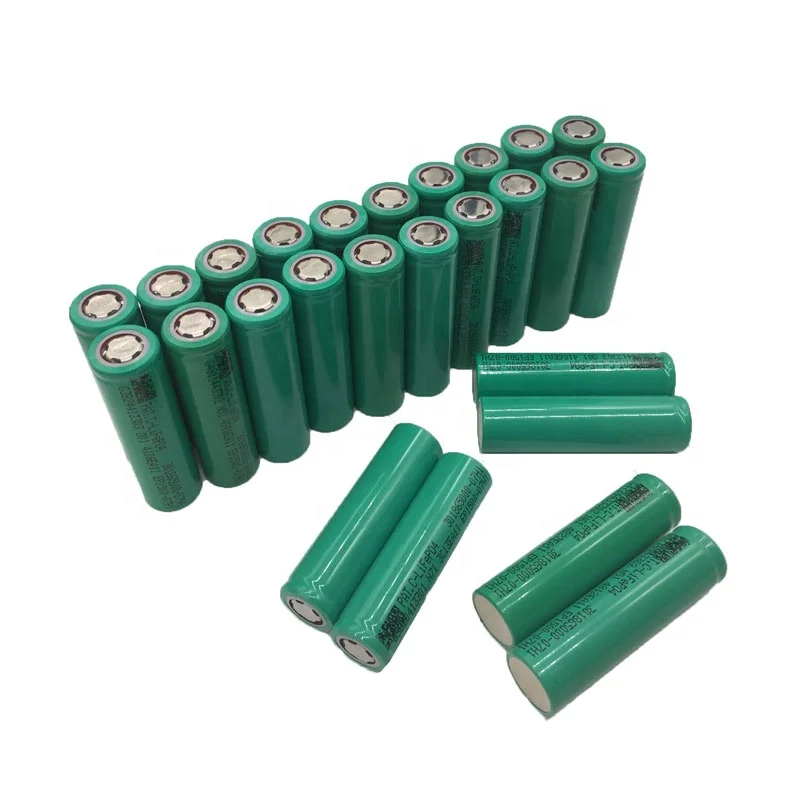
3.2v 32650 lifepo4 battery 6000mAh full capacity rechargeable battery for E-bike battery pack
Item
Condition/Note
Specification
Norminal Capacity
1C discharge capacity
6.0Ah
AC Impedance
At AC1000Hz
6.5mΩ
Norminal Voltage
3.2V
Cell SIze
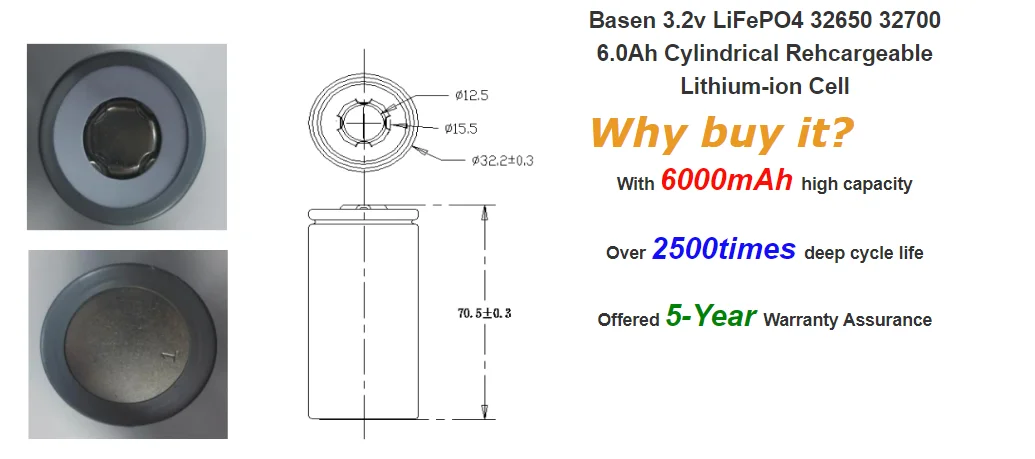
Diameter: 32.2±0.3mm, Max 32.5mm
Height: 70.5±0.3mm, Max.70.8mm
Cell Weight
140±5g
End-of-charge Voltage
CC Mode
3.65V
End-of-discharge Current
CV Mode
0.3A
Charging Method
Standard Charging
1C at CC/CV 60min
Max. Continuous Charging
6C at CC/CV 10min
End-of-discharge Voltage
CC Mode
2.0V
Max continuouse Discharge Current
36A
Max Pulse Discharging Current
3s
60A
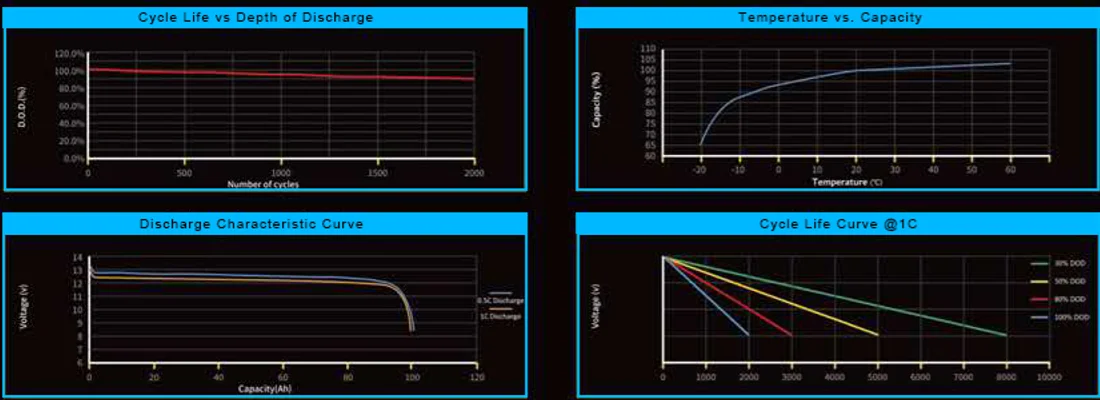
Cycle Life
1C/100% DOD
≥2000 cycles
Operating Temperature Range
Charging Temperature
Discharging Temperature
Storage Tempearture
0~60℃
-20~60℃
-20~45℃
Appearance
Without break,scratch,distortion,contamination,leakage and so on
Related Cells for Lifepo4 lithium ion cylinder shape cells:
IFR32650 6000mAh 3.2V
IFR32650 5500mAh 3.2V
IFR32650 5000mAh 3.2V
IFR26650 3800mAh 3.2V
IFR26650 3600mAh 3.2V
IFR26650 3400mAh 3.2V
IFR26650 3300mAh 3.2V
IFR26650 3000mAh 3.2V
IFR26650 2800mAh 3.2V
IFR26650 2400mAh 3.2V
IFR22650 2200mAh 3.2V
IFR22650 2100mAh 3.2V
IFR22650 2000mAh 3.2V
IFR18650 1600mAh 3.2V
IFR18650 1500mAh 3.2V
IFR18500 1000mAh 3.2V
IFR14500 600mAh 3.2V
IFR14500 500mAh 3.2V
IFR14430 400mAh 3.2V
Application for :
3.2v 32650 lifepo4 battery 6000mAh full capacity rechargeable battery for E-bike battery pack
1) Energy Storage: UPS , backup ,power station.
2) EV : Golf trolleys , Electric scooters .Electric Bike ,Electric tricyle ,Electric Motor.
3) Solar System,Wind Energy Storage,Solar/Storage Home System, Solar Street Light.
4) Telecommunications Base Stations.
5) General Energy Storage (Such as: Back-up Power, Miner’s lamp, portable power supply, digital products etc.)
Product Advantages
What is a BMS
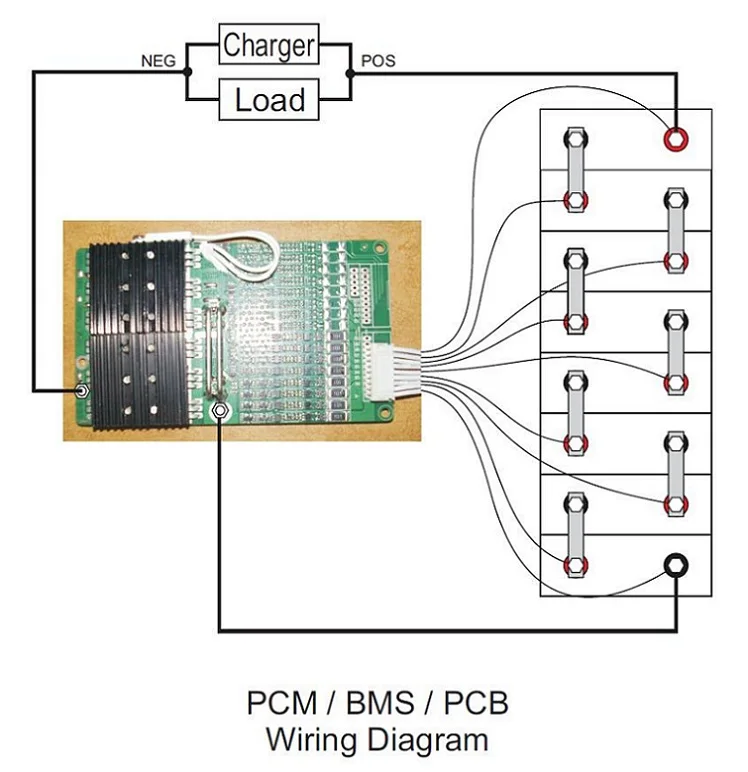
BMS stands for battery management system, this is the brain of our deep cycle lithium battery. The BMS protects the lithium cells from getting damaged in several scenarios. From low or high voltage, low or high temperatures, or if there is a short in the system. The BMS will shut off the battery to protect the li-ion cells and the user of the battery from unsafe operating conditions The BMS also regulates the amount of power you can take out of the battery. The BMS on our 100 amp-hour battery is rated to 100 amps continuous, 200 amps for 30 seconds and any higher loads for ½ second. BMS also keeps all of the cells in balance. At the top of each charge cycle, the BMS reduces the charging rate in cells that have been topped off first, letting the rest of the cells catch up. This ensures that the cells are always in balance, and maintains the quality and efficiency of the pack.
GENERAL ADVANTAGES OF LITHIUM ION BATTERY 1. Smaller and lighter: Li-ion battery is lighter than other rechargeable batteries in consideration of battery capacity. This makes it more practical in portable consumer electronic devices in which physical specifications such as weight and form factor are considered important selling points. 2. High energy density: Li-ion battery has higher energy density than other rechargeable batteries. This means having high power capacity without being too bulky. This is suitable for use in power-hungry devices such as laptops and smartphones. Advancements in technology open potential for higher capacities. 3. Low self-discharge: Li-ion battery also has a low self-discharge rate of about 1.5 percent per month. This means that the battery has a longer shelf life when not in used because it discharges slowly than other rechargeable batteries. Take note that nickel-metal hydride battery has a self-discharge of 20 percent per month. 4. Zero to low memory effect: Li-ion battery has zero to minimal memory effect. Take note than memory effect is a phenomenon observed in rechargeable batteries in which they lose their maximum energy capacity when repeated recharged after being only partially discharged. This memory effect is common in nickel-metal hydride rechargeable batteries such as NiCd and NiMH. 5. Quick charging: Li-ion battery is quicker to charge than other rechargeable batteries. It actually takes a fraction of a time to charge when compared to counterparts. 6. High open-circuit voltage: Li-ion battery has a chemistry that results in higher open-circuit voltage than other aqueous batteries such as lead acid, nickel-metal hydride, and nickel-cadmium. 7. Longer lifespan: Li-ion battery can typically handle hundreds of charge-discharge cycles. Some lithium ion batteries loss 30 percent of their capacity after 1000 cycles while more advanced lithium ion batteries still have better capacity only after 5000 cycles.
GENERAL DISADVANTAGES OF LITHIUM ION BATTERY 1. Expensive: Li-ion battery is expensive to manufacture. In fact, the total product cost of this battery is around 40 percent higher than nickel-metal hydride battery. Take note that this battery needs an on-board computer circuitry to manage and ensure that voltage and current are well within the safe limits. This circuitry makes it more expensive. 2. Sensitivity to high temperature: Li-ion battery is susceptible to the downside of too much heat caused by overheating of the device or overcharging. Heat causes the cells or packs of this battery to degrade faster than they normally would. 3. Aging effect: Li-ion battery will naturally degrade as soon as they leave the factory. This means that it is not completely durable despite longer charge-discharge lifecycle because of this normal degradation that transpires whether consumers use them or not. Storage in a cool place at 40 percent charge reduces the aging effect. 4. Deep discharge: Li-ion battery has low self-discharge. The general integrity of this battery remains intact even if partially discharged. However, deep discharge or when the voltage of a lithium ion cell drops below a certain level, it becomes unusable. 5. Safety concerns: Li-ion battery may explode when overheated or overcharged. This is because gasses formed by electrolyte decomposition increases the internal pressure of the cell. Overheating or internal short circuit can also ignite the electrolyte and cause fire. This risk might also subject li-ion batteries to transportation restrictions, especially when shipped in larger quantities.
Cylindrical Cells
The cylindrical cell continues to be one of the most widely used packaging styles of today. With its superiority making it easy to manufacture and have excellent mechanical stability. Tubular cylinders can withstand high internal stress without deformation.
Many lithium and nickel-based cylindrical cells include a positive thermal coefficient (PTC) switch. When exposed to excessive current, the normally conductive polymer heats up and becomes resistive, stopping the current flow and acting as short circuit protection. Once the short is removed, the PTC cools down and returns to the conductive state.
Most cylindrical cells also feature a pressure relief mechanism, and the simplest design utilizes a membrane seal that ruptures under high pressure. Leakage and dry-out may occur after the membrane breaks. Re-sealable vents with a spring-loaded valve are the preferred design. Some consumer Li-ion cells include the Charge Interrupt Device (CID) that physically and irreversibly disconnect the cell when activated to an unsafe pressure builds up.
Pismatic Cells
Introduced in the early 1990s, the modern prismatic cell satisfies the demand for thinner sizes. Wrapped in elegant packages resembling a box of chewing gum or a small chocolate bar, prismatic cells make optimal use of space by using the layered approach. Other designs are wound and flattened into a pseudo-prismatic jelly roll. These cells are predominantly found in mobile phones, tablets and low-profile laptops ranging from 800mAh to 4,000mAh. No universal format exists and each manufacturer designs its own.
Prismatic cells are also available in large formats. Packaged in welded aluminum housings, the cells deliver capacities of 20–50Ah and are primarily used for electric powertrains in hybrid and electric vehicles. Figure 5 shows the prismatic cell.
Prismatic cells are the most popular today due to their large capacity. The shape can connect easily four batteries at once to form a battery pack.
Cylindrical Advantages
The cylindrical cell design has good cycling ability, offers a long calendar life and is economical, but is heavy and has low packaging density due to space cavities.
The cylindrical cell battery has a strong and robust advantage as its casing has protected. Batteries, in this case, are more resistant to working at hot temperatures. Resistance to shocks is also excellent, then this battery is often familiar to use on electric vehicles. Many cells are combined in series and parallel to increase battery voltage and capacity. If one cell is damaged, the impact on the whole package is low.
Typical applications for the cylindrical cell are power tools, medical instruments, laptops, and e-bikes. To allow variations within a given size, manufacturers use partial cell lengths, such as half and three-quarter formats, and nickel-cadmium provides the largest variety of cell choices. Some spilled over to nickel-metal-hydride, but not to lithium-ion as this chemistry established its own formats.
Prismatic Disadvantages
Prismatic cells consist of many positive and negative electrodes that are flanked together making it possible for short circuit and inconsistency. Prismatic cells die faster because thermal management is less efficient and relatively sensitive to deformation in high-pressure situations. Other disadvantages include a limited number of standard sizes and higher average hourly wattage prices. BMS is also complicated to handle this sell because of the capacity that is owned.
Selecting Your Cell
Most often, choosing your lithium battery’s cell design comes down to space, cost and safety considerations.
If your lithium application requires strong power, performance and longevity with less concern for use of space, consider picking up a cylindrical cell. If overloading becomes a concern, opt for cylindrical’s improved safety profile. However, if your lithium application requires power packed into a small space and you’re able to handle the cost, prismatic is your best bet.
Right now, the cost-effective cylindrical model controls market share. However, as new products create a need for increasingly space-conscious solutions, battery technology advances and prices change, demand for prismatic cells is expected to increase.
Company Information
QSPOWER (zhuhai) Co.,LTD was founded on 2018 belonging to Qiangsheng Goup(UK) Co.,Ltd which focus on green energy products production since 2012.
QSPOWER have the strong technique support group which have the well-known expert form America and Taiwan.
QSPOWER has extensive experience with every facet of the design and manufacturing process of batteries.
QSPOWER are focus on Green energy solution, such as lithium battery technique R&D, battery testing, battery cell supplying chain, battery packing and customized green energy solution project.
QSPOWER has the experience and resources to help design engineers ensure a smooth design process and project management meet delivery schedules. We are willing to invest together for potential good project and business partner.
New developing requirements are welcome always.
Here are some general categories of markets we are in. Vehicle battery Energy Storage Power bank Power tool battery Portable Medical battery Customized batteries
FAQ
1,Q: What's the main product in QS? A: Rechargeable battery. Li-ion, Lipo battery and power battery pack.
2,Q: What is overcharge? A: After charge, tested the batteries' initial state and capacity. Charge to 10.0V at 3C current, then charge to 0.01C at CV mode. Observe changes in battery appearance.
3,Q: What is over discharge? A: After charge, test the batteries' initial state. When the batteries are normal, discharge to 0V at 0.5C. Observe changes in battery appearance
4,Q: Can I have a sample order? A: Yes, we accept sample order to test and check quality. Batteries can be made as require.
5,Q: Do you have MOQ limit? A: Yes, we have MOQ limit for mass production, but it depends on battery model. Please contact us for details.
6,Q: How about the lead time? A: Samples will takes 5-7 business days. Mass production will takes 15-25 days. It depends on quantity.
7,Q: How about shipping and delivery time? A: Generally, battery will be shipped via Express, such as DHL, TNT, FedEx and UPS, delivery time is 3-5 business days. Or DP service, delivery time is 11-15 business days. Airline and sea shipping also available.
8,Q: What about after-sale service? A: We will offer you 1 year guarantee. If there are any problems, please inform us, we will offer you positive solutions.