Kaoru Fujiithe master of Yamato Noodle School. For over 30 years, Fujii has visited thousands of noodle shops to examine their businesses. Based on his extensive experience and proven track record in the Japanese noodle making, Fujii has compiled a business know-how book. This book is used as a textbook for the business management lecture at Yamato Noodle Schools.
Description
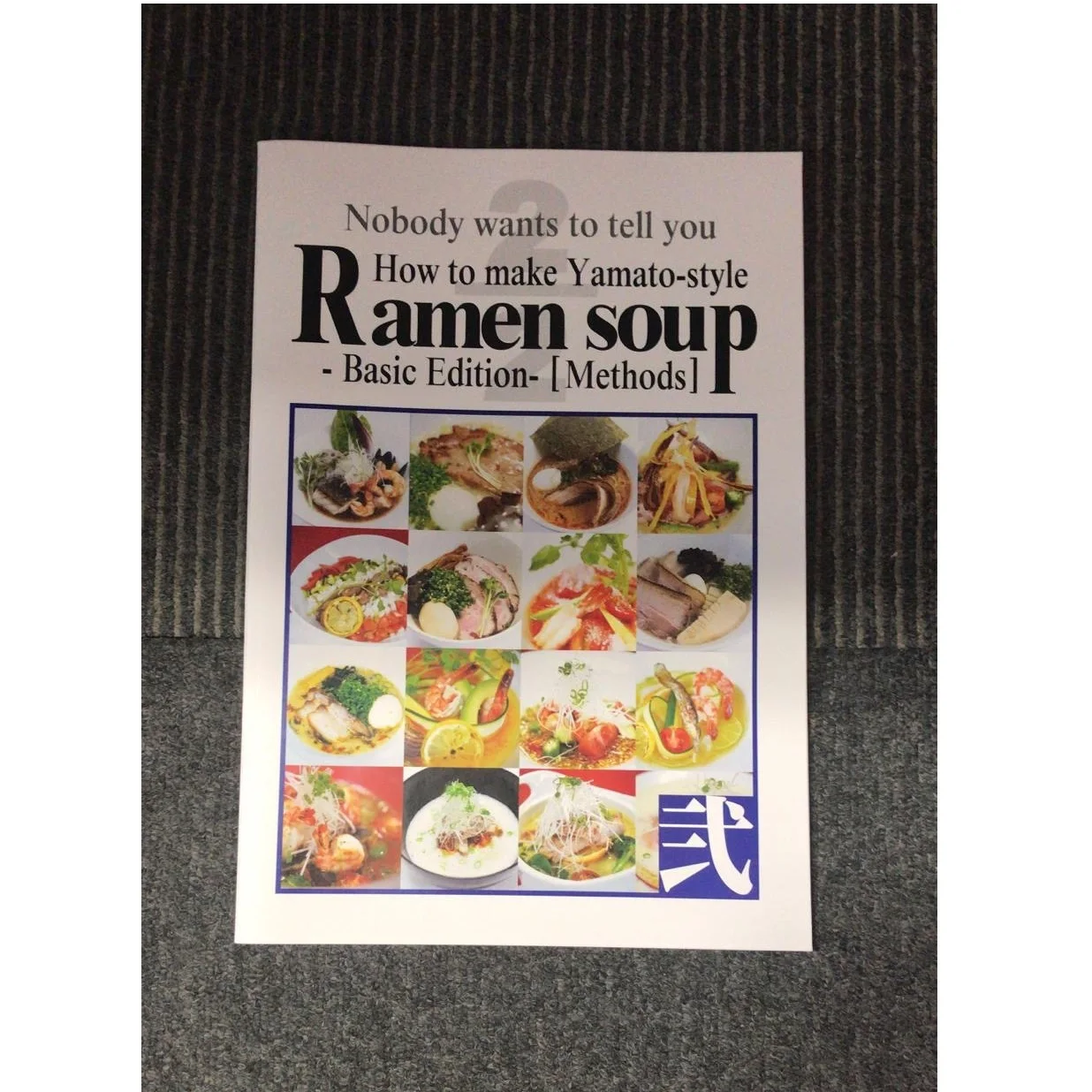
This is the book that broke the taboo of the industry, teaching ramen soup. This book discloses the inside out of unspoken, secret methodologies, knowledge, techniques, and processes of ramen soup.
Product Categories
About Us
Yamato MFG is a manufacturer owned more than 4 decades located at Kagawa, Japan that makes and ships Ramen | Udon | Soba | Pastas machines all over the world. With over 10000 units installed in over 50 countries, Yamato MFG running Noodle School for ramen, udon, and soba in Japan | Singapore | USA | Netherlands while machine users have been increasing. We are ONE Stop Noodle Business Solutions -Bring you To a Success. Your trusted partner in Noodle Cooking School & Machines business: Ramen | Udon | Soba | Pastas
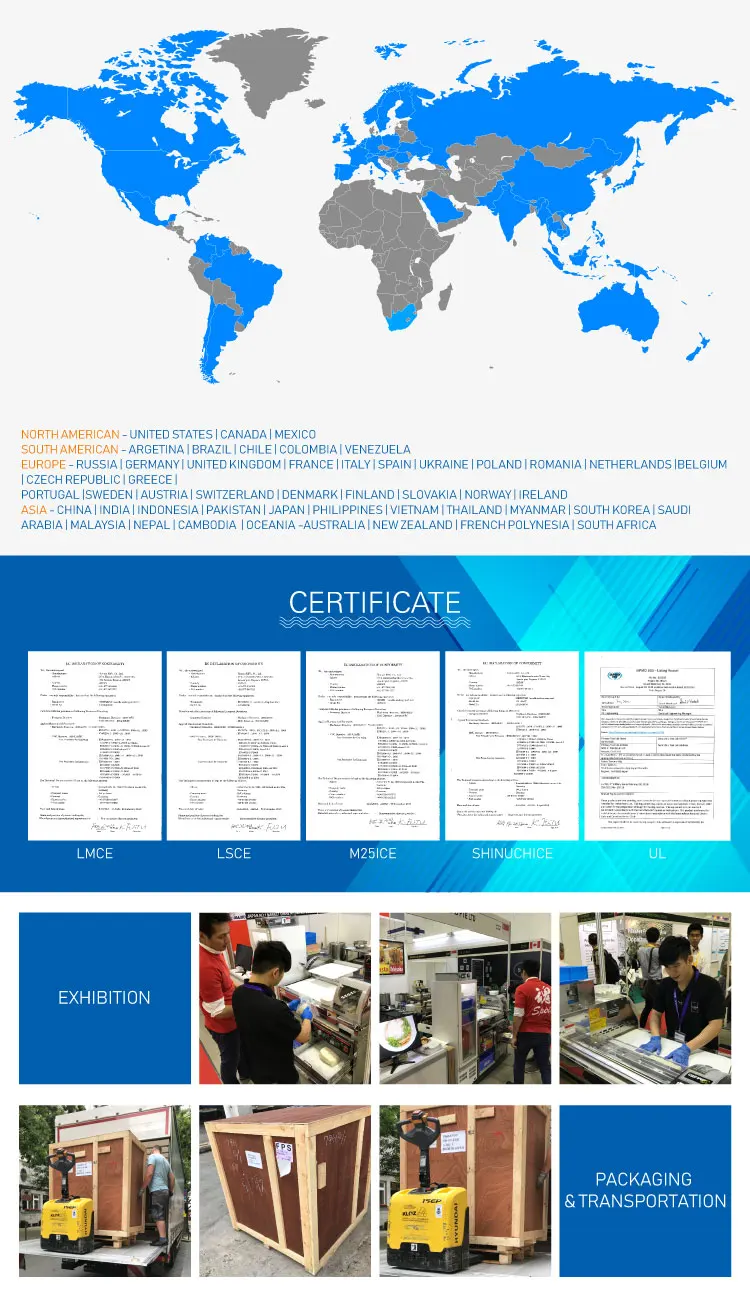
Since Yamato first began supplying its customers abroad with professional noodle making equipment – designed by the best Japanese engineers, assembled in Japan from Japanese parts, and subjected to the most rigorous quality controls – more than 1000 units have been installed in over 50 countries:
… from The Golden Coast to Lake Baikal, from The Cape of Good Hope to Botany Bay, from cold fjords to tropical beaches — Yamato noodle machines offer customers across the world the joy and satisfaction of good quality noodles.
FAQ
1. Q: How much is the machine? What is the price of noodle machine?
A: We have several types of noodles machines, designed for different types of noodles and production capacity. Also, we have different machines for different regions/countries. Also, because we ship all our machines from our factory in Japan, to estimate the total cost of getting a noodle machine, we need your shipping terms (for example, if you want us to arrange door-to-door shipping, we need your address of delivery). So, please first ask us and provide necessary information.
2. Q: How much is the import tax for noodle machine?
A: It depends on which country you’re importing the machine into as each country has its rates for different types of products imported. So, please let us know which country you’re thinking of importing our noodle machine to.
3. Q: Is there a distributor/agent in my country? How do I order a noodle machine?
A: Please refer to Global Agents page. We may have agents not listed on this page. Please ask us. You may be able to order and get the machine even if we don’t have a distributor/agent in your country.
4. Q: How do you provide servicing/maintenance in my country if we purchase a noodle machine from you?
A: When our customers have troubles with their noodles machines, they first contact us to report the symptoms. By means of remote communication, such as Skype, Whatsapp, WeChat, etc., we first diagnose what’s causing the machine problem and come up with the fastest way to fix it. When the repair requires certain parts and/or certain degree of technical skills, we would dispatch our engineer or local technician. Our maintenance team operates 365 days a year. Please contact us if you need further information on how we provide servicing in your country.
5. Q: How long is the warranty?
A: Warranty period is 12 months from installation date of a noodle machine. We would provide parts, free of charge during the warranty period. We will continue to support all our official machines users after the warranty period is over. Please feel free to contact us for more information.
6. Q: What kind of after support do you provide for a machine user?
A: After a customer purchases our noodle machine, we provide everything the customer needs to start producing high quality noodles from scratch by his or herself. They may include training, ingredients, noodle recipes, or anything else the customer needs to start making the type(s) of noodles he or she wants to produce.
7. Q: What is the lead-time for a noodle machine? How long does it take to get the machine?
A: Production lead-time is 4-5 weeks from purchase order. Shipping lead-time depends on where you are. For North America and Europe, if shipping by ocean/boat, it is usually 6-7 weeks. If going with air shipping, which may be possible under reasonable costs, it should be 1-2 weeks. Please feel free to contact if interested in getting a quote for our noodle machine.
8. Q: I want to make ramen, udon, and soba noodles. Which machine can make all 3 types?
A: Which machine we can recommend for you depends on your production needs. For example, if you want to make soba, which is made of buckwheat flour, what is the percentage of buckwheat flour mix for the soba noodles you want to make? If it is 100% buckwheat flour mix, then the only option may be our soba noodles machine, BandoTaro, which can also produce certain types of ramen noodles and udon noodles. But, the type(s) of ramen noodles that can be made on our soba machine are high in hydration. For example, Hakata style tonkotsu ramen noodles are low in hydration, so they cannot be made on soba machine. (noodles made on soba machine need to be over 45% in hydration ratio. Richmen or our ramen machines are good at making noodles that are low hydration (25-40%). These machines can also produce certain types of soba and udon noodles as well, but they need to be low-medium hydration. As for soba noodles made on ramen machine, buckwheat mix ratio need to be less than 50% (the other 50% needs to be wheat flour or other ingredients with some gluten). Please let us know your production needs (maximum daily production volume and type(s)/size(s) of noodles you want to make. And, we can suggest an option best suitable for your production needs. To consult with our representative, please contact us.
9. Q: I’m currently running a ramen business, and would want to develop some original and creative recipes but am unable to do it due various constraints related to issues of time / location / budget / personnel. Will I be able to achieve my professional goals at your school?
A: The ratio of ramen business newcomers and established ramen professionals in Yamato Ramen School is about 50/50. Moreover, some of our students choose to enroll in our ramen course multiple times to perfect their skills, and use it as a venue for development of new menus and creation of new recipes.
Below are the most prominent characteristics of our Ramen cooking school:
Students can study at any of the three school branches: Our Headquarters in Kagawa prefecture (Japan) Yamato MFG Tokyo office (Japan) Office in Singapore The ramen schools in Japan are mainly taught in Japanese (English interpreting is available upon a special request), and classes at the ramen school in Singapore are conducted mainly in English and Chinese.
Working with a great variety of ingredients:
A wide choice of soup stock types to learn and practice on:
Thick (saturated) animal-base soup stock:
Hakata tonkotsu
Thick stock from pork thigh bones
Thick stock from pork back bones
Toripaitan (either from chicken carcasses or whole chickens)
Beef paitan (upon a special request)
Light (clear) animal-base soup stock:
Light stock from pork thigh bones
Light stock from pork back bones
Light stock from whole chickens
Light stock from chicken carcasses
Beef chintan (upon a special request)
Variety of fish- and other sea food-base soup stocks:
Kelp
Dried sardines
Mackerel
Round herring
Sea bream, Oysters other types of clams (upon a special request)
Vegetable-base soup stock:
Radish
Pumpkin
Tomato
Carrot
Onion
Garlic
Celery
Fruit-base soup stock:
Apple
Pineapple
Coconut milk, etc.
Yamato Ramen School also always tries to accommodate special requests from its students regarding the ingredients they want to use. Also available are ‘clear-rich’ types of chintan stock characterized by translucency on the one hand and saturated texture on the other (achieved by a method of “two-step boiling”), as well as very light (clear) types of soup stock.
A wide choice of Motodare base sauces prepared on salt, soy sauce and miso base (more than 50 different types)
A wide choice of flavored oils – both animal and vegetable (more than 20 different types)
Using only natural ingredients (no artificial additives / chemical taste enhancers)
Additionally available are vegan and halal options.
Digital cooking approach
Preparation of even the most difficult to cook soup types is taught using a digital cooking method, so understanding and learning it is easy wherever in the world a student had come from or wherever they plan to use their knowledge and skills. We also use data-oriented approach when offering free consultations to our graduates.
Highly experienced teaching staff will help you to achieve the desired quality of soup.
Yamato Ramen School instructors make sure our students are able to fully develop the recipes they wanted to create.
Ability to come for an observation tour before enrollment
If you do not feel confident to apply at the moment, you can always come for a study tour, and decide after.
Stellar track record
A great number of famous ramen chefs have graduated from Yamato Ramen School throughout its history, and restaurants run by our former students constantly earn highest ratings both in Japan and abroad.
After-graduation support
Yamato Ramen School strives to provide its students with continuous help even after their graduation (special alumni groups and free consultation help-desks are available)
Kitchen settings thoroughly equipped with cutting-edge cooking appliances
Yamato Ramen School uses only induction heating devices (which emit no heat by themselves) making it easier to stay in kitchen during culinary practice. So, the cooking approaches students learn are optimized for current labor-market circumstances when people are becoming more reluctant to work in the food industry.
Business counselling sessions to ensure long-term commercial success
On a business lecture part of the course, students are taught management concepts and approaches to help them build successful businesses, emphasizing long-term oriented strategies instead of short-term profit seeking.
Contact Us
Wholesale Ramen Soup - Basic Edition Cooking Textbook 157 Pages Cookery Book Published By Yamato MFG Co,. Ltd