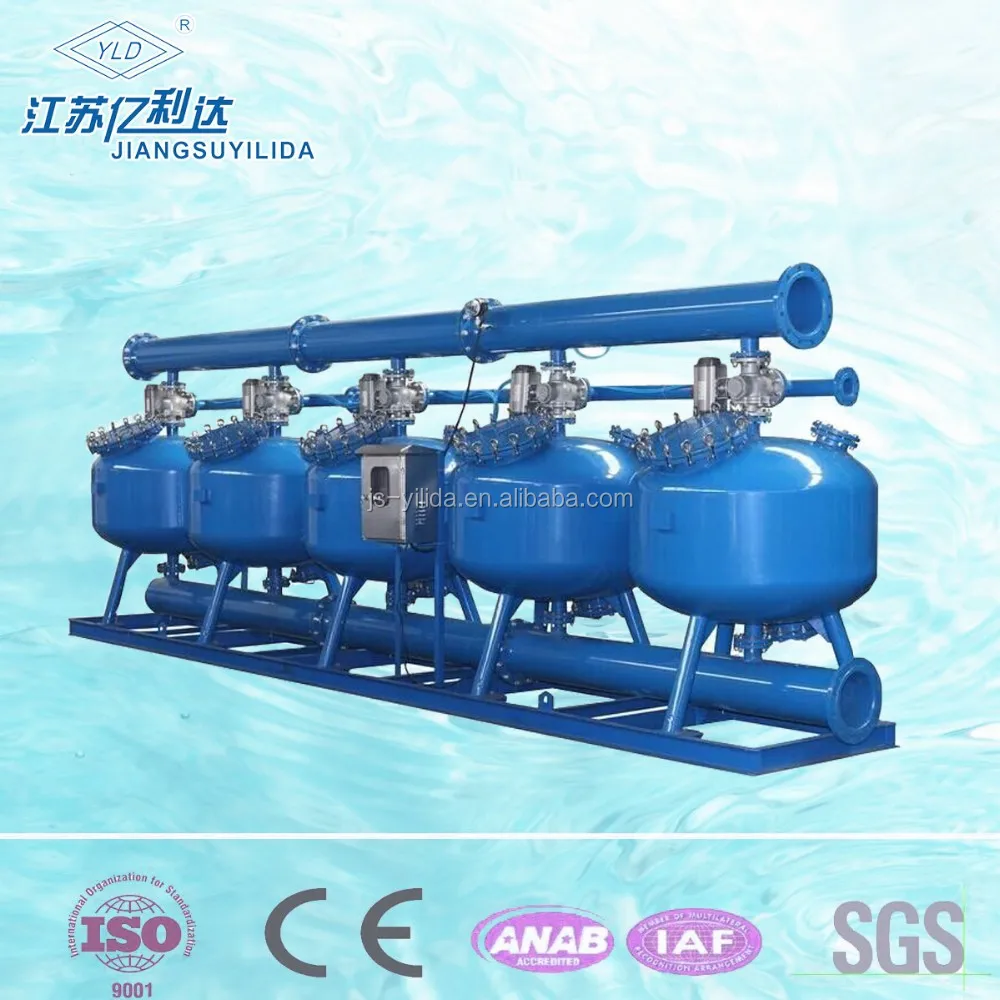
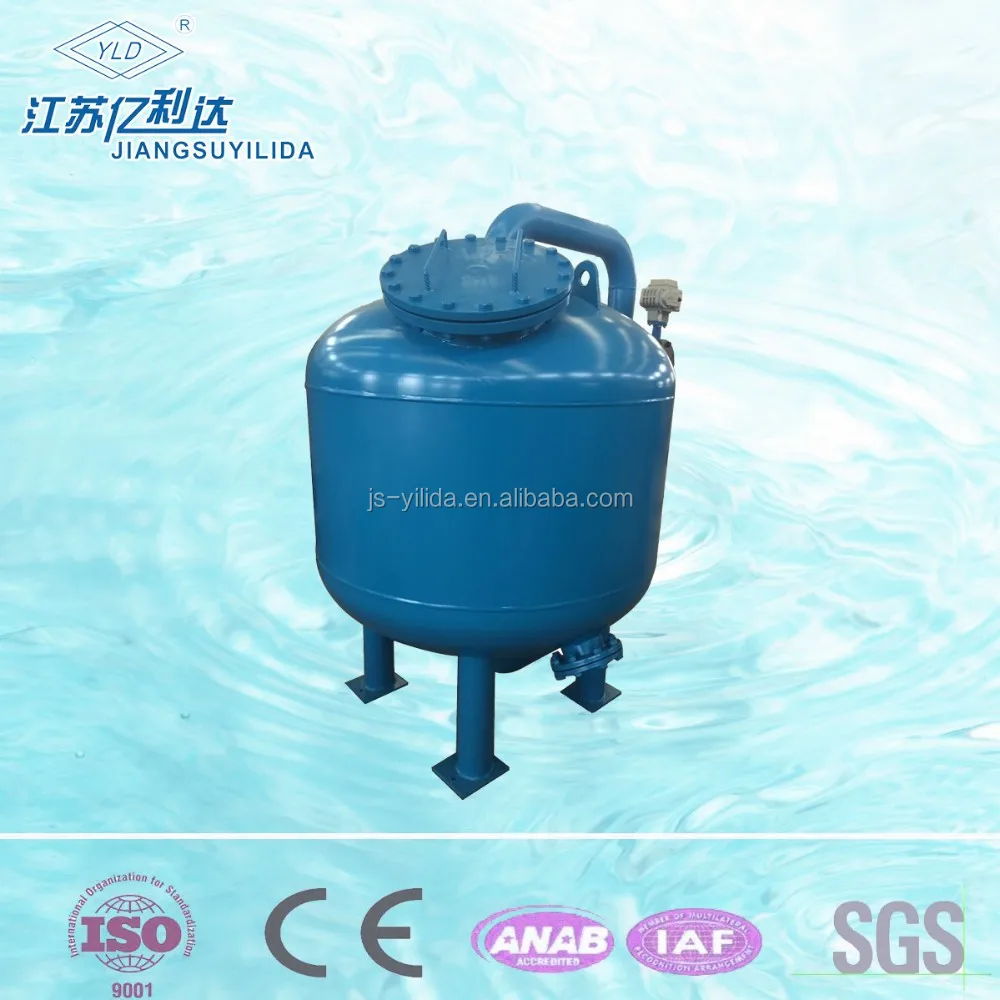
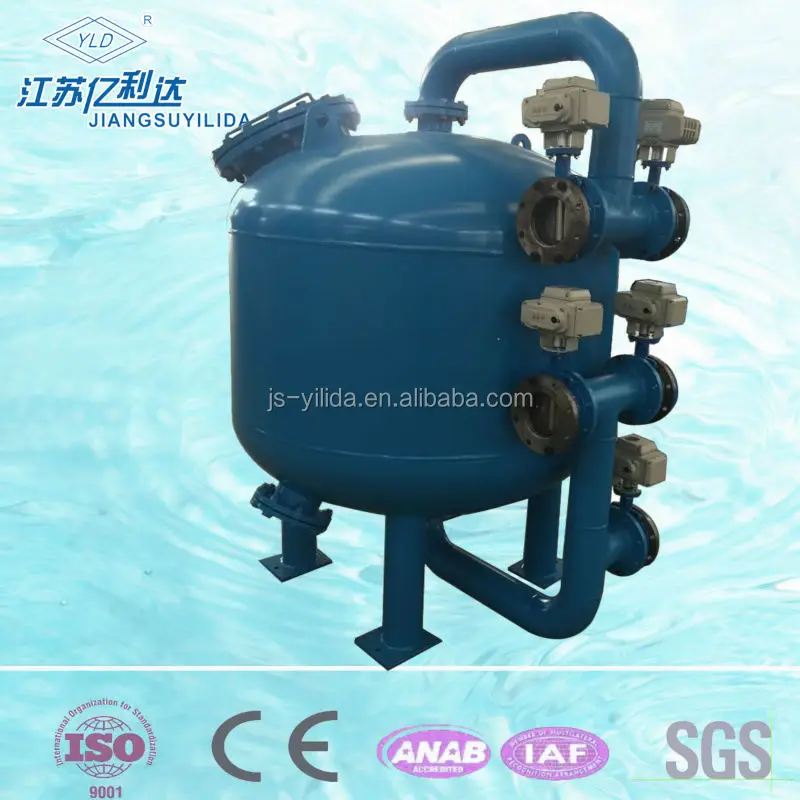
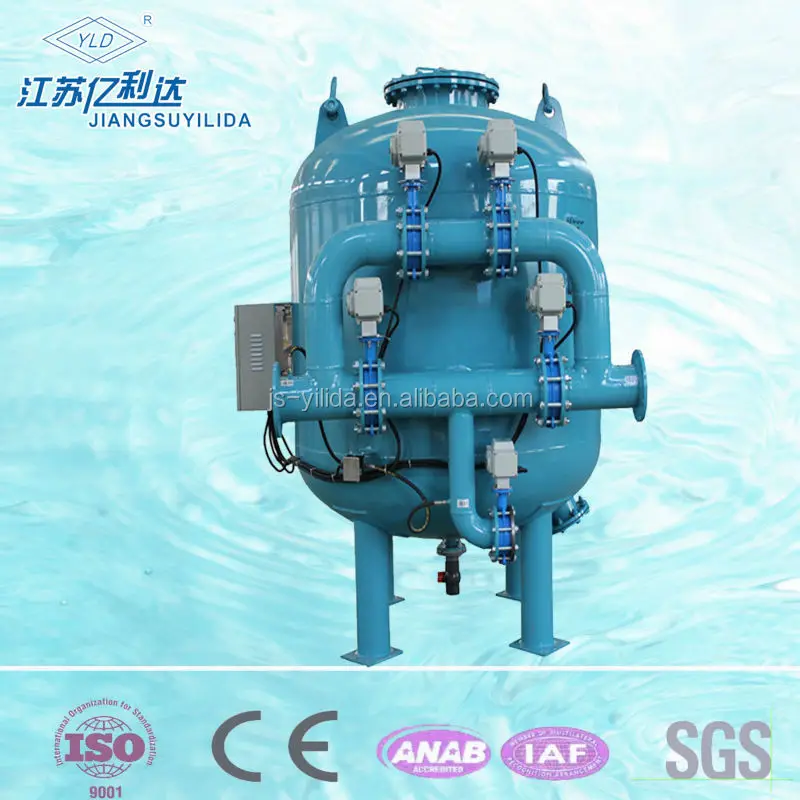
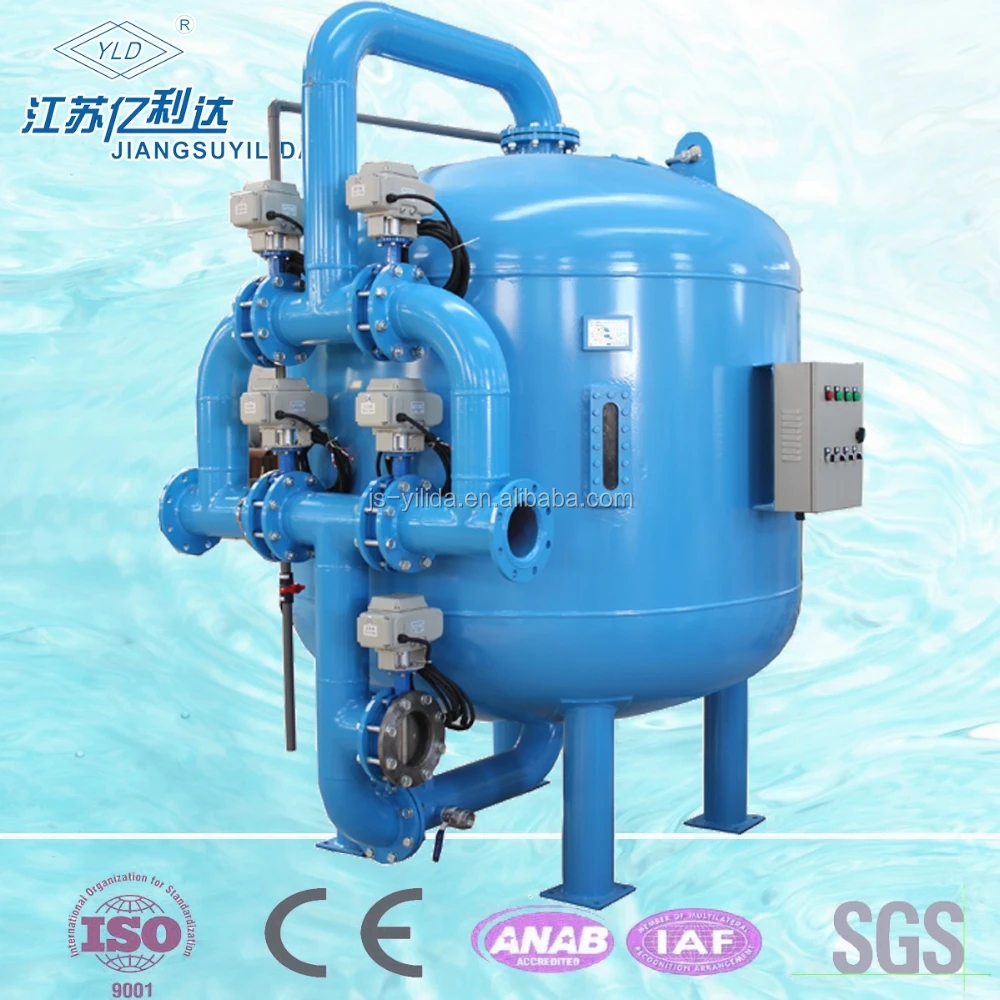
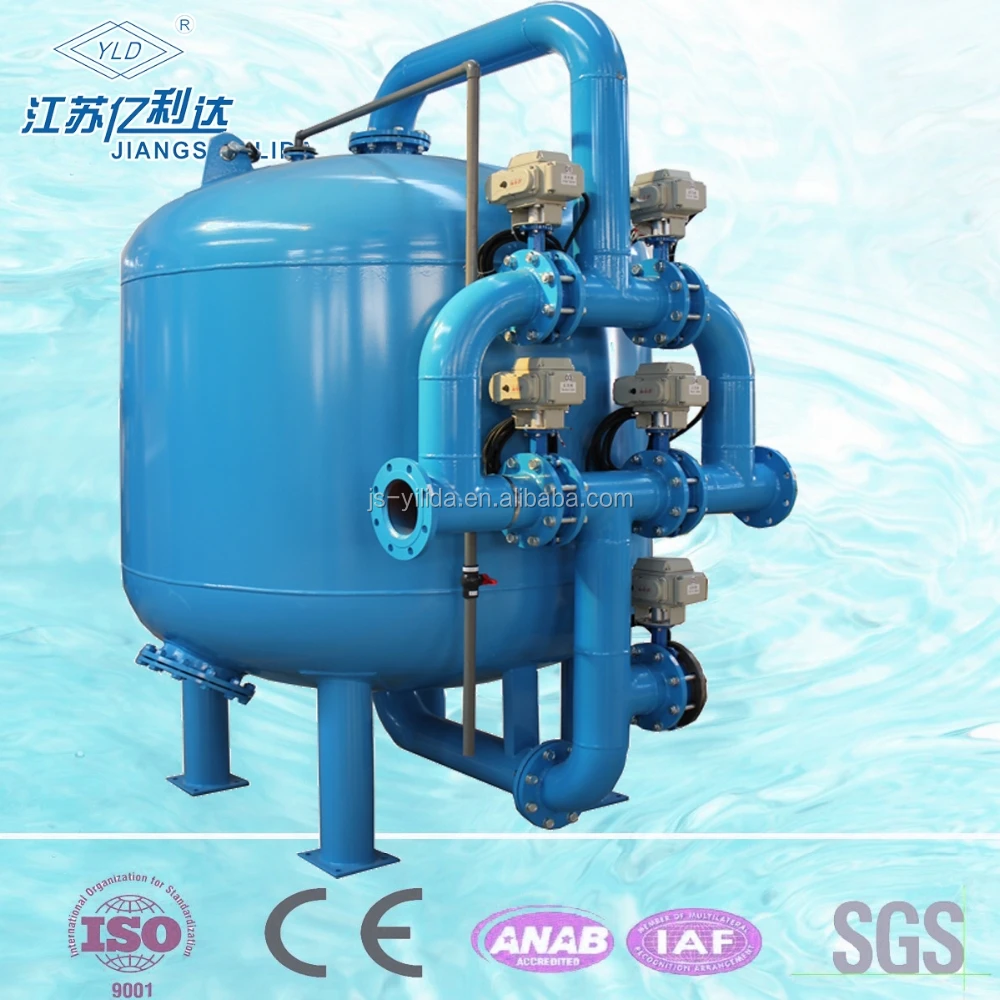
Automatic shallow sand filter for Cooling towers recirculation water
- Category: >>>
- Supplier: Jiangsu YLD Water Processing Equipment Co. Ltd.
Share on (679135428):
Product Overview
Description
Cooling towers recirculation water is large in volumes and gets easily contaminated with suspended solids, atmospheric dust, microbiological organisms, various airborne debris and sometime particulate of rusted metal coming out from heat exchanges. These contamination and impurities get settled either in cooling tower pond or deposit on the surface of Heat exchanges and significantly decrease the performance of cooling tower circuit. Under these circumstances, significant improvement might be realized with the use of a side stream filter and pond cleaning accessories.
Our unique design of Side Stream Filterand cooling tower pond accessories ensures efficient & effective removal of suspended solids & other contaminations and reinforce healthy conditions of cooling tower and associated heat exchangers.
They are available in diameters from 0.225 Mts. to 4.0 Mts.(vertically) and in length from 3.0 Mts. mm to 11 Mts. (Horizontally) with flow ratesup to 500M3/Hr. these rugged, pre-engineered, pre-assembled units minimizeinstallation and start-up costs.

Working Principle:
Water from the system is pumped through the over drain assembly at the top of the filter tank and distributed evenly over the media. Suspended particles are trapped in the filter media. The filtered water then passes from the tank through the under drain assembly at the bottom of the filter and returns to the piping system.
A rapid sand filter is a water treatment device that uses sand or other grainy media to filterout the solid particles suspended in water. These suspended solids include dirt and other organic matter that cause water to appear cloudy or turbid. Rapid sand filtration is commonly used by municipal water treatment plants to clean surface and ground water intended for drinking water. It is also used to treat sewage and industrial wastewater containing biological contaminants before these waters are discharged to the environment.
Rapid sand filtration takes place in a tank containing one or more layers of grainy media, such as sand, anthracite or hard coal, garnet, magnetite, or other minerals. The total media depth typically ranges from 2-6 feet (about 0.6-1.8 meters). In many systems the incoming water, or influent, enters near the top of the tank and flows downward through the media. The outgoing water, or effluent, leaves through a drainage system called the underdrain that lies underneath the filter media bed.
As the influent travels through the rapid sand filter, many of the water-borne suspended solids become trapped above or within the pores between grains. This straining process is the primary mechanism by which solids are removed from the water. In addition, suspended solids are adsorbed onto the surface of the grains due to intermolecular attractive forces. Other physical, chemical, and biological processes also enhance solids removal during filtration.

The effectiveness of a rapid sand filter is highly dependent on the characteristics of the influent and the grainy media. Important influent properties include the concentrations, types, and particle charges of the suspended solids in the water. The depth of the media bed and the particle charges, sizes, and shapes of the grains are also crucial.
Smooth round grains crowd closely together and create very small pores. More jagged grains may produce larger pores, but are better at snagging solids as they pass by. Typically, layers of different grains are used to take advantage of multiple removal mechanisms.
Over time, the media bed of a rapid sand filter becomes clogged with accumulated solids. At this point, the filter is cleaned through a process called backwashing. Wash water is pumped upward through the bed to dislodge the solids and rinse them out of the tank. As the wash water is drained, the granular media settle back into their original layers, and the filter is ready to be used again.
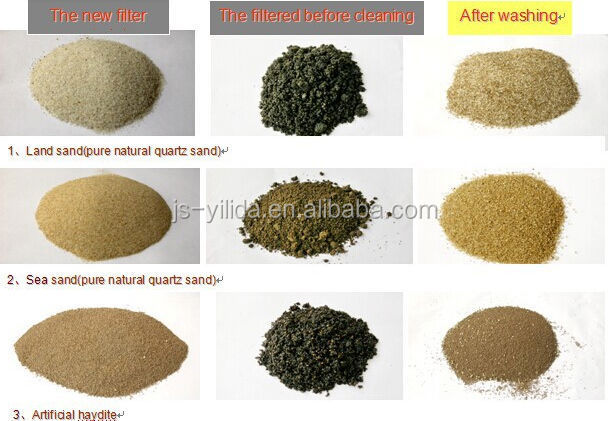
Technical parameters sheet for Shallow Sand Filter (Bypass Filtration Sand Filter)
model | Filter diameter | Height | inlet-outlet | filtration area | capacity |
mm | mm | mm | m² | m³/hour | |
YL-SSF-500 | 500 | 816 | 40 | 0.2 | 6~10 |
YL-SSF-600 | 600 | 874 | 40 | 0.28 | 8~14 |
YL-SSF-700 | 700 | 900 | 40 | 0.38 | 12~19 |
YL-SSF-800 | 800 | 960 | DN50 | 0.50 | 15-25 |
YL-SSF-1000 | 1000 | 1200 | DN50 | 0.79 | 23-39 |
YL-SSF-1200 | 1200 | 1400 | DN80 | 1.13 | 33-55 |
YL-SSF-1400 | 1400 | 1600 | DN100 | 1.54 | 45-75 |
YL-SSF-1600 | 1600 | 1800 | DN100 | 2.01 | 60-100 |
YL-SSF-1800 | 1800 | 1950 | DN150 | 2.54 | 75-125 |
YL-SSF-2000 | 2000 | 2150 | DN150 | 3.14 | 95-155 |
YL-SSF-2200 | 2200 | 2250 | DN150 | 3.80 | 115-190 |
YL-SSF-2400 | 2400 | 2100 | DN150 | 4.52 | 130-210 |
YL-SSF-2600 | 2600 | 2400 | DN150 | 5.30 | 145-225 |
YL-SSF-2800 | 2800 | 2500 | DN200 | 6.15 | 155-240 |
YL-SSF-3000 | 3000 | 2600 | DN200 | 7.00 | 170-255 |
YL-SSF-3200 | 3200 | 2800 | DN250 | 8.15 | 270-320 |
YL-SSF-3400 | 3400 | 3000 | DN300 | 9.2 | 350-400 |

We Recommend
New Arrivals
New products from manufacturers at wholesale prices