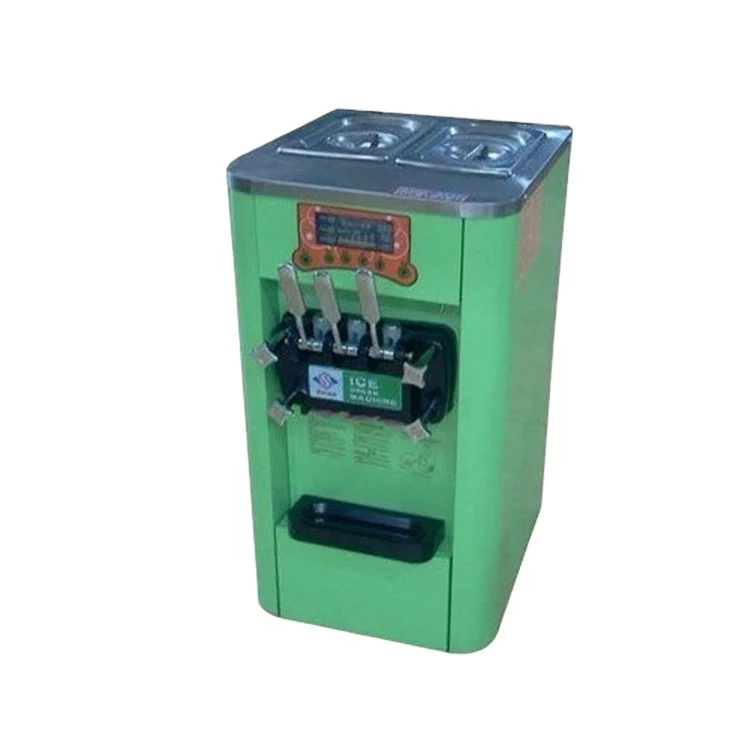
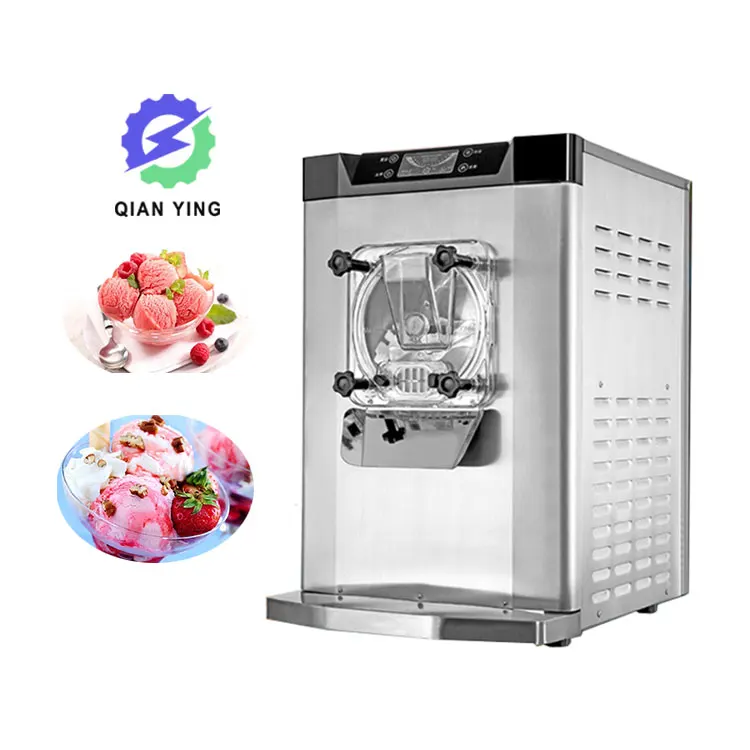
Single Flavor Super Silence Small Desktop Gelato Maker / Commercial Mini Soft Ice Cream Machine For Sale
- Category: >>>
- Supplier: Guangzhou Disen Electromechanical Equipment Co. Ltd.
Share on (705033653):
Product Overview
Description

| Product Description |
Model: DS-168S Material cylinder volume: 4.2L * 2 Capacity: 4.2L * 2-cylinder 13-16L / H Power: 0.7KW Compressor Power: 1P Maximum yield :13-18L Cooling capacity (liters / hour) :13-16 L / H Voltage : 220V/50Hz Dimensions: 393 * 490 * 720mm
Production Methods: (2) automatic key to start the machine, the automatic operating mode, press the cleaning button can also be expected to Stir, and then automatically key (washing machine traffic is not too long (1 minute)).
Functional Description:
Our accessories
We characterized
Ice cream machine Features
|
| Product Images |  |
Ice cream machine made in china Ice cream machine made in china Ice cream machine made in china Ice cream machine made in china Cheap ice cream machine Ice cream machine made in china Ice cream machine made in china
Other related products
|
| Product Related Information | |
A domestic ice cream maker or ice cream freezer is a machine used to make small quantities of ice cream at home. Ice cream makers may stir the mixture by hand-cranking or with an electric motor, and may chill the ice cream by using a freezing mixture, by pre-cooling the machine in a freezer, or by the machine itself refrigerating the mixture. An ice cream maker must freeze the mixture, and must simultaneously stir or churn it to prevent the formation of ice crystals and aerate it to produce smooth and creamy ice cream. Most ice creams are ready to eat immediately, but some, especially those containing alcohol, must be chilled further in a freezer to attain a sufficiently firm consistency. Some machines, such as certain low-priced counter-top models, require that the resulting mixture be frozen an extra four hours or more (or overnight), depending on the recipe, in order for the ice cream to harden to a desired consistency.
Manual machines These machines usually comprise an outer bowl and a smaller inner bowl with a hand-cranked mechanism which turns a paddle, sometimes called a dasher, to stir the mixture. The outer bowl is filled with a freezing mixture of salt and ice: the addition of salt to the ice causes freezing-point depression; as the salt melts the ice, its heat of fusion allows it to absorb heat from the ice cream mixture, freezing the ice cream. This type of ice cream maker is inexpensive, but inconvenient and messy as the ice and salt mixture produces a lot of salty water as it melts, which the user must dispose of, and the ice and salt mixture has to be replenished to make a new batch of ice cream. Some small manual units comprise a bowl with a capacity of about one pint (500ml) whose hollow walls are filled with a coolant. The paddle is often built into a plastic top. The mixture is poured into the frozen bowl and placed in a freezer. The paddles then are turned by hand every ten minutes or so for a few hours until the desired consistency and flavor is reached. Nancy Johnson invented the first hand-cranked model in 1843. She then sold the patent to William Young, who marketed the machine as the Johnson Patent Ice-Cream maker.
Electric machines There are three types of electric ice cream machines. Each has an electric motor which drives either the bowl or the paddle to stir the mixture. The major difference between the three is in how the cooling is performed. Counter-top machines use a double-walled bowl which contains between the two walls a solution (typically distilled water and urea) that freezes below the freezing point of water. This is frozen in a domestic freezer for up to 24 hours before the machine is needed. Once frozen, the bowl is put into the machine, the mixture is added and the machine is switched on. The paddles rotate, stirring the mixture as it gradually freezes through contact with the frozen bowl. Twenty to thirty minutes later, the solution between the double walls of the bowl has thawed, and the ice cream has frozen. The advantage of this type of electric machine is low cost, typically under $100. The disadvantage of the pre-frozen bowl approach is that only one batch can be made at a time. To make another batch, the bowl must be frozen again. For this reason, it is usually possible to buy extra bowls for the machine, but of course these take up a lot of freezer space.
More expensive, and much larger, machines have a freezing mechanism built in and do not require a bowl to be pre-chilled. The cooling system is switched on, and in a few minutes the mixture can be poured in and the paddle switched on. As with coolant-bowl machines, ice cream is ready in twenty to thirty minutes, depending on the quantity made. These machines can be used immediately with no preparation, and any number of batches of ice cream can be made without a delay between batches. Some of these machines cannot be moved without waiting twelve hours before use, as moving the unit upsets the coolant in its freezing system; they would normally be kept permanently positioned ready for use, impractical in a smaller kitchen.
|
| DiSen Company Show | |
|
We Recommend
New Arrivals
New products from manufacturers at wholesale prices