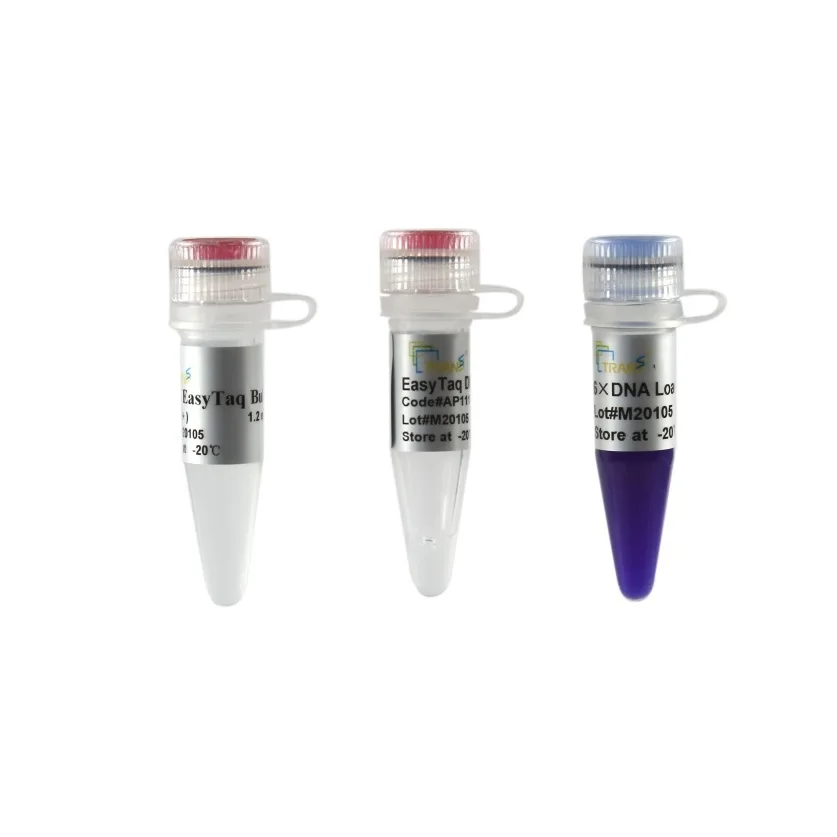
Easy Taq DNA Polymerase PCR Enzyme by TransGen Biotech
- Category: Other Chemicals >>>
- Supplier: TransGen Biotech Co. Ltd.
Share on (764457954):
Product Overview
Description
EasyTaq DNA Polymerase
EasyTaq ® DNA polymerase is purified from E. coli expressing a cloned DNA polymerase from Thermus aquaticus . The enzyme consists of a single polypeptide with a molecular weight of approximately 94 kDa. EasyTaq ® DNA polymerase has 5′ to 3′ DNA polymerase activity and 5′to 3′exonuclease activity lacking 3′-5′exonuclease activity. EasyTaq ® DNA polymerase is suitable for routine amplification. PCR products are unsuitable for PAGE.
| Cat. No. | AP111 | ||
| Specification |
dNTPs-free | AP111-01 | 500 units |
| AP111-02 | 6×500 units | ||
| AP111-03 | 4×2500 units | ||
dNTPs(2.5 mM) | AP111-11 | 500 units | |
| AP111-12 | 6×500 units | ||
| AP111-13 | 4×2500 units | ||
| Concentration: | 5 units/μl | ||
| Storage: | at -20°C for two years | ||
| Description | The extension rate is about 1-2 kb/min. | ||
| Template-independent “A” can be generated at the 3′ end of the PCR product. PCR products can be directly cloned into pEASY®-T vectors. | |||
| Amplification of genomic DNA fragment up to 4 kb. | |||
| Advantages | High efficiency amplification | ||
| Application | Routine PCR | ||
| Short fragment PCR | |||
Unit Definition
One unit(U) is defined as the amount of enzyme required to catalyze the incorporation of 10 nmol of dNTP into an acid-insoluble material in 30 minutes at 74°c, with activated salmon sperm DNA used as template.
Quality Control
Easy Taq® DNA polymerase has passed the following quality control assays: functional absence of double- and single-stranded endonuclease activity, >99% homogeneous measured by SDS-PAGE. Easy Taq® DNA polymerase has been assayed for amplification efficiency from as little as 10 ng of human genomic DNA.
Notes
• A final concentration of 2 mM MgSO4 is sufficient for most targets amplification. For some targets, more Mg2+ may be required; use the 100 mM MgSO4 stock to prepare a titration from 2 mM to 4 mM (final concentration) in 0.25 mM increments.
• 0.5 μl (2.5 units) enzyme is enough for a single 50 μl reaction. For better amplification, up to 1 μl (5 units) enzyme can be used for a single reaction.
CITATIONS
He X-L, et al. 2013. Lack of Structural Variation but Extensive Length Polymorphisms and Heteroplasmic Length Variations in the Mitochondrial DNA Control Region of Highly Inbred Crested Ibis, Nipponia nippon. 8(6): e66324. PLos One. IF= 3.73. PMID: 23805212.
Pang Z, et al. 2013. Resistance to the Novel Fungicide Pyrimorph in Phytophthora capsici: risk assessment and detection of point mutations in CesA3 that confer resistance. 8(2): e56513. PLos One. IF=3.73. PMID: 23431382.
Xu W, et al. 2013. Transcriptome-wide identification and characterization of microRNAs from castor bean (Ricinus communis L.). 8(7):e69995. PLos One. IF=3.73. PMID: 23894571.
Li X, et al. 2013. Molecular diversity of arbuscular mycorrhizal fungi associated with two cooccurring perennial plant species on a Tibetan altitudinal gradient. 1-13. Mycorrhiza. IF=2.955. PMID: 23912811.
Li X, et al. 2013. Polymorphisms of anti-lipopolysaccharide factors in the swimming crab Portunus trituberculatus and their association with resistance/susceptibility to Vibrio alginolyticus. 34(6):1560-8. Fish Shellfish Immunol. IF=2.964. PMID: 23567857.
Lu Y. et al. 2013. Nonstructural proteins of Torque teno sus virus 2 from O2AUG: Preduction to experimental validation. Virus Res. IF=2.745. PMID: 24091363.
Zhang WY. et al. 2012. Highly parallel single-molecule amplification approach based on agarose droplet polymerase chain reaction for efficient and cost-effective aptamer selection. 84(1):350-5. Anal Chem. IF= 5.856. PMID: 22103644.
Liu X. et al. 2011. Identification of novel variants of metadherin in breast cancer. 6(3):e17582. PLoS One. IF= 4.092. PMID: 21408129.
Jiang X. et al. 2012. In vitro assembly of multiple DNA fragments using successive hybridization. 7(1):e30267. PLoS One. IF= 4.092. PMID: 22291927.
Li Y. et al. 2011. A universal multiplex PCR strategy for 100-plex amplification using a hydrophobically patterned microarray. 11(21):3609-18. Lab Chip. IF= 5.67. PMID: 21909519.
Zhu L. et al. 2012. In vitro selection of highly efficient G-quadruplex-based DNAzymes. 84(19):8383-90. Anal Chem. IF= 5.856. PMID: 22954361.
Jefferies R. et al. 2009. Angiostrongylus vasorum from South America and Europe represent distinct lineages. 136(1):107-15. Parasitology. IF= 2.961. PMID: 19126274.
Wang DW. et al. 2011. Identification of a Male-Specific Amplified Fragment Length Polymorphism (AFLP) and a Sequence Characterized Amplified Region (SCAR) Marker in Eucommia ulmoides Oliv. 12(1):857-64. Int J Mol Sci. IF= 2.598. PMID: 21340018.
Qie F. et al. 2012. Extracting genomic DNA of foodstuff by polyamidoamine (PAMAM)-magnetite nanoparticles. 93:166-71. Talanta. IF= 3.794. PMID: 22483894.
Wu F. et al. 2012. Identification of Major Active Ingredients Responsible for Burn Wound Healing of Centella asiatica Herbs. 2012:848093. Evid Based Complement Alternat Med. IF= 4.774. PMID: 23346217.
Chen L. et al. 2012. Assessing the risk that Phytophthora melonis can develop a point mutation (V1109L) in CesA3 conferring resistance to carboxylic acid amide fungicides. 7(7):e42069. PLoS One. IF= 4.092. PMID: 22848705.
Zheng T. et al. 2012. Development of a simvastatin selection marker for a hyperthermophilic acidophile, Sulfolobus islandicus. 78(2):568-74. Appl Environ Microbiol. IF= 3.829. PMID: 22081574.
Zhang N. et al. 2011. BCL-2 (-938C > A) polymorphism is associated with breast cancer susceptibility. 12:48. BMC Med Genet. IF= 2.328. PMID: 21457555.
Zhao HL. et al. 2012. Elastolytic mechanism of a novel M23 metalloprotease pseudoalterin from deep-sea Pseudoalteromonas sp. CF6-2: cleaving not only glycyl bonds in the hydrophobic regions but also peptide bonds in the hydrophilic regions involved in cross-linking. 287(47):39710-20. J Biol Chem. IF= 4.773. PMID: 23012370.
Wu Y. et al. 2012. Molecular cloning and characterization of an endogenous digestive β-glucosidase from the midgut of the fungus-growing termite Macrotermes barneyi. 21(6):604-14. Insect Mol Biol. IF= 2.529. PMID: 23126269.
Lu B. et al. 2009.Expression and evolutionary divergence of the non-conventional olfactory receptor in four species of fig wasp associated with one species of fig.9:43. BMC Evol Biol. IF= 3.521. PMID: 19232102.

We Recommend

Cheap and best Caluanie Muelear Oxidize Parteurized
US $8.90-$9.30

CAS 143-18-0 Catalyst Emulsifier Potassium Oleate
US $70.00-$88.00

Good price Boron Nitride Nanosheets BN Nanosheets
US $0.58-$0.72

China Factory of Trinexapac-ethyl CAS: 95266-40-3 with high-quality
US $460.00-$560.00
New Arrivals
New products from manufacturers at wholesale prices