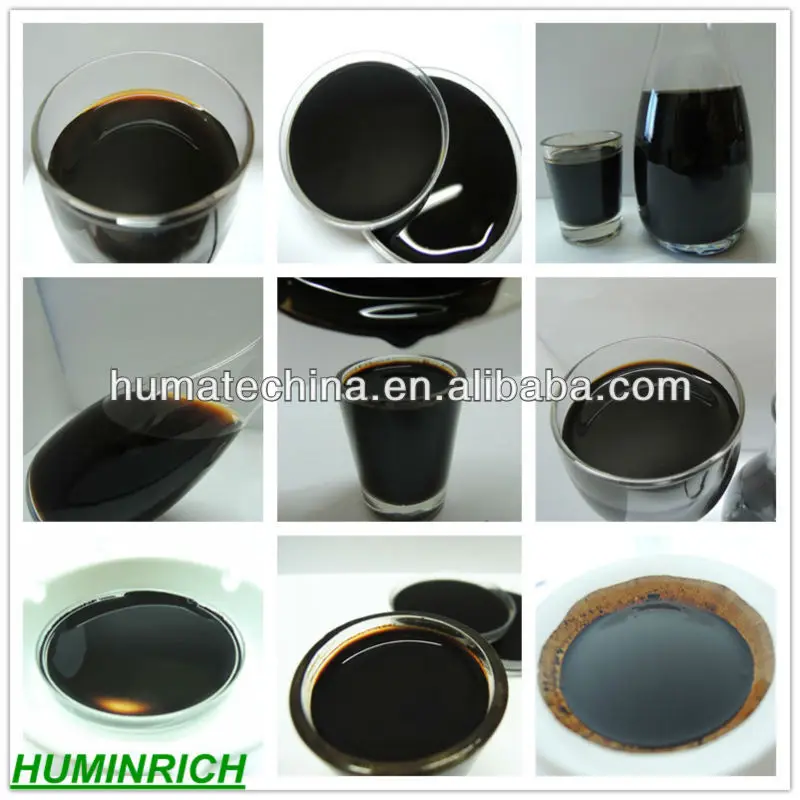
Liquid Humus Potassium Humate Humic Acid Organic fertilizer from leonardite (K Humate)
- Category: >>>
- Supplier: Shenyang Humate Technology Co. Ltd.
Share on (850207745):
Product Overview
Description
Shenyang Humate Technology Co.,Ltd
www.humatechina.en.alibaba.com | ||
We Shenyang Humate Technology Co., Ltd, specialize in supplying Humic Fulvic Acid, Seaweed Extract, Amino Acid, Sodium Lignosulphonate, Bentonite, Diatomite, Cat Litter, etc. All our products enjoy good reputation and feedbacks by our customers.
Potassium humate (K-humate) is obtained by alkaline extraction of lignite or brown coal or leonardite and is used commercially as a soil conditioner.Also can be used in agriculture as a biostimulator, stimulates plants growth rate, fishes non-specific and warm-blooded animals specific immunity and adaptive capabilities
Our company covers an area of 100,000 square meters, with research and development centers, training centers, materials bases, and so on. We have developed 5 series and totally more than 300 kinds of products, which focus on humic acid, seaweed, amino acid and peatmoss. We have carried out over 50 customized products and manufactured various plant nutriments and fertilizers. | ||
Details | ||
Commodity: Liquid humus-Potassium Humate Humic Acid Organic fertilizer from leonardite-(K-Humate) | ||
SPECIFICATION | Source | High Grade Leonardite |
Potassium(K2O) | 1-2%MIN | |
Water Soluble | 100% | |
Humic acid | 10-12% | |
PH | 9-11 | |
Source | High Grade Leonardite | |
DESCRIPTION | Other Name | Liquid Humic Fertilizer |
Brand Name | HuminRich | |
Type | Organic Fertilizer | |
Classification | Organic Fertilizer | |
CAS No. | 68514-28-3 | |
EINECS No. | 271-030-1 | |
Place of Origin | Liaoning China(Mainland) | |
Shape | Liquid | |
Color | Black | |
Purity | 100% | |
Payment Term | L/C, TT, etc. | |
Application | Organic Fertilizer | |
Delivery Detail | Within 15 working days after receipt of payment or L/C | |
Packaging Detai | In 20L/Plastic Drum | |
Storage | Cool, dry, sealed storage away from direct sunlight. |
Formation and Desctiption Humic substances are formed by the microbial degradation of dead plant matter, such as lignin. They are very resistant to further biodegradation. The precise properties and structure of a given sample depend on the water or soil source and the specific conditions of extraction. Nevertheless, the average properties of humic substances from different sources are remarkably similar. Humic substances in soils and sediments can be divided into three main fractions: humic acids, fulvic acids, and humin. The humic and fulvic acids are extracted as a colloidal sol from soil and other solid phase sources into a strongly basic aqueous solution of sodium hydroxide or potassium hydroxide. Humic acids are precipitated from this solution by adjusting the pH to 1 with hydrochloric acid, leaving the fulvic acids in solution. This is the operational distinction between humic and fulvic acids. Humin is insoluble in dilute alkali. The alcohol-soluble portion of the humic fraction is, in general, named ulmic acid. So-called "gray humic acids" (GHA) are soluble in low-ionic-strength alkaline media; "brown humic acids" (BHA) are soluble in alkaline conditions independent of ionic strength; and fulvic acids (FA) are soluble independent of pH and ionic strength. Liquid chromatography and liquid-liquid extraction can be used to separate the components that make up a humic substance. Substances identified include mono-, di-, and tri-hydroxy acids, fatty acids, dicarboxylic acids, linear alcohols, phenolic acids, and terpenoids. |
Chemical characteristics of humic substances
A typical humic substance is a mixture of many molecules, some of which are based on a motif of aromatic nuclei with phenolic and carboxylic substituents, linked together; the illustration shows a typical structure. The functional groups that contribute most to surface charge and reactivity of humic substances are phenolic and carboxylic groups.Humic acids behave as mixtures of dibasic acids, with a pK1 value around 4 for protonation of carboxyl groups and around 8 for protonation of phenolate groups. There is considerable overall similarity among individual humic acids.For this reason, measured pK values for a given sample are average values relating to the constituent species. The other important characteristic is charge density. The molecules may form a supramolecular structure held together by non-covalent forces, such as Van der Waals force, π-π, and CH-π bonds. The presence of carboxylate and phenolate groups gives the humic acids the ability to form complexes with ions such as Mg2+, Ca2+, Fe2+ and Fe3+. Many humic acids have two or more of these groups arranged so as to enable the formation of chelate complexes.The formation of (chelate) complexes is an important aspect of the biological role of humic acids in regulating bioavailability of metal ions. |
APPLICATION | 1) Improve the structure of soil; increase the buffering power of soil. In light and sandy soils, humic acid increase the cation exchange capability to retain nutrients and water, importantly to magnify the ability of root to take up nutrients. In heavy and compact soils, working with fungi to create a crumb structure for better water oxygen and nutrients intake and improved root penetration. 2) Neutralize both acidic and alkaline soil; regulate the pH-value of soil. Under alkaline conditions, humic acid can buffer the pH and convert the nutrients and trace elements into absorbable form and promote their uptake by the roots, as under high pH value many essential nutrients and trace element are not in plant-available form. In acidic soil, it can largely reduce the toxins such as the ally aluminum and heavy metals, which will be bonded firmly and immobilized by humic acid, thus their toxicity is reduced and phosphate is bonded by aluminum is released. Salinalised oil: Salts are split up by the high cation exchange capability cation (eg.Ca, Mg) are bonded and chelated. The high osmotic pressure within the root area is largely reduced. 3) Stimulate plant growth, increase the yield and quality. Stimulate the membrane of seeds as well as the metabolic activities and thereby increase the germination rate.Increase the capacity of root to take up nutrients (N, P, K + Fe, Zn and other trace elements) as these elements is easier to be converted into forms available to plants. Accordingly, the yield will be increased up to 30%. Enhanced cell assimilation as well as photosynthesis increase the plant's sugar and vitamin content. |
EFFECTS | Potassium Humate is concentrated humic acid extracted from young active leonardite mine. Presented as fine powder or flakes, it has a feature of wonderful water solubility in a wide span of pH value including the slightly acid conditions; the small molecular weight enhances its chelating capability and enables it more easily to be uptaken by plant. |
CAPABILITY | → Technical Support : like dosage & usage → After-sales Service : like Promotion support &Demonstration support → Help you to be the Leader in the Organic Fertilizer Market . |
TECHNOLOGY SUPPORT | If you want to know more about SHENYANG HUMATE Organic fertilizer and Technical information like Usage, Dosage, Applicable soil, Crop etc , also if you want to get advices from Shenyang Humate. Please feel free to contact us !!! |
ADVANTAGE | 1.MOQ: 1 ton, you can believe that we are the least mininum in order to support you.. 2.Good Service : We treat clients as friend, and we can customize your brands. 3.Good Quality :We have strict quality control system .Good reputation in the market. 4.Fast & Cheap Delivery: We have big discount from forwarder (Long Contract). 5.Comprehensive Products: We have developed 5 series and more than 300 kinds of products. 6.SHENYANG HUMATE: Now SHENYANG HUMATE is one of the most important and integrated company of China Humic Acid Industry Association with independent international export & import rights.
|
We Recommend
New Arrivals
New products from manufacturers at wholesale prices