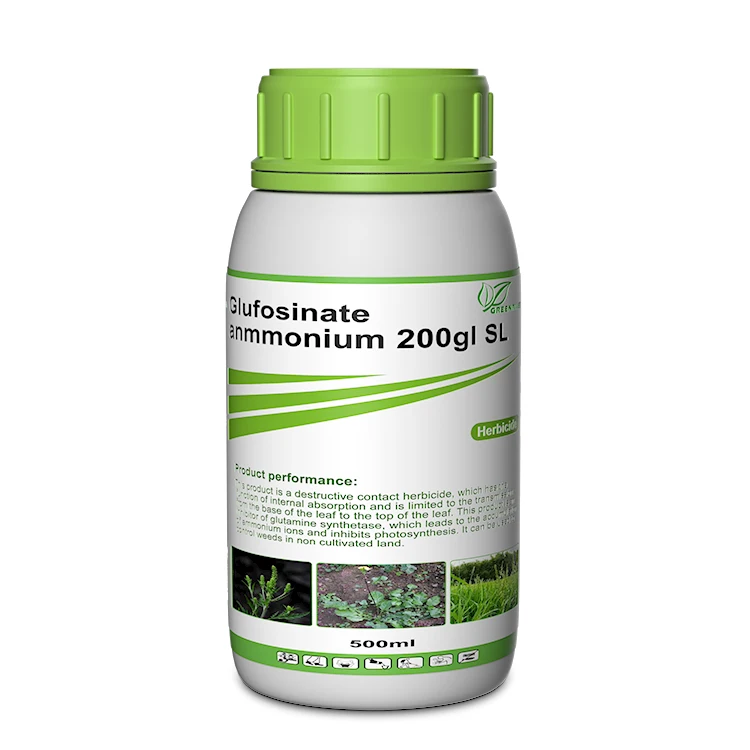
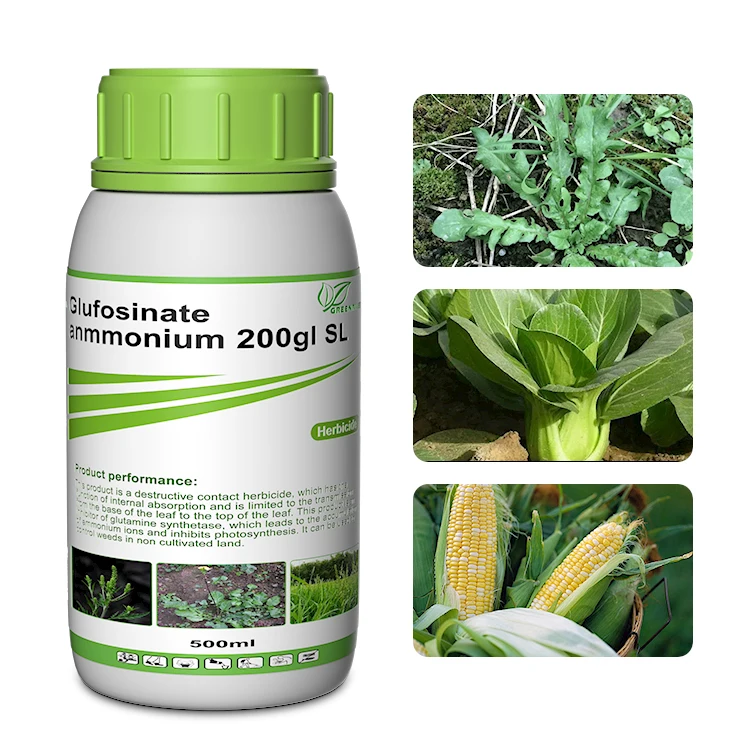
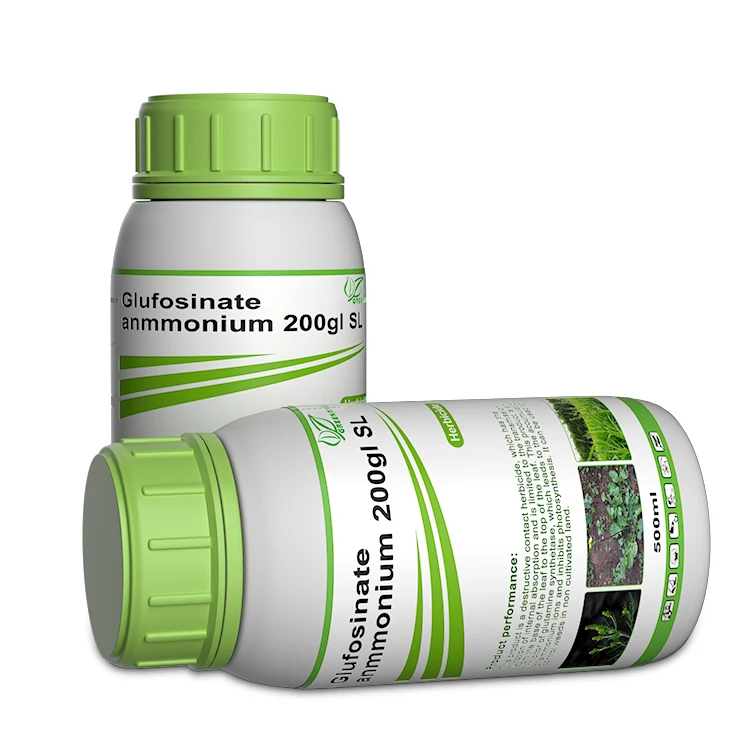
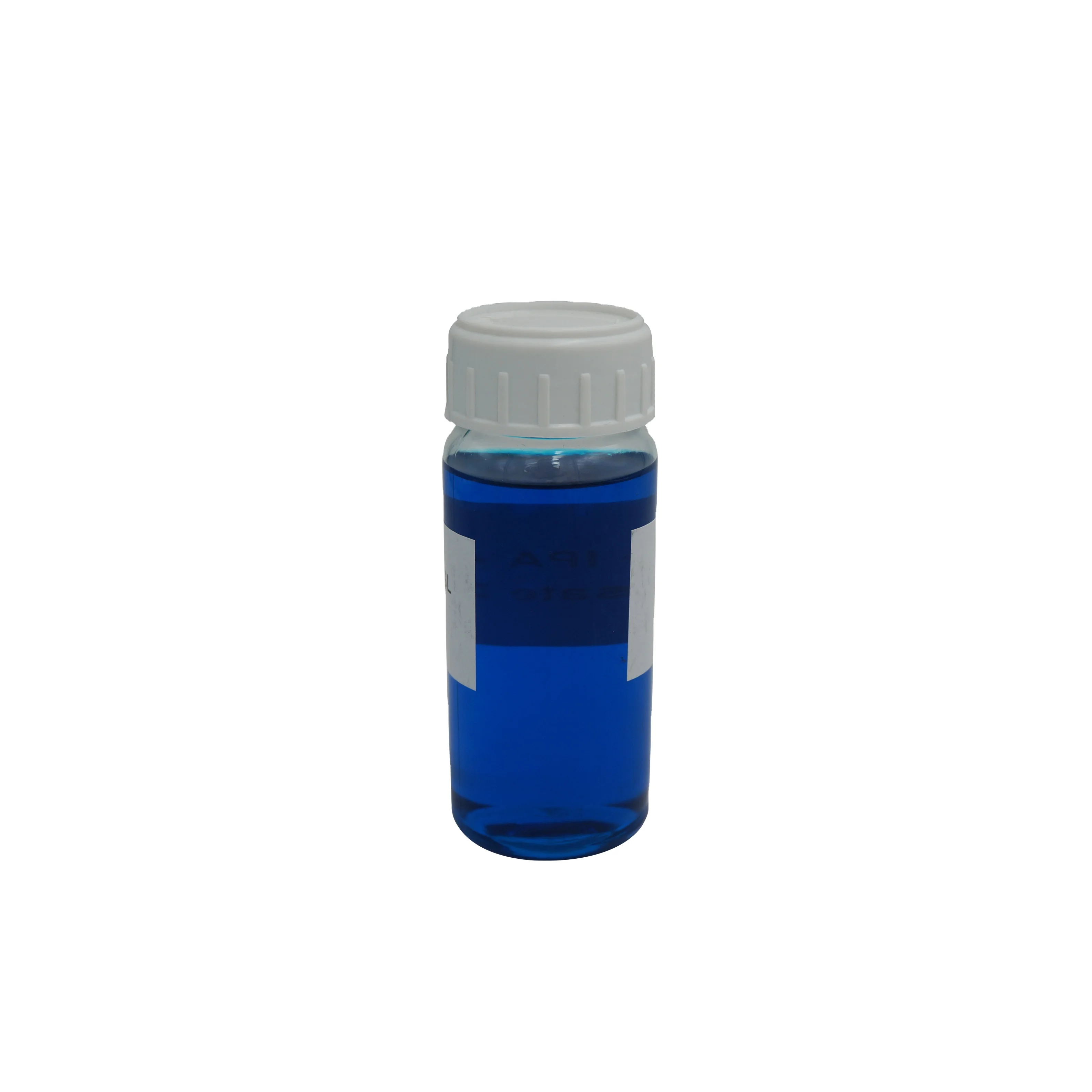
High effect Herbicide Glufosinate ammonium 95%Tech 200 G/L SL 77182 82 2
- Category: Agrochemicals >>>
- Supplier: Greenriver Industry Co. Ltd.
Share on (60668490772):
Product Overview
Description
Product Description


Glufosinate Ammonium
A broad-spectrum, absorbed by roots, stem and leaves, ALS inhibitor, selective sulfonylurea herbicide.
Glufosinate is a key herbicide to manage glyphosate-resistant weeds mainly because it is a broad-spectrum herbicide, and transgenic glufosinate-resistant crops are available.

Major features of our product
1. Broad spectrum of weeding: It is a biocidal herbicide, which has an effect on most annual broad-leaved weeds and some perennial grassy weeds, especially broad-leaved weeds.
2. Fast killing of weeds: Generally, green plants can show obvious symptoms of poisoning within 2-3 hours after spraying. It is a herbicide species with a faster rate of killing weeds.
3. Low residue: It can be strongly adsorbed by soil colloids, so the medicament loses its activity as soon as it contacts the soil, and there is basically no residue in the soil. There is no residual toxic effect on the next crop.
4. Easily degradable: This product is easier to photodegrade than paraquat, and 80% of it can be photodegraded in 4 days under strong sunlight.


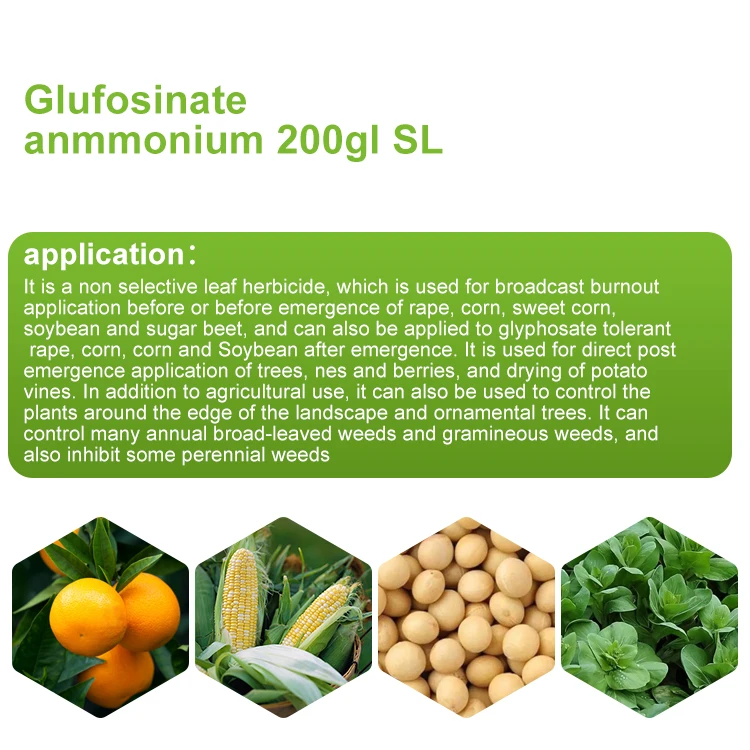
Uses: Glufosinate-ammonium is used for control of a wide range of annual and perennial broad-leaved weeds and grasses in fruit orchards, vineyards, rubber and oil palm plantations, ornamental trees and bushes, non-crop land, and pre-emergence in vegetables. Also used as a desiccant in potatoes, sunflowers, etc. For control of annual and perennial weeds and grasses in glufosinate-tolerant crops (oilseed rape, maize, soya beans, sugar beet) developed through gene technology.
Specification
Active ingredient | Glufosinate-ammonium | ||
Chemical name | ammonium (?-2-amino-4-(hydroxymethylphosphinyl)butanoate | ||
Classification | Herbicide / Agrochemical | ||
Formulation | 95%TC, 200 G/L SL, 18%SL | ||
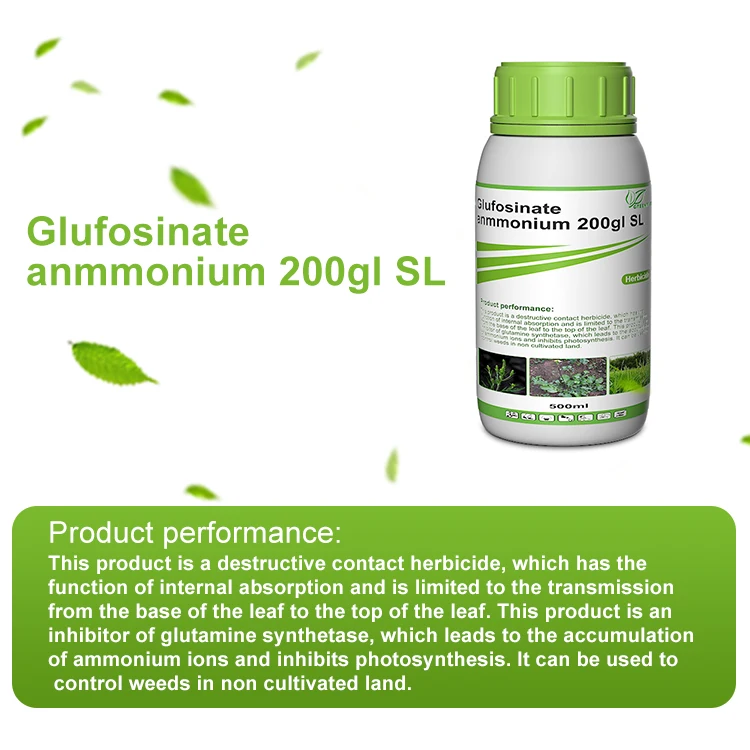
Biochemistry | Glutamine synthetase inhibitor; leads to accumulation of ammonium ions, and inhibition of photosynthesis. | ||
Mode of action | Non-selective contact herbicide with some systemic action. Translocation occurs only within leaves, predominantly from the leaf base to the leaf tip. | ||
Usage | Glufosinate-ammonium is used for control of a wide range of annual and perennial broad-leaved weeds and grasses in fruit orchards, vineyards, rubber and oil palm plantations, ornamental trees and bushes, non-crop land, and pre-emergence in vegetables. Also used as a desiccant in potatoes, sunflowers, etc. For control of annual and perennial weeds and grasses in glufosinate-tolerant crops (oilseed rape, maize, soya beans, sugar beet) developed through gene technology. Applied at 0.4-1.5 kg/ha | ||
Mammalian Toxicology | Oral: Acute oral LD50 for male rats 2000, female rats 1620, male mice 431, female mice 416, dogs 200-400 mg/kg. Skin and eye: Acute percutaneous LD50 for male rats >4000, female rats c. 4000 mg/kg. Not a skin or eye irritant. Inhalation: LC50 (4 h) for male rats 1.26, female rats 2.60 mg/l air (dust); for rats >0.62 mg/l air (aerosol). |
Company Profile

FAQ
Q1. I want more styles, how can I get latest catalogue for your reference?
A: You can contact us by Email, we will give you our latest catalogue according to your information.
Q2. Can you add our own logo on the product?
A: Yes. We offer the service of adding customers’ logo. There are many types of this service. If you have this need, kindly send us you own logo you are welcome.
Q2. Can you add our own logo on the product?
A: Yes. We offer the service of adding customers’ logo. There are many types of this service. If you have this need, kindly send us you own logo you are welcome.
Q3. How does your factory do regarding quality control?
A: "Quality is priority? We always attach great importance to quality controlling.
A: "Quality is priority? We always attach great importance to quality controlling.
1) Skillful workers care every details in handling the producing and packing processes;
2) Quality Control Department specially responsible for quality checking in each
process.
Q4. How can we guarantee quality?
Always a pre-production sample before mass production;
Always final Inspection before shipment;
Q5. How can I order?
A: You can directly place an order on our shop in Alibaba web. Or you can tell us the product name, packing and quantity you need, then we will send you the quotation.
Q6.what can you buy from us?
Insecticide,Herbicide,Fungicide,Rodenticide,Plant Growth Regulator
Q7. what services can we provide?
Accepted Delivery Terms: FOB,CFR,CIF,CIP,CPT,DDP,DDU,Express Delivery;
Accepted Payment Currency:USD,EUR,HKD,CNY;
Accepted Payment Type: T/T,L/C,D/P D/A,Credit Card,PayPal,Western Union,Cash;
Language Spoken:English,Chinese,Spanish,Arabic,Russian
process.
Q4. How can we guarantee quality?
Always a pre-production sample before mass production;
Always final Inspection before shipment;
Q5. How can I order?
A: You can directly place an order on our shop in Alibaba web. Or you can tell us the product name, packing and quantity you need, then we will send you the quotation.
Q6.what can you buy from us?
Insecticide,Herbicide,Fungicide,Rodenticide,Plant Growth Regulator
Q7. what services can we provide?
Accepted Delivery Terms: FOB,CFR,CIF,CIP,CPT,DDP,DDU,Express Delivery;
Accepted Payment Currency:USD,EUR,HKD,CNY;
Accepted Payment Type: T/T,L/C,D/P D/A,Credit Card,PayPal,Western Union,Cash;
Language Spoken:English,Chinese,Spanish,Arabic,Russian
We Recommend

100% Water soluble npk fertilizer/ NPK 17-17-17
US $0.51-$0.55


100% water soluble NPK 19-19-19 fertilizer
US $0.80-$1.50

New Arrivals
New products from manufacturers at wholesale prices